

glossary
LiveOps
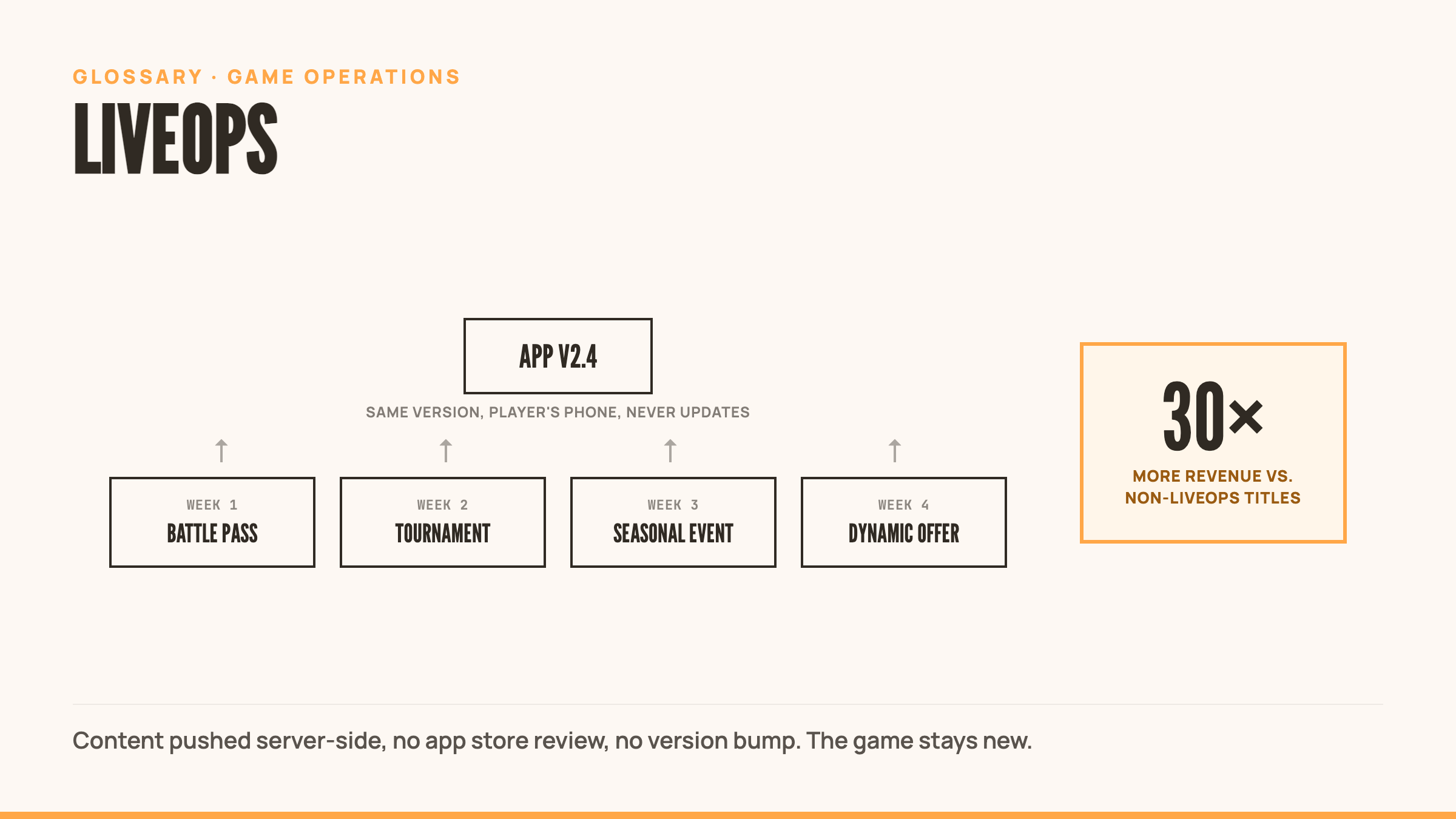
LiveOps (Live Operations): Ongoing content updates, events, and features pushed to a game without releasing a new app version. The difference between a game that prints money for years and one that dies after launch.
Quick Definition
LiveOps (Live Operations): Ongoing content updates, events, and features pushed to a game without releasing a new app version. The difference between a game that prints money for years and one that dies after launch.
What is LiveOps
LiveOps is how studios keep games alive after the first install. The best liveops games turn a single launch into years of ongoing revenue instead of a spike that fades.
New events. Limited-time challenges. Battle passes. Seasonal content. Tournament brackets. Dynamic pricing. All delivered server-side while players keep the same version on their phone.
Think Fortnite dropping new skins every week. Candy Crush rotating events. Pokemon Go launching community days. That’s LiveOps.
The game stays fresh. Players stay engaged. Revenue keeps flowing.
Why LiveOps Matters
The vast majority of mobile IAP revenue comes from games running LiveOps. Research shows games with LiveOps generate up to 30x more revenue than non-GaaS titles. That’s not a nice-to-have. That’s the game.
95% of studios now build or maintain live service titles according to Griffin Gaming Partners’ 2023 Game Development Report. Because the alternative is launching a game, watching retention cliff-dive after week two, and wondering why nobody came back.
LiveOps solves three problems:
- Retention — Give players a reason to open the app tomorrow
- Monetization — Create purchase moments tied to events and urgency
- Discovery — Test new mechanics and content without betting the farm on a full release
The studios winning long-term aren’t the ones with the best launch. They’re the ones with the sharpest LiveOps loop.
Types of LiveOps Content
Events
Time-limited gameplay with exclusive rewards.
Individual events: Solo challenges, missions, progression tracks Group vs group: Guild wars, faction battles, team tournaments
Fortnite’s Late 2024 events pulled 14M+ players. Events work.
Battle Passes
Tiered reward systems with free and premium tracks. Players grind progression, unlock cosmetics and boosters, come back daily to hit the next tier.
Tournaments and Leaderboards
Competitive brackets that rank players and reward top performers. Drives engagement spikes and creates bragging rights.
Seasonal Content
Themed updates tied to holidays or in-game seasons. New skins, maps, modes that rotate in and out.
Dynamic Pricing
Real-time offers based on player behavior, spend history, or progression. The right bundle at the right moment.
Special Offers
Limited-time discounts, starter packs, comeback deals. Urgency drives conversion.
Strategy Elements
Segmentation
Don’t treat all players the same.
Target by spend level, progression stage, session frequency, or RFM (recency, frequency, monetary value). A whale at endgame needs different content than a new F2P player.
Timing
Consistent but not overwhelming. Predictable but not boring.
Run events on a rhythm players can anticipate. But vary the content so it doesn’t feel like clockwork. Too much and you burn players out. Too little and they forget you exist.
Remote Config
Update game mechanics, balance, and features server-side. No app store approval. No version gate. Just push and test.
A/B Testing
Test event structures, pricing, rewards, messaging. Let data show what works instead of guessing.
Content Management System
Centralized scheduling and execution. Replace spreadsheet chaos with a platform that tracks what’s live, what’s next, and what performed.
Success Examples
Fortnite: Seasonal events, celebrity tie-ins, map changes every few weeks. Late 2024 events drove 14M+ concurrent players. LiveOps isn’t a side feature. It’s the core business model.
Candy Crush: Rotating events, limited-time challenges, team competitions. Kept a match-3 game printing money for over a decade.
Pokemon Go: Community Days, raid events, seasonal updates. Turned a novelty into a sustained revenue machine.
Wordscapes: Once players hit certain levels, LiveOps events unlock — daily puzzles, tournaments, team play. LTV increased 40% in three years. LiveOps works in casual games too.
Common Mistakes
Too aggressive: Bombarding players with overlapping events burns them out. They log in, see a wall of timers and notifications, and log out.
Too predictable: Running the same event every Tuesday at 3pm trains players to ignore you. Consistency is good. Monotony kills.
No segmentation: Offering endgame content to new players or F2P deals to whales wastes your shot. Personalize or lose them.
Ignoring feedback: LiveOps is live for a reason. If an event flops, adjust. If pricing doesn’t convert, test something new. Studios that treat LiveOps like a launch-and-forget feature miss the point.
Poor timing: Launching a major event during a competitor’s massive release or a holiday when players are offline. Timing matters.
Related Terms
- Battle Pass — Tiered reward system common in LiveOps
- Retention — Core metric LiveOps is designed to improve
- LTV (Lifetime Value) — Revenue LiveOps drives per player over time
- Remote Config — Server-side control enabling LiveOps updates
- F2P (Free-to-Play) — Business model where LiveOps drives monetization
- Seasonal Content — Time-limited updates tied to events or holidays
External Resources
- A Full Guide to LiveOps in Games 2024 — SplitMetrics
- What is Live Ops? — Adjust
- What are LiveOps and Why are They Important? — AppLovin
Frequently Asked Questions
How is LiveOps different from regular game updates?
Regular updates require pushing a new app version through app store review. LiveOps updates happen server-side. Players open the game and the new content is already there, no download required.
Do all game genres need LiveOps?
Not all. Single-player story games with a defined ending don’t need it. But if your game is F2P, multiplayer, or relies on retention and LTV, LiveOps is critical.
How often should we run LiveOps events?
Depends on your game and audience. Hardcore games can handle weekly or daily events. Casual games might run one major event a month with smaller daily activities.
Can small studios afford LiveOps?
Yes, but scale matters. You don’t need Fortnite-level production. Start with leaderboards, limited-time challenges, and themed sales, and use tools with remote config and A/B testing.