

glossary
LTV (Lifetime Value)
Quick Definition: The total revenue a player generates from install to churn. The north star metric for UA profitability. — 01. What is LTV? LTV measures how much money a player brings in over their entire relationship with your game. Every dollar. IAP, subscriptions, ad revenue. All of it. The formula is straightforward: LTV = […]
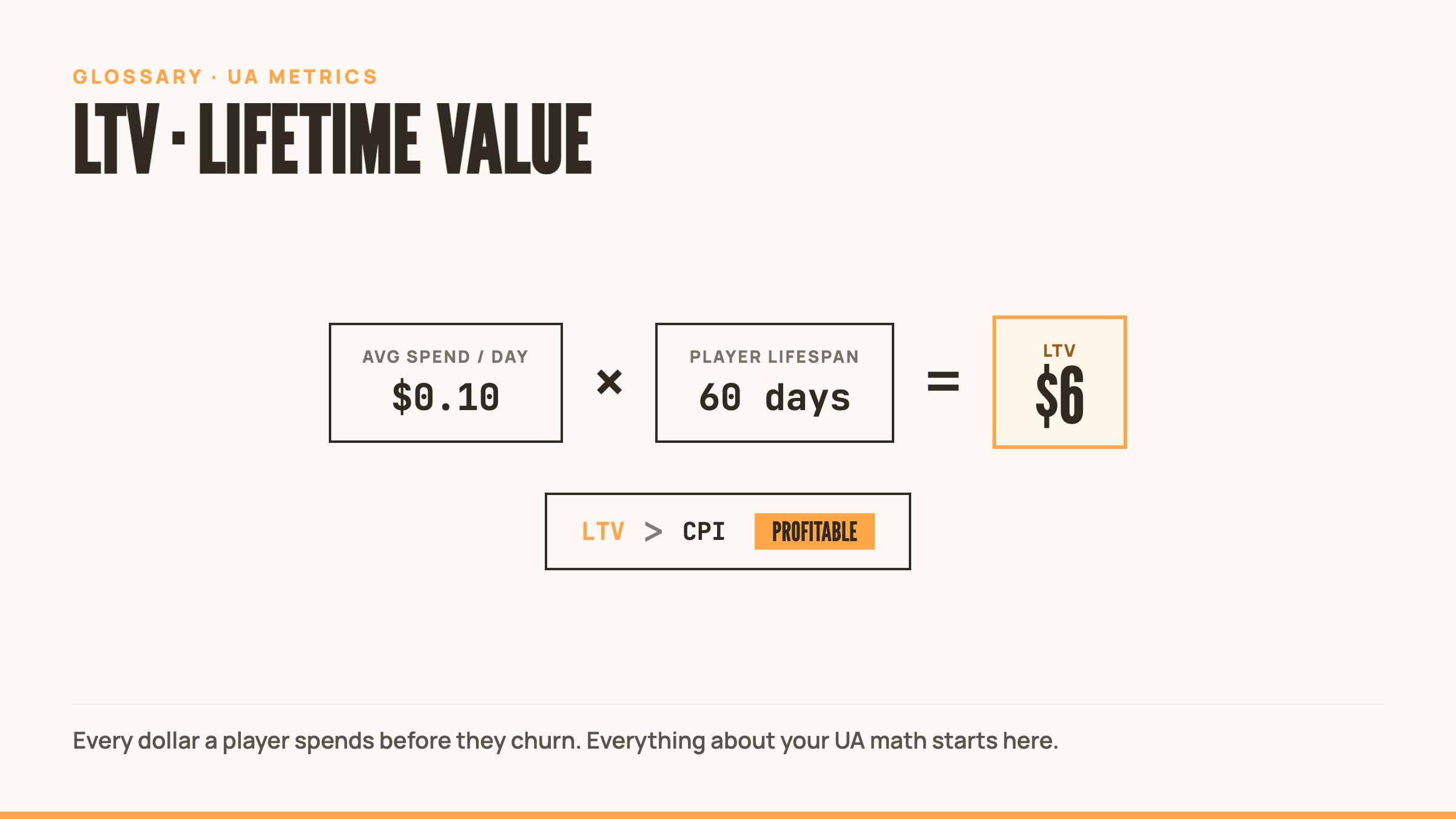
Quick Definition: LTV, or lifetime value, is the total revenue a player generates from install to churn. It’s the north star metric for UA profitability.
What is LTV?
LTV measures how much money a player brings in over their entire relationship with your game. Every dollar. IAP, subscriptions, ad revenue. All of it.
The formula is straightforward:
LTV = Average Purchase Value × Purchase Frequency × Player Lifespan
A player who spends $0.10/day for 60 days delivers $6 LTV. Simple math. Powerful insight.
Most studios track LTV at specific milestones. D7, D30, D180. Each window tells a different story about player value and retention patterns.
Why LTV Matters
LTV determines if your UA math works.
If LTV > CPI, you’re profitable. If LTV < CPI, you’re burning money. Everything else is commentary.
UA teams live and die by this number. It decides how much you can bid, which networks you can compete on, and whether you scale or shut down campaigns.
High LTV games can outbid competitors for the same installs. Low LTV games get priced out of premium inventory. The market is ruthless about this.
LTV also exposes where your revenue comes from. Are whales carrying your entire economy? Are dolphins converting consistently? Are minnows just noise in your analytics?
Answer those questions and you know where to focus product, LiveOps, and creative strategy.
How to Calculate LTV
Basic Formula: “ LTV = (Average Revenue Per User) × (Average Player Lifespan) “
More Precise: “ LTV = (ARPU per Day) × (Average Lifetime in Days) “
(See ARPU and ARPDAU for related metrics)
Cohort-Based (Best Practice): Track revenue per cohort over time. Measure D1, D7, D30, D90, D180. Plot the curve. Extrapolate to full lifetime.
Most attribution platforms handle this automatically. AppsFlyer, Adjust, GameAnalytics, Firebase. They track install cohorts and calculate LTV at each milestone.
The hard part isn’t the math. The hard part is knowing which LTV window matters for your business. Hypercasual? D7 tells the story. RPG with long tail monetization? D180 or bust.
Benchmarks
Industry averages vary wildly by genre and monetization model.
Casual Games (D180):
- $1.80 to $2.50 LTV
- Ad-heavy monetization
- Short session length
Mid-Core Games (D180):
- $4 to $6 LTV
- IAP + ads hybrid
- Longer retention curves
These are starting points. Not targets. Your LTV depends on game design, LiveOps execution, and how well you monetize without killing retention.
Whales skew averages hard. A game with $3 average LTV might have 5% of players at $50+ LTV and 80% under $1. Segment ruthlessly.
Strategies to Improve LTV
1. Retention First Dead players don’t spend. Fix D1 and D7 retention before optimizing monetization.
2. Smart Segmentation Whales, dolphins, minnows. Each group needs different offers, cadence, and creative messaging.
3. LiveOps That Convert Events, sales, limited-time offers. Timed right, they spike LTV without burning goodwill.
4. Paywall Placement Test offer timing. Too early kills retention. Too late leaves money on the table.
5. Ad Monetization Balance More ads = more revenue until players churn. Find the ceiling without crossing it.
6. Cross-Promotion Move high-LTV players into your other titles. Compound their lifetime value across your portfolio.
Common Mistakes
Ignoring Cohort Decay Early cohorts always look better. Compare apples to apples or your projections will be fantasy.
Confusing LTV with ARPU ARPU is a snapshot. LTV is the full movie. Don’t optimize for the wrong metric.
Chasing Whales, Ignoring Dolphins Whales are loud. Dolphins are consistent. Build for both or your economy collapses when whales churn.
Over-Monetizing Early Players Squeeze too hard on D1 and your D30 LTV craters. Patience pays.
Not Segmenting by Source Organic installs have different LTV than paid. TikTok users behave differently than Meta users. Blend them and your analysis is worthless.
Related Terms
- CPI (Cost Per Install) – What you pay to acquire a player
- ROAS (Return on Ad Spend) – Revenue divided by ad spend
- ARPU (Average Revenue Per User) – Revenue snapshot at a specific time
- Retention Rate – Percentage of players who return after install
- Cohort Analysis – Tracking groups of users by install date
External Resources
Frequently Asked Questions
What is the meaning of lifetime value?
Lifetime value, or LTV, is the total revenue a player generates over their entire relationship with your game, combining IAP, subscriptions, and ad revenue. It’s the north star metric for UA profitability: if LTV beats your cost per install, you’re making money.
How do you calculate lifetime value?
The basic formula is average purchase value times purchase frequency times player lifespan, or more simply, average revenue per user per day times average lifetime in days. Best practice is cohort-based: track D1, D7, D30, D90, and D180 revenue and extrapolate the curve.
Is it CLV or LTV?
Both terms describe the same concept and get used interchangeably. LTV is the standard term in mobile gaming and UA. CLV, or Customer Lifetime Value, is more common in general e-commerce and business marketing contexts.
What’s a good LTV for mobile games?
It depends entirely on genre and monetization model. Casual games average $1.80-$2.50 at D180. Mid-core games with IAP and ads hybrid monetization run $4-$6. “Good” ultimately means profitable relative to your CPI, not a fixed number.
Can LTV be too high?
No, but chasing it the wrong way backfires. Squeezing players too hard to spike short-term LTV kills retention and craters long-term value. Sustainable LTV beats a short-term spike every time.