

glossary
Hypercasual Games
Mobile games built for instant playability and maximum reach. One-tap mechanics, zero tutorials, infinite loops. Revenue from ads. Success determined at the UA level.
Quick Definition
Hypercasual games are mobile games built for instant playability and maximum reach. One-tap mechanics, zero tutorials, infinite loops. Revenue from ads. Success determined at the UA level.
What are Hypercasual Games
Hypercasual games strip gaming down to its core loop. No progression systems. No elaborate tutorials. No in-app purchases.
You download. You play within seconds. You watch ads to continue.
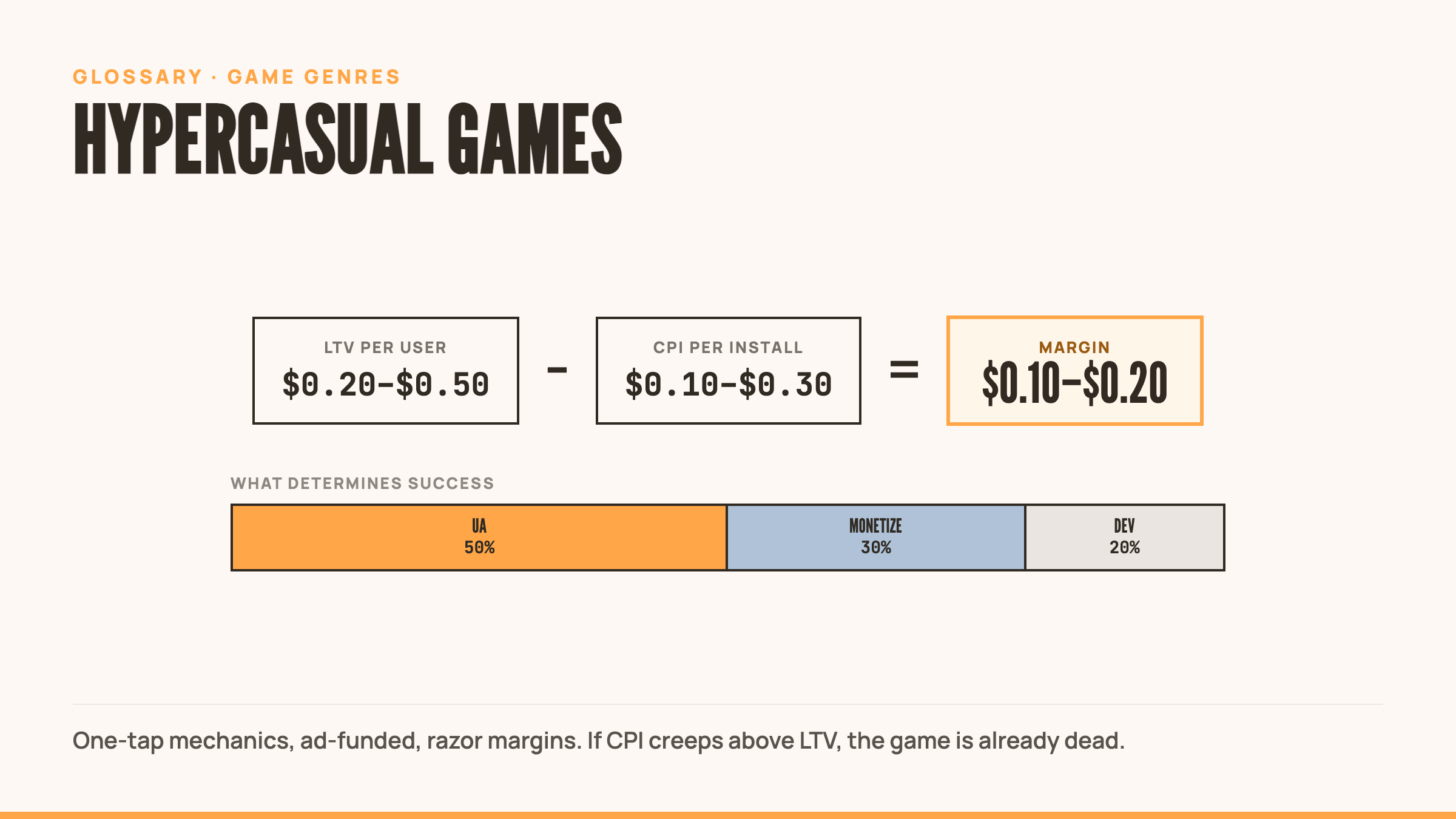
The entire business model lives or dies on UA efficiency. If your CPI is higher than your LTV, you’re done.
Publishers launch hundreds of prototypes to find the one game that scales. The hit rate is brutal. Most games never see profitability.
Key Characteristics
Instant Playability No onboarding. No explanation screens. The mechanic is self-evident within the first three seconds.
Minimalist UI Clean interface. One or two buttons max. Visual noise kills conversion.
Infinite Loops Levels restart endlessly with slight variations. Players can pick up and drop off without losing progress.
One-Tap Mechanics Tap to jump. Swipe to turn. Hold to shoot. Complexity is the enemy.
Universal Appeal Designed for everyone. Grandmothers play the same games as teenagers.
Monetization Model
Hypercasual games run on in-app advertising. Over 95% of revenue comes from ads.
Players watch rewarded videos to continue playing or gain small advantages. Interstitial ads appear between levels. Banner ads occupy screen real estate.
The math is simple. Revenue per install needs to exceed cost per install. The margin is thin.
Typical Economics (blended global targets; CPI runs notably higher in tier-1 markets like the US and UK):
- CPI target: $0.10-$0.30
- LTV target: $0.20-$0.50
- Margin: $0.10-$0.20 per user
Volume matters. Hypercasual publishers need millions of installs to generate meaningful revenue.
UA Strategy
Hypercasual success splits roughly 80/20 between go-to-market and the game itself: UA accounts for about 50% of the outcome, monetization another 30%, and development the remaining 20%.
CPI (Cost Per Install) The price you pay for each app install. Lower is better. Most hypercasual games target $0.10-$0.30.
LTV (Lifetime Value) The total revenue generated by one user through ad views. Must exceed CPI for profitability.
IPM (Installs Per Mille) Critical metric for UA creatives. Measures how many installs you get per 1,000 ad impressions.
High IPM means your creative resonates. Players see your ad and immediately want to try the game. Low IPM kills hypercasual games before they launch.
Playable ads dominate hypercasual UA. Video ads work but playables convert better. The ad IS the game demo, which is why playable production at speed matters so much for hypercasual UA.
Recent Evolution
The hypercasual category is blurring.
Pure hypercasual games face saturation. Publishers now blend hypercasual mechanics with hybrid-casual elements. Progression systems creep in. Meta layers appear. IAP starts showing up.
The term “hypercore” emerged to describe hypercasual games with deeper mechanics and longer retention curves.
What used to work in 2020 doesn’t work today. Bare-bones prototypes get buried. Players expect more.
The new baseline:
- Polished core loop
- Light progression systems
- Quality visuals
- Smooth animations
- Satisfying feedback loops
Hypercasual became the entry point. Hybrid-casual became the evolution. The lines are now hard to draw.
Common Mistakes
Overcomplicating the Mechanic Adding features kills hypercasual games. Complexity reduces conversion. Stick to one core loop.
Ignoring IPM If your creative doesn’t generate high IPM in testing, the game will fail. Period. No amount of optimization fixes weak creative hook.
Poor Ad Integration Rewarded ads should feel like a choice. Forced interstitials between every level create negative experiences.
Underestimating Production Quality Hypercasual doesn’t mean ugly. Visual polish and smooth animations matter. Players notice bad UX instantly.
Betting on One Game Hypercasual is a portfolio game. Publishers test 50-100 prototypes to find 2-3 winners through systematic creative research and ideation. Expecting your first game to hit is naive.
Related Terms
- Hybrid-Casual Games – Hypercasual mechanics with meta progression
- Playable Ads – Interactive ad format, essential for hypercasual UA
- IPM – Installs per thousand impressions
- CPI – Cost per install
- LTV – Lifetime value
- IAA – In-app advertising
- Creative Fatigue – When ad performance degrades over time
External Resources
- How to Make a Hyper-Casual Game Successful – Adjust
- Hyper-Casual Games Guide – AppsFlyer
- The Hypercasual Business Model – Homa Games
Frequently Asked Questions
What is a hypercasual game?
A mobile game built for instant playability and maximum reach: one-tap mechanics, no tutorials, no progression systems. Players download, play within seconds, and watch ads to continue. Revenue comes almost entirely from in-app advertising, not purchases.
Is Candy Crush a hypercasual game?
No. Candy Crush is casual, not hypercasual. It has deep progression, hundreds of levels, and in-app purchase monetization. True hypercasual games like Fruit Ninja or Crossy Road strip that away entirely and run on one-tap loops and ad revenue.
What IPM is considered good for hypercasual games?
It varies by network and format, but the industry benchmark median sits around 8-9 installs per 1,000 impressions. Strong performers hit 15+ IPM. Below 5 IPM signals a weak creative hook that will struggle to scale.
How many prototypes do I need to test before finding a hit?
The industry average is 50-100 prototypes per successful hypercasual game. Some publishers test even more. Hypercasual is fundamentally a volume game, both in creative testing and in game prototyping.