

glossary
Ad Fatigue
Quick Definition Ad fatigue happens when users see the same (or similar) ads too often. Performance tanks. CTR drops. CPA climbs. Your winning creative becomes invisible noise. What is Ad Fatigue? Ad fatigue is the declining effectiveness of advertising creative when audiences get overexposed to it. The psychology is simple. First time you see an […]
Quick Definition
Ad fatigue happens when users see the same (or similar) ads too often. Performance tanks. CTR drops. CPA climbs. Your winning creative becomes invisible noise.
What is Ad Fatigue?
Ad fatigue is the declining effectiveness of advertising creative when audiences get overexposed to it.
The psychology is simple. First time you see an ad, you might pay attention. Third time, maybe you still engage. Tenth time? You’ve trained yourself to scroll past it. Your brain filters it out before you even register it consciously.
In performance marketing, ad fatigue shows up in the metrics before you feel it in your gut. CTR starts sliding. Conversion rates drop. CPA creeps up. The creative that crushed last week suddenly can’t buy an install.
Mobile makes this worse. Users scroll faster, attention spans are shorter, and the same people see your ads across multiple apps and placements. Fatigue sets in faster on mobile than desktop.
Key Statistics & Warning Signs
Frequency benchmarks vary by audience type. For cold prospecting, keep frequency under 3.0 to avoid early fatigue. For retargeting, aim for 4.0-6.0 and avoid exceeding 7.0, per AdAmigo’s Meta Ads frequency research.
Watch for these warning signs:
CTR decline of 10%+ over seven days, 20%+ over two weeks A 10% drop is an early warning. A 20% drop over 14 days signals fatigue has become a serious problem.
Rising CPA despite stable budgets When cost per acquisition climbs while spend stays constant, your creative is losing effectiveness.
Conversion rate drop on same traffic Same audience, same targeting, worse results. Classic fatigue pattern.
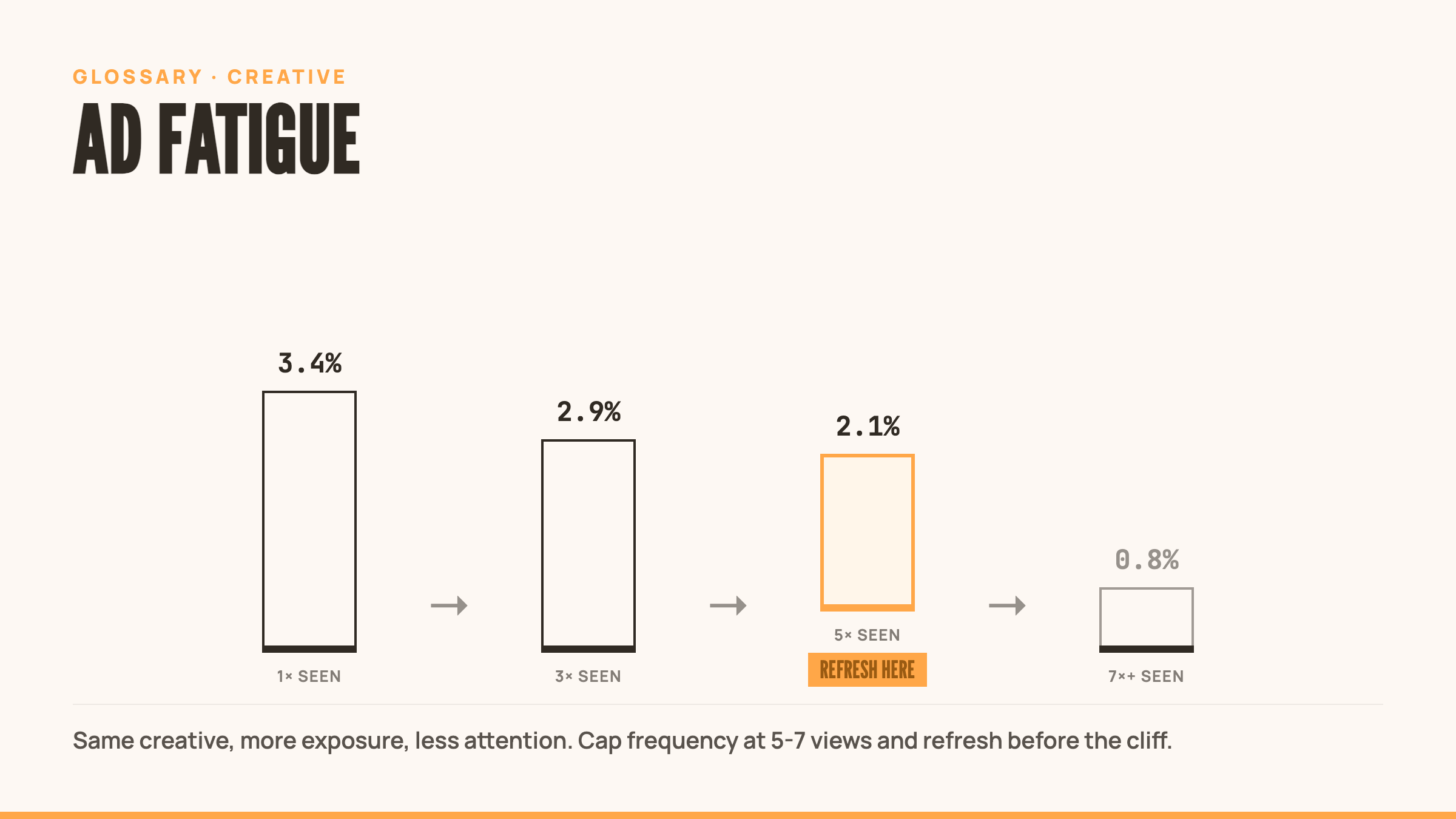
Frequency metrics above 5-7 At 5+ exposures, costs can rise 50-80% and CTR can drop 40-55%, per the same AdAmigo research. Retargeting audiences hit the “fatigue zone” at 6.0+ impressions per user.
Mobile gaming sees faster fatigue cycles than other verticals, though exact shelf life varies by genre, format, and audience size. Watch frequency and performance data, not the calendar, to know when a playable ad needs refreshing or rotation.
Prevention Strategies
Frequency capping Set hard limits on how many times one user sees the same creative. Most ad networks let you cap at 3-5 impressions per user per week.
Paced delivery Spread impressions evenly throughout the day instead of front-loading. Gives users breathing room between exposures.
Creative rotation Build multiple variations and cycle them. Even small differences (new hook, different color scheme, alternate gameplay moment) reset the fatigue clock.
Segment by lifecycle stage New users and retargeting audiences need different creative rotation strategies. Fresh eyes can handle more exposure. Returning users need variety faster.
Kill creatives while they still work Counterintuitive but true. Retire ads before they completely burn out. Easier to bring them back later than to recover from total fatigue.
Test constantly Always have new creatives in the pipeline, backed by agentic creative generation that keeps it stocked. When one starts showing fatigue, you’ve got fresh options ready to deploy.
Common Mistakes
Running a single winning creative until it dies You found a winner. Great. Now make five more variations before this one burns out completely.
Ignoring frequency data Platforms show you frequency metrics for a reason. Use them. They’re early warning systems.
Confusing seasonal drops with fatigue Not every performance dip is ad fatigue. Check external factors (holidays, competitor activity, platform changes) before declaring fatigue.
Refreshing too early Killing a creative after 3 days because you’re bored with it. You’ve seen it 100 times. Your audience has seen it twice. Let data decide, not your personal taste.
Making tiny, meaningless changes Swapping one word in the headline won’t reset fatigue. Different enough to split your reporting, not different enough to feel fresh to users.
Related Terms
- Creative Fatigue – Broader term covering creative burnout across all formats
- Frequency Capping – Technical mechanism to limit ad exposure
- Creative Rotation – Strategy for cycling multiple creatives
- CTR (Click-Through Rate) – Primary metric for detecting fatigue
- CPA (Cost Per Acquisition) – Cost metric that rises with fatigue
External Resources
- Funnel.io: What is Ad Fatigue? – Comprehensive guide to identifying and preventing ad fatigue
- HubSpot: Ad Fatigue Guide – Practical strategies for combating fatigue across platforms
- AppsFlyer: Creative Fatigue in Mobile – Mobile-specific insights and prevention tactics
Frequently Asked Questions
What is an example of ad fatigue?
Classic example: your top-performing video ad crushes it for two weeks, then CTR starts sliding for no reason. Same targeting, same budget, same creative. That’s ad fatigue. Users on Instagram or Facebook have seen the ad so many times they scroll past without registering it.
How long until ad fatigue sets in?
Depends on audience size and platform. Mobile gaming typically sees fatigue in 2-4 weeks, faster with smaller audiences. Watch frequency, not the calendar. Once the average user hits 5-7 impressions in 30 days, performance usually starts falling off a cliff.
What causes ad fatigue?
Overexposure. Users see the same creative too many times, tune it out, and engagement drops while costs rise. Frequency is the root cause. Same ad, same eyeballs, repeated too often.
How do you prevent ad fatigue?
Cap frequency at 3-5 impressions per user per week, rotate creatives before they die, and keep new concepts in the pipeline constantly. The real fix is volume: always have fresh creative ready so you can swap out a fatiguing ad before it tanks your CPA.