
glossary
IAP (In-App Purchase)
Quick Definition: Monetization transactions that happen inside a mobile app after download. Players buy virtual goods, currency, subscriptions, or premium content without leaving the game. — 01. What is IAP IAP is how free-to-play mobile games make money. Download is free. Revenue comes from what players buy inside the game. Virtual currency, power-ups, cosmetics, battle […]
Quick Definition: An in-app purchase (IAP) is a monetization transaction that happens inside a mobile app after download. Players buy virtual goods, currency, subscriptions, or premium content without leaving the game.
What is IAP
IAP is how free-to-play mobile games make money.
Download is free. Revenue comes from what players buy inside the game. Virtual currency, power-ups, cosmetics, battle passes, ad removal. The entire F2P model depends on converting a small percentage of players into paying users.
The mechanic is simple. The execution is not.
IAP sits at the center of mobile game economics. Get it right and you have a sustainable revenue engine. Get it wrong and you burn through acquisition budgets with nothing to show.
Types of IAP
Consumable
One-time use items that players buy repeatedly.
Lives, coins, boosters, energy refills. These drive recurring transactions. Players use them, need more, buy again.
Non-Consumable
Permanent unlocks. Buy once, own forever.
Ad removal, premium characters, level packs. These typically command higher price points but lower purchase frequency.
Subscriptions
Recurring payments for ongoing benefits.
Battle passes, VIP memberships, monthly content drops. Predictable revenue. Higher lifetime value. Growing fast in mobile gaming.
Bundles
Multiple items packaged together at perceived discount.
Starter packs, limited-time offers, seasonal bundles. Create urgency. Drive first purchase. Account for 18% of best-selling IAP items.
Loot Boxes
Randomized rewards purchased with real money or premium currency.
Gacha mechanics, mystery boxes, card packs. Controversial but effective. Regulatory scrutiny varies by market.
Best Practices
Pricing Strategy
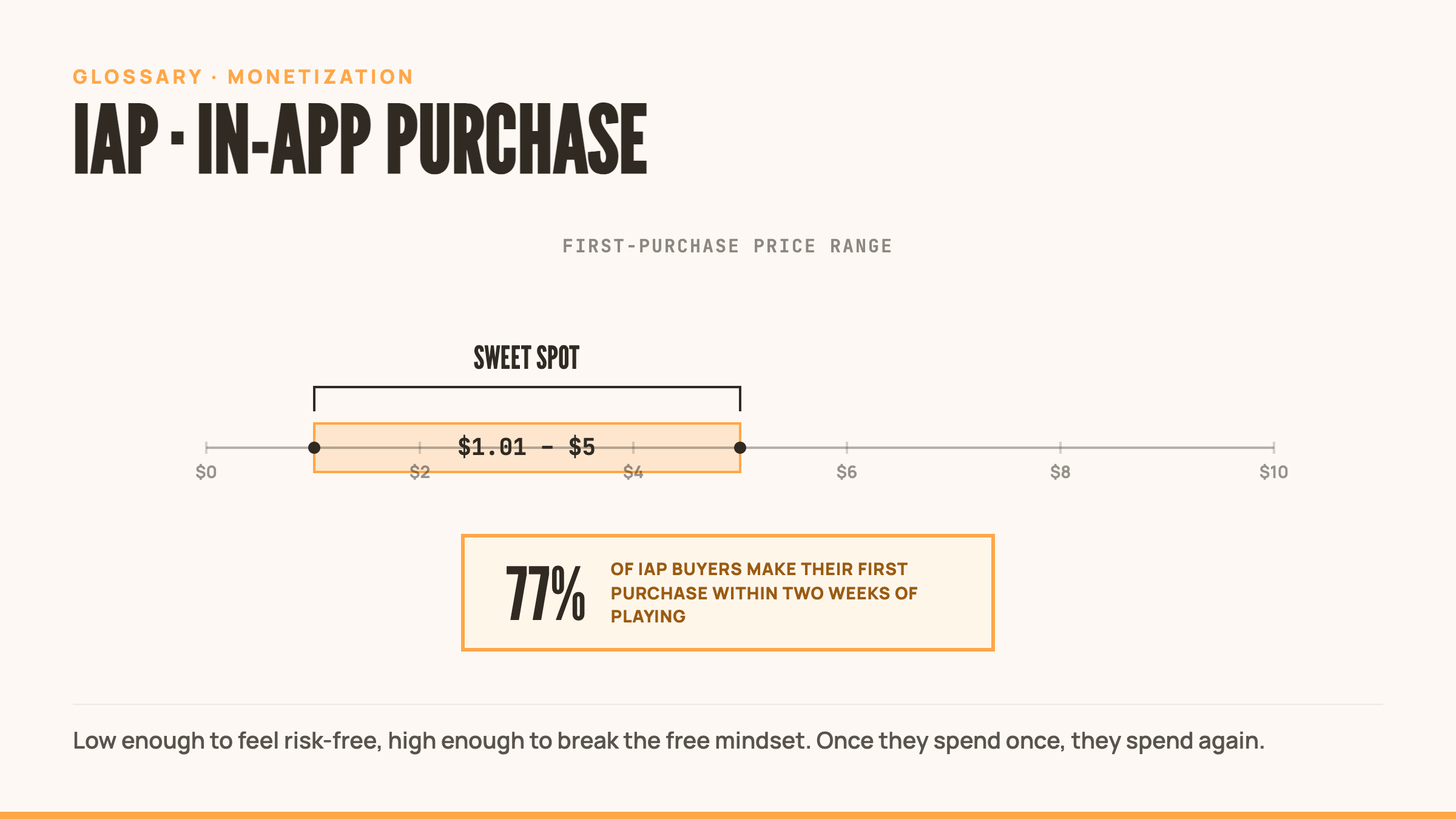
First purchase matters most. The sweet spot is $1.01 to $5.
Low enough to feel risk-free. High enough to break the free-to-play mindset. Once players spend once, they’re far more likely to spend again.
Higher-tier offers exist for whales. But conversion starts small.
Timing
77% of IAP purchasers make their first purchase within two weeks of playing.
The monetization window is narrow. If you don’t convert players early, you probably never will.
Design monetization moments into the first-session experience. Not aggressive. Strategic. Give players reasons to spend when engagement is highest.
Personalization
40% of IAP spenders would spend more with personalized offers.
Generic stores leave money on the table. Show different offers based on player behavior, progression, and spending patterns.
Spenders see premium bundles. Non-spenders see first-time offers. Lapsed players see re-engagement deals.
The storefront should adapt to the player, not the other way around.
Market Data
Global mobile game IAP revenue hit $82B in 2024. That’s a 4% year-over-year increase.
The market is mature but still growing. Competition for player spending is brutal.
Best-selling IAP categories:
- Virtual currencies: 23%
- Limited-time sales: 20%
- Bundles: 18%
Limited-time mechanics work. Scarcity drives urgency. Players respond to countdown timers and exclusive offers.
Common Mistakes
Monetizing Too Late
Waiting until players are “engaged enough” means missing the monetization window. Design IAP touchpoints early.
Generic Storefronts
Same offers for every player. No segmentation. No personalization. Whales see the same $0.99 starter pack as first-time spenders.
Ignoring Payers
Focusing all attention on conversion while neglecting high-value spenders. Your top 1% of players drive disproportionate revenue. Give them reasons to keep spending.
Poor Value Perception
Players need to feel purchases are worth it. Weak bundles, bad pricing ratios, unclear benefits all kill conversion.
No Testing
Running the same IAP offers for months without iteration. Test pricing, bundles, timing, placement. IAP optimization is continuous.
Related Terms
- ARPDAU (Average Revenue Per Daily Active User)
- Conversion Rate (Percentage of players who make any purchase)
- LTV (Lifetime Value)
- Whale (High-spending player)
- ARPPU (Average Revenue Per Paying User)
- Monetization Rate (Percentage of users who convert to paying)
External Resources
- In-App Purchases Guide – Udonis
- Mobile Game IAP Deep Dive – Mistplay
- IAP Trends in Mobile Gaming – MAF
Frequently Asked Questions
What does IAP mean?
IAP stands for in-app purchase: a transaction made inside a mobile app after download, for virtual currency, power-ups, cosmetics, subscriptions, or premium content. It’s the primary way free-to-play games make money.
What percentage of mobile game players make IAP purchases?
Industry average is roughly 2-5% of players. Most players never spend a cent; revenue comes from a small, high-value segment, which is why segmenting offers by spender type matters so much.
When should I introduce IAP in the player journey?
Early. Most IAP purchasers who ever spend do so within their first two weeks of playing. Design monetization moments into the first-session experience instead of waiting until players feel “engaged enough.”
What’s the optimal first purchase price point?
Somewhere between $1.01 and $5. Low enough to feel risk-free for a first purchase, high enough to break the free-to-play mindset. Once someone spends once, they’re far more likely to spend again.