

glossary
DSP (Demand-Side Platform)
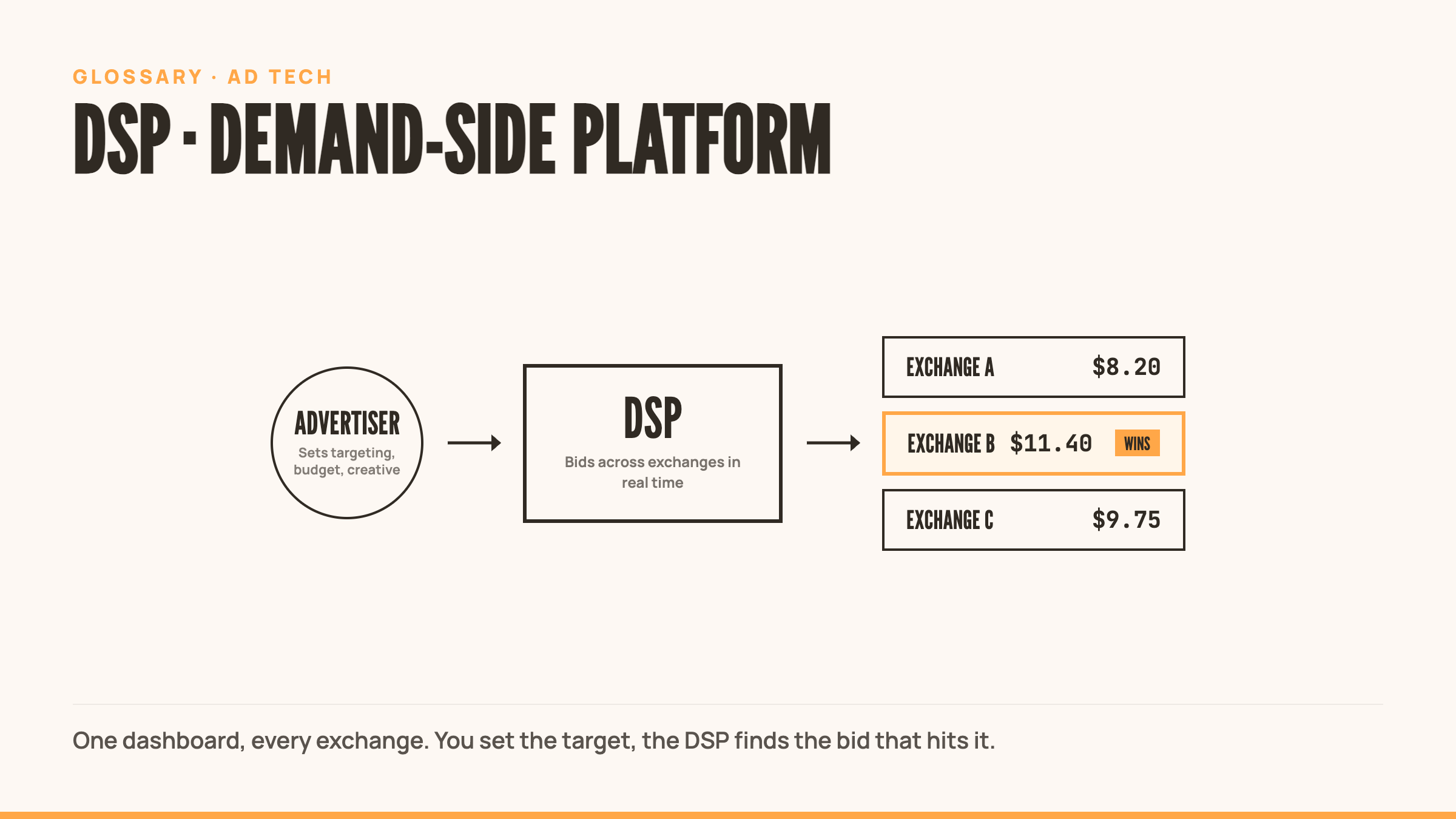
Software that lets advertisers buy ad inventory across multiple sources with automation. Upload creative, set targeting and budgets, let the DSP handle the bidding.
Quick Definition
A DSP, or demand side platform, is software that lets advertisers buy ad inventory across multiple sources with automation. Upload creative, set targeting and budgets, let the DSP handle the bidding.
What is a DSP
A Demand-Side Platform is software built for the buy side of advertising. It aggregates inventory from multiple ad exchanges and publisher networks into one interface. You manage campaigns, targeting, bids, and budgets from a single dashboard instead of negotiating with dozens of publishers separately through ad networks.
Think of it as your buying agent. You tell it what you want (installs, geography, CPI target), and it finds the inventory to match. The IAB defines DSPs as essential infrastructure for programmatic buying.
How DSPs Work
The process moves fast:
- You upload creative and set parameters – Define your targeting (device type, geography, audience), set your bid strategy, assign budgets.
- DSP scours the network – When impression opportunities appear across connected exchanges, the DSP evaluates them against your criteria.
- Real-time bidding happens – If the impression matches, the DSP submits a bid on your behalf. The auction resolves in milliseconds.
- Winner serves the ad – Highest bid wins. Your creative shows to the user.
All of this happens before the page finishes loading. You get real-time reporting on what’s working and what’s burning budget.
Mobile DSPs
Mobile DSPs handle mobile-specific inventory. They connect to mobile ad exchanges and understand the nuances of app environments: in-app vs. mobile web, video vs. playable formats, iOS vs. Android targeting.
For mobile gaming UA, mobile DSPs are the standard. They integrate with MMPs (Mobile Measurement Partners) to track installs and post-install events, closing the loop between spend and performance. Unity Ads operates as both an ad network and DSP for gaming inventory.
DSP vs Ad Network
An ad network buys inventory in bulk and resells it. You negotiate directly with the network. Pricing is often less transparent.
A DSP gives you access to multiple networks and exchanges with algorithmic bidding. You control targeting, budgets, and bids. More transparency, more control, more complexity to manage.
Most UA teams use both. Networks for scale and relationships. DSPs for precision and real-time optimization.
Market Size
US programmatic digital display ad spend hit $157.35 billion in 2024, up 15.9% year-over-year (eMarketer). Most of that spend flows through DSPs.
The shift to programmatic reflects a larger trend: manual media buying gets outpaced by algorithmic speed. DSPs make it possible to manage thousands of placements and bid adjustments that would be impossible by hand. Digiday covers how DSP technology continues reshaping media buying.
Common Mistakes
Assuming all inventory is equal – DSPs surface inventory from many sources. Quality varies. Some placements drive installs, some drive fraud. Watch performance by source.
Setting and forgetting – Automation doesn’t mean autopilot. Creative fatigue, audience saturation, and competitive pressure change daily. Monitor, adjust, iterate.
Ignoring data integration – If your DSP doesn’t talk to your MMP, you’re flying blind. Post-install data should feed back into bid strategies.
Over-relying on one DSP – No single platform has all the inventory. Running multiple DSPs gives you broader reach and leverage in negotiations.
Related Terms
- [SSP (Supply-Side Platform)] – The sell-side equivalent. Publishers use SSPs to manage and sell their inventory.
- [Ad Exchange] – Marketplace where DSPs and SSPs meet to trade inventory in real-time auctions.
- [RTB (Real-Time Bidding)] – Auction mechanism that powers programmatic buying through DSPs.
- [MMP (Mobile Measurement Partner)] – Attribution platform that tracks installs and events, feeding data back to DSPs for optimization.
- [Programmatic Advertising] – Automated ad buying powered by DSPs and algorithmic bidding.
External Resources
Frequently Asked Questions
Do I need a DSP if I’m already running on Meta and Google?
Meta and Google are walled gardens with their own interfaces. A DSP gives you access to everything outside those ecosystems: ad networks, publisher direct deals, in-app inventory across exchanges. If you want scale beyond the big two, you need a DSP.
What’s the difference between a DSP and a DMP?
A DMP (Data Management Platform) organizes audience data. A DSP uses that data to buy ads. They often integrate, but DMP is about knowing your audience while DSP is about reaching them.
How much does a DSP cost?
Most DSPs charge a percentage of media spend, typically 10-20%, or a flat CPM markup. Some offer self-serve pricing for smaller spends, others require six-figure minimums. You’re paying for inventory access, bidding algorithms, and reporting.
How do I know if my DSP is buying quality inventory?
Track performance by source, not just CPI. Look at install-to-event rates. High installs with zero retention usually means bad inventory or fraud. Work with your DSP’s account team to whitelist and blacklist sources based on real performance.