

glossary
Ad Network
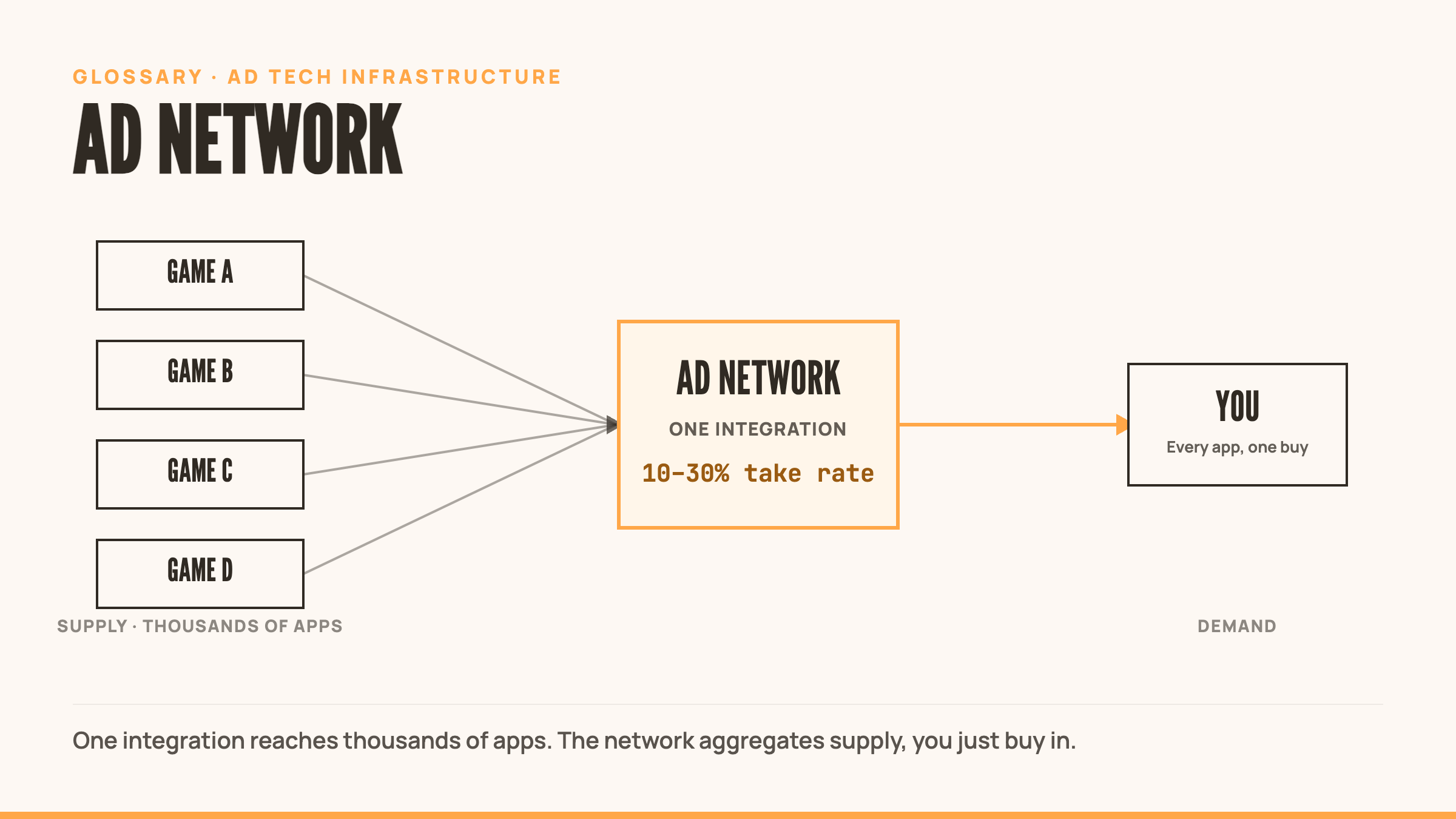
A platform that connects advertisers with publishers who have ad inventory. Think of it as a marketplace where you buy placement across multiple apps and sites through one interface.
Quick Definition
An ad network is a platform that connects advertisers with publishers who have ad inventory. Think of it as a marketplace where you buy placement across multiple apps and sites through one interface.
What is an Ad Network
Ad networks aggregate inventory from publishers and sell it to advertisers at scale.
You want to run ads across 500 mobile games. Instead of cutting 500 individual deals, you go through Unity or AppLovin. They bundle the inventory, handle the tech, and take a cut.
Ad networks aggregate inventory directly from publishers and sell it to advertisers. That puts them alongside the Supply-Side Platform (SSP)-to-exchange-to-Demand-Side Platform (DSP) programmatic stack, not inside it as the matcher between the two. The IAB provides standards for how mobile ad networks handle creative formats.
For mobile gaming UA, this means access to millions of players across thousands of apps. One integration, massive reach.
How Ad Networks Work
The flow is simple:
- Publishers list inventory – Game developers make ad space available
- Network aggregates supply – Bundles inventory from hundreds or thousands of apps
- Advertisers set targeting – Define audience, budget, and creative specs
- Network serves ads – Matches demand to supply in real-time
- Performance tracking – Reports installs, ROAS, retention data back to advertisers
The network handles the plumbing. You focus on creative and budget allocation.
Types of Ad Networks
Vertical Networks
Topic-specific inventory. Gaming networks only sell placements in games. Fitness networks focus on health apps.
Benefit: Better targeting, higher engagement. Trade-off: Smaller reach than general networks.
Blind Networks
Cheapest CPIs, least transparency. You don’t always know where your ads run.
Benefit: Low cost, high volume. Trade-off: Brand safety risk, questionable placement quality.
Targeted Networks
Use behavioral and contextual data to match ads to users.
Benefit: Higher ROAS through better targeting. Trade-off: Premium pricing.
For mobile gaming UA, most teams use a mix. Premium networks like Meta and Google for brand-safe scale. Blind networks for cheap volume testing.
Mobile Ad Formats
Banner Ads
Small rectangular ads at top or bottom of screen. Cheap, low engagement. See banner ads.
Video Ads
15-30 second clips. Standard format for mobile UA. High CPM, better conversion than banners. See video ads.
Interstitial Ads
Full-screen ads between app sessions. Common in casual games. Higher engagement but can hurt retention if overused. See interstitial ads.
Native Ads
Blend into app content. Look like regular posts or content cards. Higher CTR, less intrusive.
Rewarded Ads
Users watch in exchange for in-game currency or content. Highest completion rates. Players actually want to see them. See rewarded video.
Global mobile ad spend topped $400B in 2024. Video and rewarded formats dominate gaming UA. Unity Ads specializes in rewarded video for mobile games.
Ad Network vs DSP
Ad network: Owns inventory relationships. Buys from publishers, sells to advertisers. Takes a margin.
DSP: Tech layer for buying ads programmatically. Connects to multiple ad exchanges and networks. You control the buying logic.
Think of it this way: Ad networks are retailers. DSPs are trading platforms.
Most gaming UA teams use both. Networks for guaranteed volume (Facebook, Unity, AppLovin). DSPs for programmatic optimization across long-tail inventory. Digiday explains the evolution from traditional ad networks to programmatic platforms.
Common Mistakes
Treating all networks the same
Meta inventory performs differently than Unity. Tailor creative and bidding by network.
Ignoring placement quality
Cheap CPIs mean nothing if users churn in 24 hours. Track D7 ROAS by network.
Running the same creative everywhere
What works on TikTok flops on rewarded video placements. Format and context matter.
Not testing blind networks
Brand-safe doesn’t always mean profitable. Some of the best ROAS comes from unglamorous inventory.
Forgetting creative fatigue
Ad networks burn through creative faster than you think. One winning video gets hammered with impressions. Creative fatigue kills performance in weeks.
Related Terms
- DSP (Demand-Side Platform) – Programmatic buying interface
- SSP (Supply-Side Platform) – Publisher side of the equation
- CPI (Cost Per Install) – What you pay per app install
- ROAS (Return on Ad Spend) – Revenue generated per dollar spent
- Creative Fatigue – Performance decay as users see the same ad repeatedly
- Programmatic Advertising – Automated ad buying via algorithms
- Ad Exchange – Real-time bidding marketplace for ad inventory
External Resources
Frequently Asked Questions
What is an ad network?
An ad network is a platform that aggregates ad inventory from publishers and sells it to advertisers at scale. Instead of cutting individual deals with hundreds of apps, you buy placement across all of them through one integration. The network handles the tech and takes a cut.
Do ad networks still exist?
Yes, and they still carry most mobile UA spend. Meta, Google, Unity, and AppLovin all operate as ad networks today. (Unity absorbed ironSource’s LevelPlay mediation platform in 2022.) Programmatic buying and DSPs have grown alongside them, but for guaranteed volume, networks remain the default.
What is an example of an ad network?
Meta, Google, Unity, and AppLovin dominate mobile gaming UA. Meta and Google give you brand-safe scale. Unity (which absorbed ironSource’s LevelPlay mediation in 2022) and AppLovin specialize in gaming inventory and rewarded formats.
What’s the difference between an ad network and a DSP?
An ad network owns inventory relationships. It buys from publishers and sells to advertisers, taking a margin. A DSP is a tech layer for buying ads programmatically across multiple exchanges and networks. Networks are retailers. DSPs are trading platforms.