

glossary
Creative Strategy
Quick Definition: The systematic approach to planning, producing, and testing ad creatives that attract high-value players. Post-ATT, your creative strategy is your targeting mechanism. — 01. What is Creative Strategy Creative strategy is how you turn ideas into winning ads at scale. It’s the framework that connects who you’re trying to reach with what you’re […]
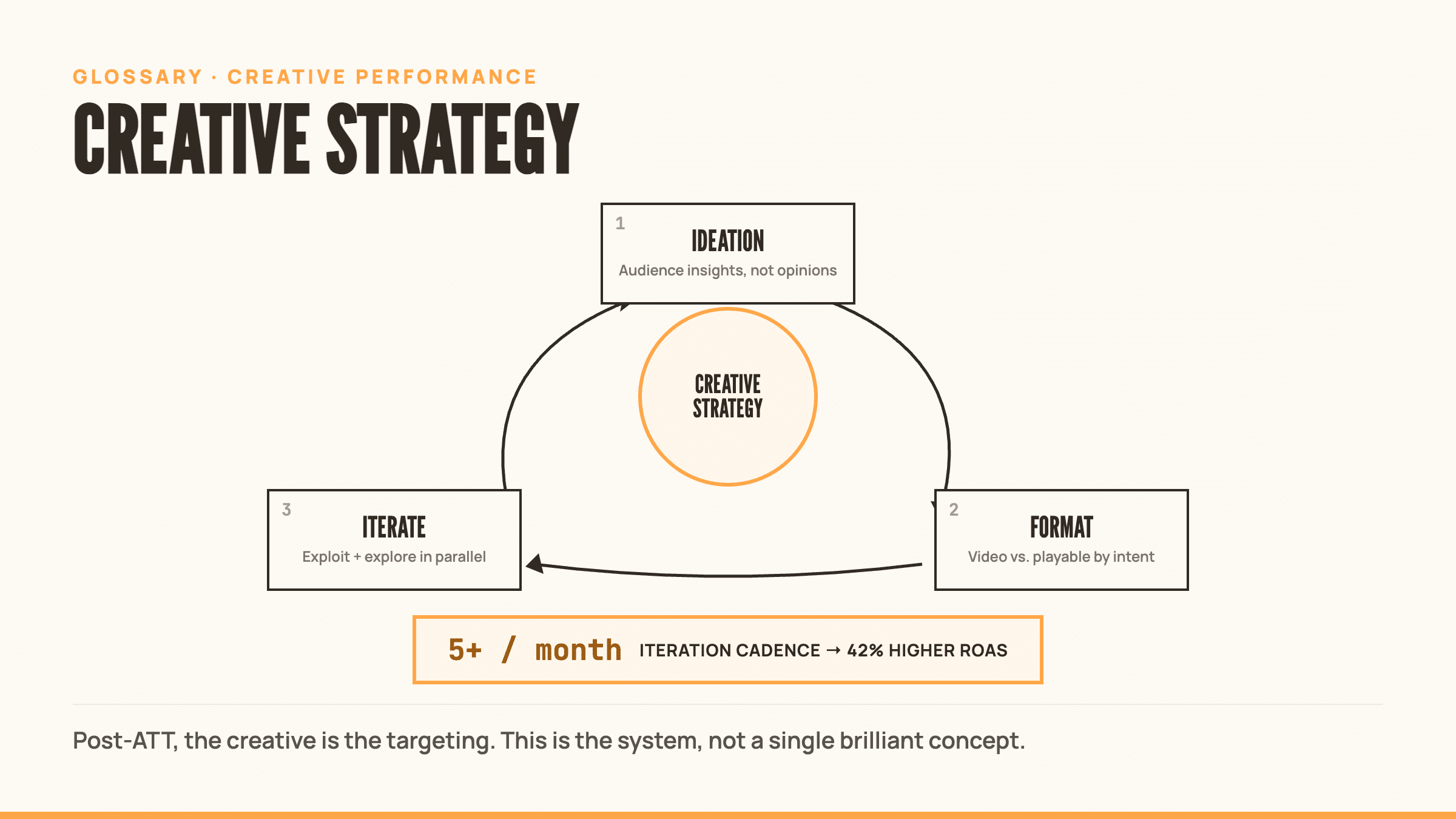
Quick Definition: The systematic approach to planning, producing, and testing ad creatives that attract high-value players. Post-ATT, your creative strategy is your targeting mechanism.
What is Creative Strategy
Creative strategy is how you turn ideas into winning ads at scale.
It’s the framework that connects who you’re trying to reach with what you’re going to show them. Not a single brilliant concept. A system for discovering what works, consistently.
In mobile gaming, creative strategy determines which players see your game and whether they install. One winning creative can transform your entire user acquisition performance. One missed opportunity can kill momentum.
The shift happened when ATT cut off event data. Ad networks lost their targeting superpowers. Now, creatives do the heavy lifting. Your ad becomes the signal that tells algorithms which audiences to find.
This elevated creative strategy from “make some nice-looking ads” to “this is how we acquire users.”
Framework Components
1. Ideation & Planning
Start with audience insights, not creative opinions. That’s the discipline behind creative research and ideation.
Who are your high-LTV players? What motivates them? What creative concepts resonate with similar audiences in competitive games?
Define your USP in one punchy sentence. Not a positioning deck. A clear statement of what makes your game different.
Example: a head-to-head competitive game might anchor everything around one promise: beat the person across from you, right now.
2. Ad Format Strategy
Match formats to discovery goals.
Video ads: Show gameplay, demonstrate value fast. Hook in 3 seconds or lose them.
Playable ads: Let players experience core mechanics. Higher intent, better retention signals.
Different formats attract different player types. Testing both reveals which audiences convert best for your game.
3. Testing & Iteration
Creative strategy lives or dies here.
Most studios test narrow. One market. Small budgets. Careful launches.
But ML-driven networks need volume to find signal. Feed them diverse concepts. Let the algorithm explore across audiences and placements.
The best teams run two parallel tracks:
Exploit: Variations on proven winners. Same core concept, new angles. Finds additional audience pockets.
Explore: Wildly different concepts. Bold experiments. Most fail. But breakthrough winners live here.
Studios that iterate on creative frequently and consistently outperform those running static creative sets on ROAS over time.
Market Context
Creative strategy became mission-critical.
The data from 2024 shows explosive growth, per SocialPeta’s Mobile Game Marketing report:
- Mobile gaming advertisers increased 60.4% year-over-year
- Creative asset volume grew 15.4% to 46.2M+ assets
- Western Europe: 58.7% of advertisers launch new creatives monthly
Mobile gaming represents 49% of the $188B gaming industry, growing 3% YoY (Newzoo, 2024). Competition intensified dramatically even as growth slowed.
The shift from “cheap CPI” to ROAS campaigns pushed complexity to ad networks. This freed UA teams to focus on the one lever that still moves performance: creatives.
Teams that master creative iteration win. Teams that rely on a few safe concepts get buried.
Best Practices
Start with Research, Not Hunches
Analyze competitors. Study what’s working in your genre. Identify patterns in high-performing creatives.
Don’t copy directly. Understand why concepts resonate, then adapt to your game’s strengths.
Build Cross-Functional Alignment
Creative strategy fails when UA, creative, and product teams operate in silos.
UA knows which audiences convert. Creative knows what resonates visually. Product knows what makes the game special.
Bring them together. Make creative strategy a shared discipline.
Test in Real Environments
Forget isolated A/B tests in small markets. They don’t predict BAU performance.
Test creatives where players actually are. In live campaigns. Across networks. With real budgets.
Let ML algorithms tell you what works. Their feedback loop beats any pre-launch test.
Maintain Velocity
Creative fatigue kills performance fast.
Plan for monthly iteration at minimum. Build production systems that support speed. Explore new concepts while exploiting winners.
Speed to discovery beats perfect execution.
Create Key Visuals
Establish consistent theme, art style, and mood across touchpoints.
Your creative strategy should flow seamlessly from ad to app store to in-game experience. Visual consistency improves conversion quality and retention while reducing acquisition costs.
Common Mistakes
Treating Creative as Production, Not Strategy
Making ads is easy. Making ads that systematically find high-LTV players is hard.
If your creative team just executes requests from UA, you’re doing it wrong. Creative strategy requires collaboration from day one.
Copying Competitor Concepts Directly
What works for them won’t work for you.
Different games attract different players. Your audience motivations differ. Your core loop differs. Your meta differs.
Learn from competitors. Don’t clone them.
Testing Too Conservatively
Small budgets in safe markets feel responsible. They also hide the truth.
ML networks need volume and diversity to optimize. Give them 20 wildly different concepts, not 3 safe variations.
Ignoring the Post-Click Experience
Your ad promises an experience. Your app store listing continues the story. Your onboarding delivers on it.
Break that chain anywhere and your creative strategy falls apart. High install rates mean nothing if retention tanks.
Waiting for Perfect
The team that tests 50 concepts and finds 2 winners beats the team that labors over 5 perfect concepts and finds 0 winners.
Velocity matters more than polish in discovery. Ship fast. Learn fast. Iterate.
Related Terms
- Creative Fatigue – Performance decay as audiences tire of seeing the same ad concepts
- ROAS – Return on Ad Spend, the metric that replaced CPI as the primary optimization target
- Playable Ads – Interactive ad format that lets users experience core gameplay before installing
- User Acquisition (UA) – The strategies and channels used to acquire players for mobile games
- ML-Driven UA – Machine learning algorithms that optimize ad delivery based on creative signals
External Resources
- Mobile Game Advertising: How UA & Creative Strategies Work Together
- What is Mobile Creative Strategy and How to Create One
- The Rise of Creative Expertise: Mastering Mobile UA Creatives
Frequently Asked Questions
What is an example of a creative strategy?
Clash Royale’s USP, “Me against you,” is a creative strategy in one sentence. It defines who the game is for and what makes it different, then every ad concept and format decision flows from that single clear statement.
What does a creative strategist do?
A creative strategist connects audience insight to creative output. They define the USP, decide which formats to test against which audiences, and set the framework the production and UA teams use to systematically discover winning ads.
How is creative strategy different from creative production?
Production makes the ads. Strategy decides which ads to make, why, and how to test them systematically. Production is execution. Strategy is the system that guides execution toward consistently finding winners.
How has ATT changed creative strategy?
Before ATT, ad networks used event data to find high-LTV players and creative was secondary. After ATT cut off that data, creatives became the primary signal networks use to find audiences. Your ad creative is now your targeting strategy.
How many creative concepts should we test monthly?
Enough to find signal without drowning in noise. Teams with strong performance typically test 15-25 new concepts monthly, split roughly 60-70% exploit variations on proven winners and 30-40% explore experiments on new ideas.