
glossary
Creative Testing
Quick Definition: The systematic process of running multiple ad creative variations against each other to identify which drives the best performance metrics (installs, engagement, ROAS). The reality: most tests fail. The winners pay for everything. — 01. What is Creative Testing? Creative testing is the process of evaluating different ad creative variations to find the […]
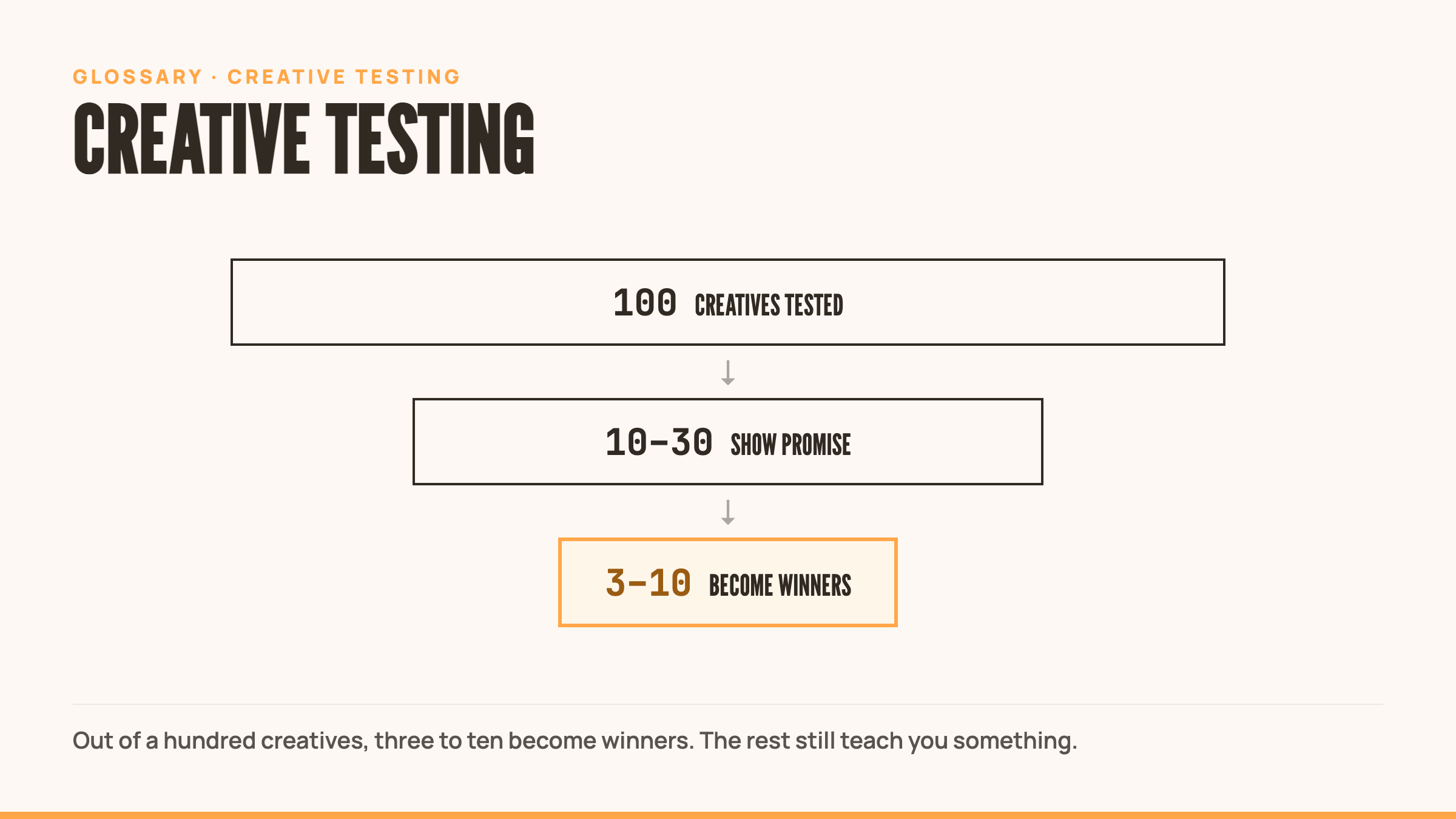
Quick Definition: The systematic process of running multiple ad creative variations against each other to identify which drives the best performance metrics (installs, engagement, ROAS). The reality: most tests fail. The winners pay for everything.
What is Creative Testing?
Creative testing is the process of evaluating different ad creative variations to find the concepts that outperform your current benchmarks. In mobile game user acquisition, this means testing videos, playables, static images, and copy combinations to discover which drives the highest install rates and player value.
The goal is simple: craft ads that beat your existing “control” creative. That winning ad becomes the new benchmark. Then you test again.
But creative testing in mobile isn’t like testing web landing pages. You have 1.7 seconds to win attention in a feed. Your creative either hooks or dies. Most die.
Testing reveals what works before you spend serious budget scaling it. In ML-driven UA, networks like AppLovin and Unity need massive creative volume and diversity to find the audiences that convert. Creative testing feeds that machine with validated concepts worth scaling.
The hard truth: most creative ideas fail. Testing is how you find the rare ones that win. Those winners can carry entire campaigns and make the difference between profitable growth and burning budget.
Why Creative Testing Matters for Mobile Games
Creative fatigue kills UA performance. What worked last month stops working this month. Networks exhaust audiences. Players get blind to the same hooks.
Creative testing is the only systematic answer to fatigue. You need a constant flow of new, diverse concepts to replace dying winners. Modern creative analysis identifies those concepts before they scale.
The stakes are high. One winning playable can drive millions in profitable installs. One bad creative scaled too fast can burn through budget in days. Testing separates the two.
In the ML era, networks optimize delivery, but they can’t create winning concepts for you. That’s your job. Testing is how you discover what resonates before the algorithm spends your money proving it doesn’t.
Mobile game studios that win at UA treat creative testing as a core competency, not an afterthought. They build processes to test fast, test often, and test boldly.
Key Metrics for Creative Testing
IPM (Installs Per Mille)
The essential KPI for UA managers. Measures how many installs your creative drives per 1,000 impressions. Higher IPM means your creative hooks players and converts them efficiently. This is the primary signal that separates winners from losers.
CTR (Click-Through Rate)
Percentage of viewers who tap your ad. High CTR means your hook works. But CTR alone lies. Players might click but not install. Always pair CTR with conversion metrics.
CVR (Conversion Rate)
Percentage of clicks that become installs. Reveals whether your creative attracts the right players. Low CVR despite high CTR means you’re hooking the wrong audience or misleading them.
CPI (Cost Per Install)
What you pay per install. Lower CPI means your creative acquires players efficiently. But cheap installs don’t always mean valuable players. Pair CPI with retention and LTV metrics.
ROAS (Return on Ad Spend)
The ultimate test. Revenue generated divided by ad spend. A creative can have great IPM but terrible ROAS if it attracts non-payers. Winners drive both volume and value.
Creative Testing Best Practices
Test one variable at a time. Change the imagery or change the CTA. Not both. Otherwise you can’t know what drove the performance shift. Isolate variables to learn what actually works.
Prioritize imagery over copy. Imagery changes typically drive more performance impact than CTA or copy changes. Your visual hook matters more than your words. Test bold visual concepts first.
Separate test campaigns from BAU campaigns. Don’t disrupt your main campaign algorithms by injecting random test creatives. Run dedicated test campaigns with controlled budgets. Protect your performing campaigns from noise.
Build on winners, not opinions. When a creative wins, dissect why. What hook worked? What gameplay did it show? Design your next test creatives from the highest-performing elements, not from what the team thinks will work.
Test in real environments. Winning in an A/B test in New Zealand means almost nothing for global BAU performance. Test where you’ll actually run the campaigns. Networks, audiences, and behaviors differ.
Accept the failure rate. Most tests fail. That’s the game. Budget for it. Build processes that make failures cheap and fast so you can test more ideas and find the rare winners.
Track learning, not just winners. Failed tests reveal what doesn’t work. Document patterns. “Fantasy themes underperform puzzle themes” is valuable even when both concepts lose. Build institutional knowledge.
Exploit vs Explore Framework
Sett approaches creative testing through two parallel tracks:
Exploit Track: Efficiently search for new ways to take a winning concept and create variations that convey the same underlying experience in innovative ways. Exploit creatives let ad networks find additional audience pockets for proven concepts. Safe but limited upside.
Explore Track: Test wildly different and bold concepts. This is where breakthroughs happen. Take your match-3 game and test adding mini-games inside the playable. Try completely different visual styles. Explore is risky. Most concepts fail. But the rare winners redefine your creative performance.
Major Explore winners are rare and come after many failed experiments. When one lands, it often carries campaigns for months.
The Machine teams invest in both tracks simultaneously. Exploit keeps performance steady. Explore hunts for the next breakthrough. Both matter.
Common Mistakes
Testing too few variations. With most concepts failing, five ideas rarely surface a winner. You need volume to beat the odds.
Stopping winners too early. A creative wins your test, so you kill it and move on. Wrong. Scale the winner until it fatigues. Exploit it fully before retiring it.
Adding test creatives to BAU campaigns. This disrupts the network’s optimization. Your performing campaigns suffer. Always isolate tests.
Trusting geo-specific test results. What wins in one country often flops in another. Test where you’ll scale.
Betting on opinions over data. Your team thinks a concept will win. The data says it won’t. Trust the data. Opinions don’t predict hits.
Ignoring creative fatigue. A winning creative eventually fatigues. Performance drops. Plan for it. Have new tests ready to replace dying winners before they crash.
Not documenting learnings. Teams lose institutional knowledge when people leave. Document what you learn from every test. Build a knowledge base of what works for your game.
Related Terms
- Creative Fatigue – The performance decline that happens when audiences see the same creative too many times
- IPM (Installs Per Mille) – The core metric measuring ad creative effectiveness
- ROAS (Return on Ad Spend) – The ultimate performance metric combining efficiency and revenue
- Playable Ads – Interactive ad formats that let players experience gameplay before installing
External Resources
- AppsFlyer: Creative Testing Guide
- AppAgent: How to Read Mobile Ad Creative Performance Data
- LifeStreet: Creative Testing Best Practices
Frequently Asked Questions
What does creative testing look like on Meta ads?
Same principles apply as anywhere else: isolate one variable per test, run dedicated test campaigns separate from BAU spend, and let the data pick the winner instead of team opinion.
How many creative variations should I test at once?
Start with 5-10 if you’re new to testing. Teams running mature programs test 20+ variations simultaneously across exploit and explore tracks.
How long should I run a creative test?
Until you hit statistical significance, which for most mobile games means thousands of impressions per variation minimum. Stopping early leads to false conclusions.
How do I know when to retire a winning creative?
Watch IPM and CPI trends. When performance drops 20-30% from peak and doesn’t recover after a few days, the creative is fatigued. Have a replacement ready to swap in.