

glossary
SDK (Software Development Kit)
Quick Definition: A toolkit that connects your app to third-party services like ad networks, analytics platforms, or payment systems. In mobile gaming, SDKs handle everything from serving ads to tracking installs to mediating between multiple ad networks. — 01. What is an SDK An SDK is a package of code, libraries, and documentation that lets […]
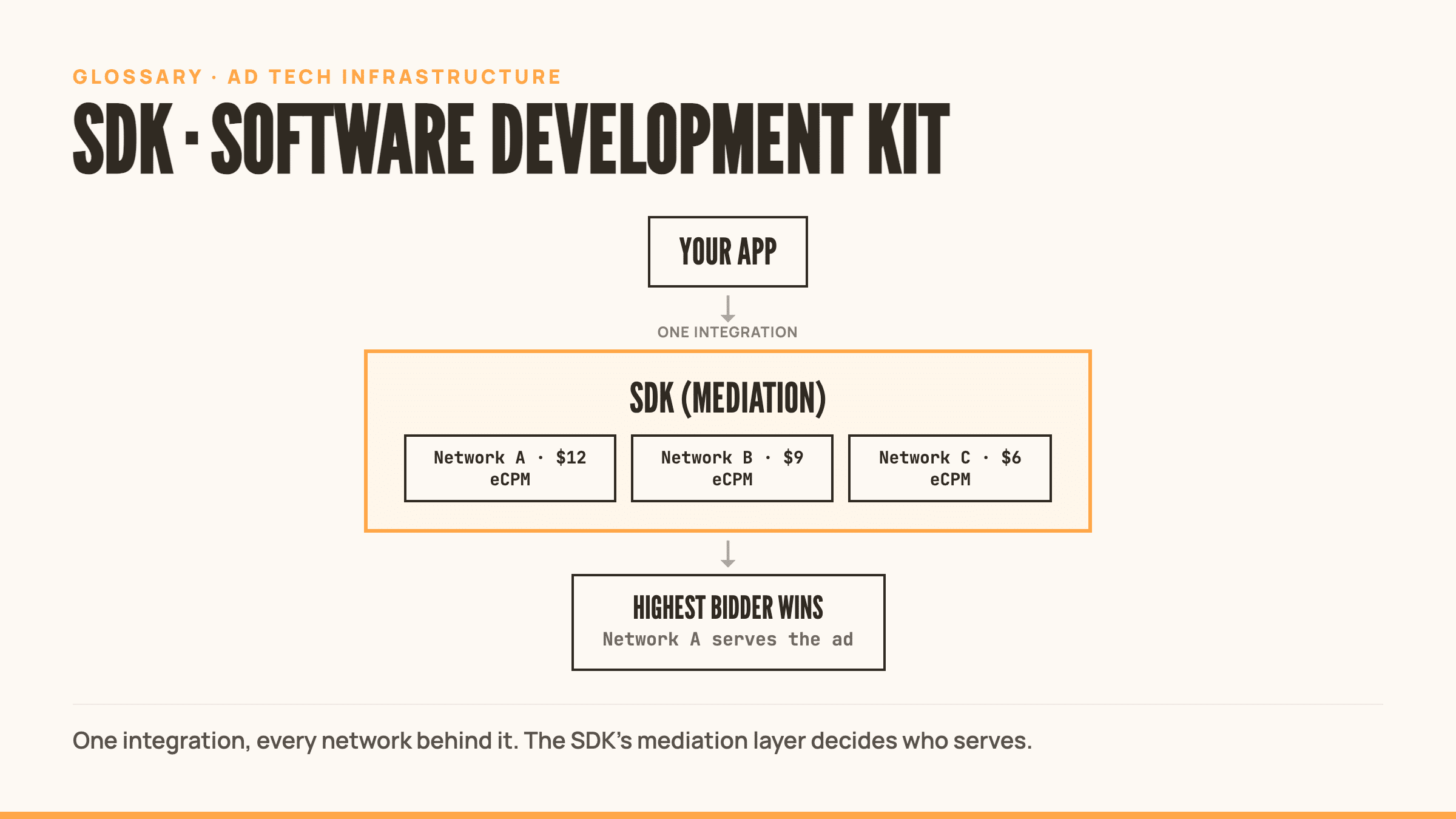
Quick Definition: A toolkit that connects your app to third-party services like ad networks, analytics platforms, or payment systems. In mobile gaming, SDKs handle everything from serving ads to tracking installs to mediating between multiple ad networks.
What is an SDK
An SDK is a package of code, libraries, and documentation that lets developers integrate external services without building from scratch.
For mobile game monetization and UA, SDKs do the heavy lifting. They connect your app to ad networks, handle bidding logic, manage creative delivery, and track performance.
You integrate the SDK once. It handles the rest. The IAB provides technical standards for how mobile ad SDKs should operate.
Types of Ad SDKs
Ad Network SDK
Direct connection to a single ad network (Google AdMob, Unity Ads, AppLovin). You integrate their SDK, you show their ads, you get paid.
Simple. But limited to one network’s demand.
Mediation SDK
Sits between your app and multiple ad networks. Manages bidding, prioritizes networks by eCPM, maximizes fill rates. One SDK, many demand sources.
Examples: AppLovin MAX, Google AdMob Mediation, Unity LevelPlay (formerly ironSource).
Server-Side Bidding SDK
Runs auctions on the server side instead of in-app. Faster, less device overhead, better privacy compliance.
Growing fast in the cookie-free era.
Common SDK Providers
| Provider | Market Share | Primary Use | |———-|————–|————-| | Google AdMob | ~86% | Display, video, banner ads | | Unity Ads | ~20% | Gaming-first video ads | | AppLovin MAX | ~17% | Mediation, in-app bidding |
Share of Android apps using ad network SDKs, per 42matters’ SDK analysis. These numbers overlap because most apps run multiple SDKs through mediation, and they shift over time as the data updates.
SDKs power the entire mobile ad economy, connecting billions in ad spend to billions of app sessions. Unity Ads provides comprehensive SDK documentation for game developers.
Integration Best Practices
Start with mediation. Single ad network means one network down kills your revenue. Mediation spreads risk and maximizes fill.
Test on real devices. Simulators lie. SDKs interact with hardware, OS permissions, and network conditions differently than dev environments.
Monitor SDK overhead. Every SDK adds weight. Track app size, startup time, and battery drain. Users notice bloat.
Version control matters. SDK updates can break integrations. Test updates in staging before pushing to production.
Respect privacy laws. GDPR, CCPA, ATT. SDKs collect data. Make sure yours comply.
Common Mistakes
Integrating too many SDKs. More isn’t better. Each SDK increases crash risk and app size. Pick the ones that deliver.
Ignoring user experience. Interstitial ads every 30 seconds destroy retention. Balance monetization with playability.
Skipping test builds. SDK conflicts are real. Test every integration before launch.
Not updating SDKs. Old SDKs = missed features, security holes, and lower eCPMs. Keep them current.
Hardcoding network priorities. What works today won’t work next month. Use dynamic mediation that adapts to real-time performance.
Related Terms
- Mediation – Layer that manages multiple ad networks
- eCPM – Effective cost per thousand impressions
- Fill Rate – Percentage of ad requests that return an ad
- Waterfall – Sequential ad serving based on fixed priorities
- Header Bidding – Real-time auction where networks bid simultaneously
External Resources
- PubMatic: Cheat Sheet on SDKs
- Freestar: What is an SDK and Why They Matter in Ad Tech
- Gourmet Ads: What is an Ad SDK
Frequently Asked Questions
What is an SDK vs API?
An API is a set of endpoints you call directly. An SDK is a package of code, docs, and tools that wraps those APIs and makes integration easier. Most mobile ad SDKs bundle multiple APIs into one toolkit.
What does an SDK mean?
SDK stands for Software Development Kit, a package of code and libraries that lets developers integrate an external service without building it from scratch. In mobile gaming, ad SDKs handle everything from serving ads to tracking installs.
What are the most popular ad SDKs?
Google AdMob, Unity Ads, and AppLovin MAX lead mobile ad SDK market share. Most apps run several through mediation rather than relying on a single network’s demand.
How many SDKs should I integrate?
Start with one mediation SDK, then add network SDKs through the mediator. Most games run 3-5 networks total. More isn’t better since each SDK adds crash risk and app size.