

glossary
Interstitial Ads
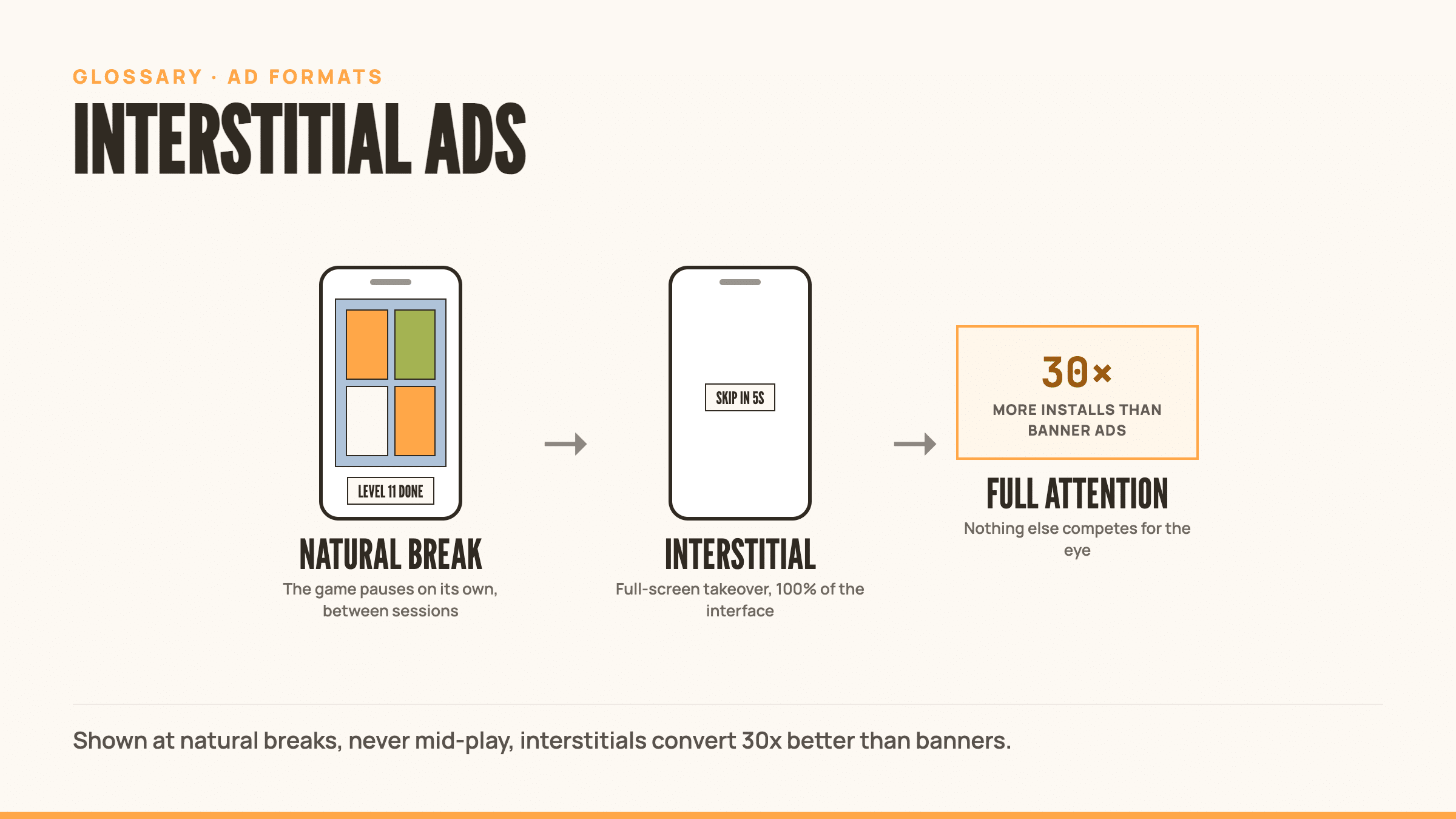
Full-screen ads that appear at natural transition points in mobile games. They cover 100% of the app interface during breaks between gameplay sessions.
Quick Definition
Full-screen ads that appear at natural transition points in mobile games. They cover 100% of the app interface during breaks between gameplay sessions.
What are Interstitial Ads
Interstitial ads takeover the entire screen when players pause, complete levels, or move between game sections. They show up where gameplay naturally stops.
57% of mobile game publishers use interstitials. That number jumps to 63% for casual and hyper-casual games, while hardcore and mid-core studios sit at 47% (based on older DeltaDNA/Smaato industry survey data — adoption has likely shifted since, but the pattern of casual games leaning harder on interstitials still holds).
These ads work because they don’t interrupt active gameplay. A player finishes level 10, sees a full-screen ad, then moves to level 11. The flow feels natural. The conversion rate proves it: interstitials drive 30x more installs than banner ads.
The format has evolved beyond static images. Video dominates, accounting for 76% of all interstitial ads served. Playable ads are growing fast too — top-grossing games spent 35% more on playables than other formats in 2024, per Liftoff’s 2025 Mobile Ad Creative Index, as studios chase higher engagement rates.
Types of Interstitials
Static Image The simplest format. A single full-screen image with a call-to-action. Fast to load, easy to skip. Lower engagement but minimal impact on load times.
Video The workhorse. 76% of interstitial ads use video. 15-30 seconds of gameplay footage, features, or branded content. Higher engagement than static, stronger conversion rates.
Playable The rising star. Mini-games that let users test the advertised app before installing. Adoption grew sharply in 2024 as top-grossing games shifted spend toward the format. Takes longer to create — though modern creative generation pipelines are closing that gap — but it delivers qualified installs.
Rich Media Interactive ads with animations, swipeable galleries, or expandable elements. More engaging than static, less resource-intensive than playables. Good middle ground.
Best Practices
Timing Show interstitials at natural pauses. Between levels. After game sessions. During voluntary breaks. Never mid-gameplay.
Frequency Cap at once per hour during active sessions. Limit to 6 per week for casual players. More than that and retention drops.
New User Grace Period Wait 1-2 weeks before showing interstitials to new players. Let them get hooked first. Early monetization kills retention faster than anything else.
Exit Options Always include a clear, visible exit button. Make it easy to skip. Forced viewing pisses off players and tanks session length.
Load Times Pre-cache ads when possible. Nobody waits 5 seconds for an ad to load. They just close the app.
Performance Benchmarks
CPM has climbed steadily in recent years, landing around $4.80 globally by 2024.
eCPM by Region (Q4 2024):
United States leads globally, per Appodeal’s eCPM benchmark report:
- iOS: $14.32
- Android: $14.08
The US market pays premium rates because advertiser demand stays high. Other tier-1 markets (UK, Canada, Australia) typically range $8-10 eCPM.
Emerging markets see lower rates but higher fill rates. The volume play can work if retention holds.
Common Mistakes
Too Frequent Bombarding users kills retention faster than it makes money. Sharp increases in interstitial frequency without testing the retention impact are a common way studios torch their own D7 numbers.
Wrong Timing Mid-level ads destroy flow. Players rage-quit when ads interrupt gameplay. Only show during natural breaks.
No Grace Period Hitting new users with ads in their first session tanks conversion. Let them play first, monetize later.
Poor Load Performance Slow-loading ads create dead air. Players close apps rather than wait. Pre-cache or risk losing sessions.
Ignoring Frequency Data Not all players tolerate the same ad load. Power users (high session frequency) can handle more. Casual players (low frequency) need gentler treatment.
Related Terms
- Rewarded Video Ads – Voluntary ads that give in-game rewards
- Banner Ads – Persistent ads at screen edges
- Playable Ads – Interactive mini-game ad format
- eCPM – Effective cost per thousand impressions
- Ad Mediation – Platform managing multiple ad networks
- Fill Rate – Percentage of ad requests successfully filled
External Resources
- Udonis – Complete Guide to Interstitial Ads
- Business of Apps – Interstitial Ad Guide
- Game Biz Consulting – Interstitial Ads Best Practices
Frequently Asked Questions
What is an interstitial in advertising?
A full-screen ad that takes over 100% of the app interface at a natural transition point, like when a player finishes a level or moves between game sections.
What is an example of an interstitial ad?
A player finishes level 10, sees a full-screen video or static ad, then moves to level 11. The flow feels natural because it fills a pause that was already happening.
How much do interstitial ads pay?
eCPM varies by region. US traffic runs $14.32 (iOS) and $14.08 (Android). Other tier-1 markets like the UK, Canada, and Australia run $8-10. The global average sits around $4.80.
What are interstitial ads in games specifically?
57% of mobile game publishers use them, rising to 63% for casual and hyper-casual titles. They show at level breaks and session transitions, never mid-gameplay.