

glossary
Video Ads (Mobile)
Quick Definition: Short video creatives (typically 15-30 seconds) that run across mobile apps and websites to drive user acquisition and engagement. 01. What Are Mobile Video Ads? Mobile video ads are pre-recorded video creatives designed for mobile screens. They run in apps, mobile games, and mobile websites to capture attention and drive installs. The format […]
Quick Definition: Video ads are short video creatives (typically 15-30 seconds) that run across mobile apps and websites to drive user acquisition and engagement.
What Are Mobile Video Ads?
Mobile video ads are pre-recorded video creatives designed for mobile screens. They run in apps, mobile games, and mobile websites to capture attention and drive installs.
The format has been a UA staple for years. A well-crafted video ad tells a story, shows gameplay, or creates desire in seconds. But there’s a catch: video ads are passive. Users watch them happen. They don’t interact, don’t explore, don’t make choices.
That’s where the performance ceiling lives.
Video ads work when you nail the first three seconds, communicate value fast, and drive users toward a clear action. They struggle when creative fatigue sets in, when audience saturation hits, or when your 47th iteration of the same hero character fails to move the needle.
The problem compounds in mobile gaming UA. You’re competing for attention in a feed, against rewarded video placements, and inside apps where users came to do something else. Your video needs to interrupt that flow and make them care.
Production is straightforward compared to playables. Render gameplay footage, add text overlays, include a CTA. But distribution scale creates volume demands that strain creative teams. One winning video doesn’t stay winning. You need variants, refreshes, and entirely new concepts to fight fatigue, the kind of throughput agentic creative generation is built to sustain.
Video ads remain a critical part of the UA mix. But their passive nature means they discover interest less effectively than interactive formats. You’re showing, not letting users experience.
Types of Mobile Video Ads
Rewarded Video Users choose to watch in exchange for in-app rewards (coins, lives, power-ups). High completion rates because users opt in. Common in free-to-play games where the reward creates positive association with your ad.
Interstitial Video Full-screen ads appearing at natural transition points (between levels, after rounds). Users didn’t choose to watch, so the first three seconds matter more. Skip rates can be brutal if you don’t hook immediately.
In-Stream Video Pre-roll, mid-roll, or post-roll video within other video content. Less common in mobile gaming UA, more relevant for apps with video content feeds.
Out-Stream Video Video ads within non-video environments (article feeds, social streams). Auto-play on mute until users engage. Requires visual storytelling that works without sound.
Vertical Video Portrait-oriented video optimized for how users hold their phones. Became critical after Stories formats proved users don’t rotate devices. Your creative needs to own the full screen in portrait mode.
Key Specifications
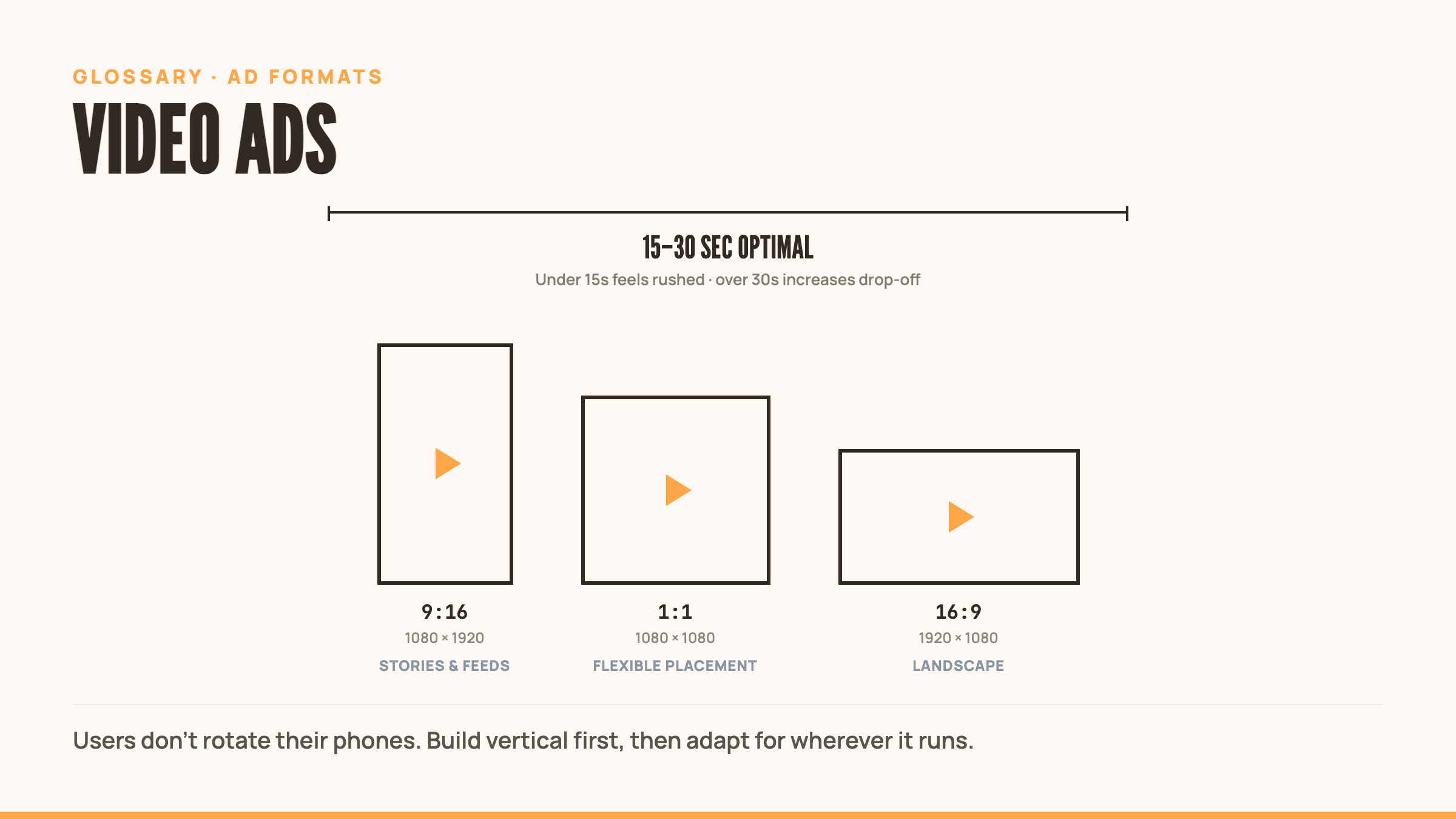
Duration: 15-30 seconds optimal. Under 15 feels rushed. Over 30 increases drop-off.
File Size: Keep under 2MB for fast loading. Heavy files delay impression delivery and hurt performance.
Format: MP4 (H.264 codec) is standard. MOV works but creates compatibility issues on some networks.
Resolution: 1080×1920 for vertical (9:16), 1920×1080 for horizontal (16:9), 1080×1080 for square (1:1).
Aspect Ratios: Vertical (9:16) for Stories and feeds, horizontal (16:9) for landscape placements, square (1:1) for flexible placement.
Frame Rate: 30fps standard. Higher frame rates increase file size without meaningful performance lift.
Audio: Include it, but design video to work without it. Most placements auto-play on mute.
Video Ads vs Playable Ads
Video ads show your game. Playable ads let users experience it.
Video Ads:
- Passive viewing experience
- Fast to produce at scale
- Limited interaction data (completion rate, click-through)
- Creative fatigue sets in faster
- Lower signal on user intent
Playable Ads:
- Active, hands-on experience
- More complex production
- Rich interaction data (exploration paths, engagement patterns)
- Longer shelf life per creative
- Higher signal on qualified interest
Video ads work for top-of-funnel awareness and broad reach. Playables filter for users who engage and explore. You need both in your UA mix, but they solve different problems.
The real question: Are you using video because it works, or because it’s easier to produce than playables? If it’s the latter, you’re leaving performance on the table. Modern playable ad platforms have closed much of that production gap.
Best Practices
Hook in three seconds. Users decide to keep watching or skip in the first moments. Lead with your strongest visual or value proposition.
Design for sound-off. Most placements auto-play muted. Text overlays, visual storytelling, and clear imagery carry the message.
Show actual gameplay. Misleading video ads tank post-install retention. Users who install expecting one experience and get another churn immediately.
Test vertical formats. Portrait video fits how users hold phones. Stop forcing users to rotate devices for horizontal video.
Refresh creative frequently. Video ads fatigue faster than interactive formats. Plan for regular iteration and new variants.
Track completion rates. High drop-off tells you where users lose interest. Optimize based on where they bail.
Match video pacing to game pace. Fast-paced action games need quick cuts and energy. Strategy games can breathe and show depth.
Clear CTA. Users need to know what happens when they tap. “Download Now,” “Play Free,” “Install.” Be explicit.
Common Mistakes
Generic gameplay montages. Showing random gameplay moments without narrative or hook. Users scroll past because nothing stands out.
Misleading creative. Showing gameplay that doesn’t exist in your game. Drives installs but destroys retention and inflates CPI through churn.
Ignoring the first frame. The thumbnail or first frame determines whether users engage. Treat it like a poster for your 20-second film.
Sound-dependent storytelling. Building your message around voiceover or music that users won’t hear because the video auto-plays muted.
One-size-fits-all aspect ratios. Running horizontal video in vertical placements. Wastes screen real estate and looks amateur.
No variation strategy. Running the same video until performance dies, then scrambling to produce new creative. Fatigue is predictable. Plan for it.
Overproduced cinematics. Spending budget on Hollywood-style production that doesn’t reflect actual gameplay. Users feel baited.
Weak CTAs. Ending videos without clear direction. Users watch, feel interested, but don’t know what action to take.
Related Terms
- Playable Ads – Interactive ad format where users experience gameplay
- Rewarded Video – Video ads offering in-app rewards for completion
- Interstitial Ads – Full-screen ads at natural app transition points
- Creative Fatigue – Performance decline as audiences see the same creative repeatedly
- ROAS – Return on Ad Spend, measuring revenue generated per dollar spent
External Resources
- Video Advertising Basics – Adobe’s guide to video advertising fundamentals
- IAB Digital Video Glossary – Industry standard terminology and definitions
- Video Advertising Guide – SendPulse overview of video ad formats
Frequently Asked Questions
What is a video ad?
A pre-recorded video creative, typically 15-30 seconds, that runs before, during, or within apps and mobile content to drive installs. In mobile gaming UA, video ads show gameplay or create desire fast, but the viewing experience stays passive, unlike interactive or playable formats.
How long should mobile video ads be?
15-30 seconds is the sweet spot. Under 15 feels rushed and struggles to communicate value. Over 30 seconds increases drop-off as attention fades.
Do users actually watch video ads with sound?
Most don’t. Auto-play placements default to mute. Design your video to work without audio: text overlays and visual storytelling should carry the message, with sound as enhancement, not requirement.
What’s the difference between rewarded and interstitial video ads?
Rewarded video requires the user to opt in, watching in exchange for an in-app reward, which drives high completion rates. Interstitial video interrupts at a transition point without asking, so the first three seconds have to work much harder to hold attention.
What makes a video ad better than a playable ad?
Video ads are faster to produce and easier to scale, which makes them strong for top-of-funnel awareness. Playable ads take more production effort but generate richer engagement data and filter for higher-intent users. Most UA mixes need both, aimed at different jobs.