

glossary
Ad Mediation
Ad mediation is a system that lets you work with multiple ad networks through a single SDK integration. Instead of integrating each ad network separately, you plug into one mediation platform that manages them all.
One SDK. Multiple ad networks. Maximum revenue.
Quick Definition
Ad mediation is a system that lets you work with multiple ad networks through a single SDK integration. Instead of integrating each ad network separately, you plug into one mediation platform that manages them all.
The result: simplified integration, better fill rates, and optimized revenue from every ad placement.
What is Ad Mediation
Ad mediation platforms sit between your game and ad networks. They manage requests, prioritize networks, and handle the auction logic that decides which network gets to serve each ad.
Without mediation, you’d need:
- Separate SDK integration for each network
- Manual management of each network’s settings
- Custom logic to decide which network serves which ad
- Individual reporting dashboards for each network
With mediation, you get:
- Single SDK integration
- Automated network prioritization
- Unified reporting across all networks
- Centralized optimization controls
Mobile in-game advertising has grown into a multi-billion dollar category, though market-size estimates vary widely by research firm and definition. Ad mediation is how successful studios capture their share. AppLovin MAX became an industry leader in mobile ad mediation.
How It Works
Your game makes an ad request. The mediation platform receives it and decides which ad network gets the opportunity to fill it.
The decision happens through one of three methods: waterfall, bidding, or hybrid. Each determines network priority differently.
Once a network wins, it serves the ad. The mediation platform tracks impressions, revenue, and performance. All data flows into a single dashboard.
Mediation Methods
Waterfall
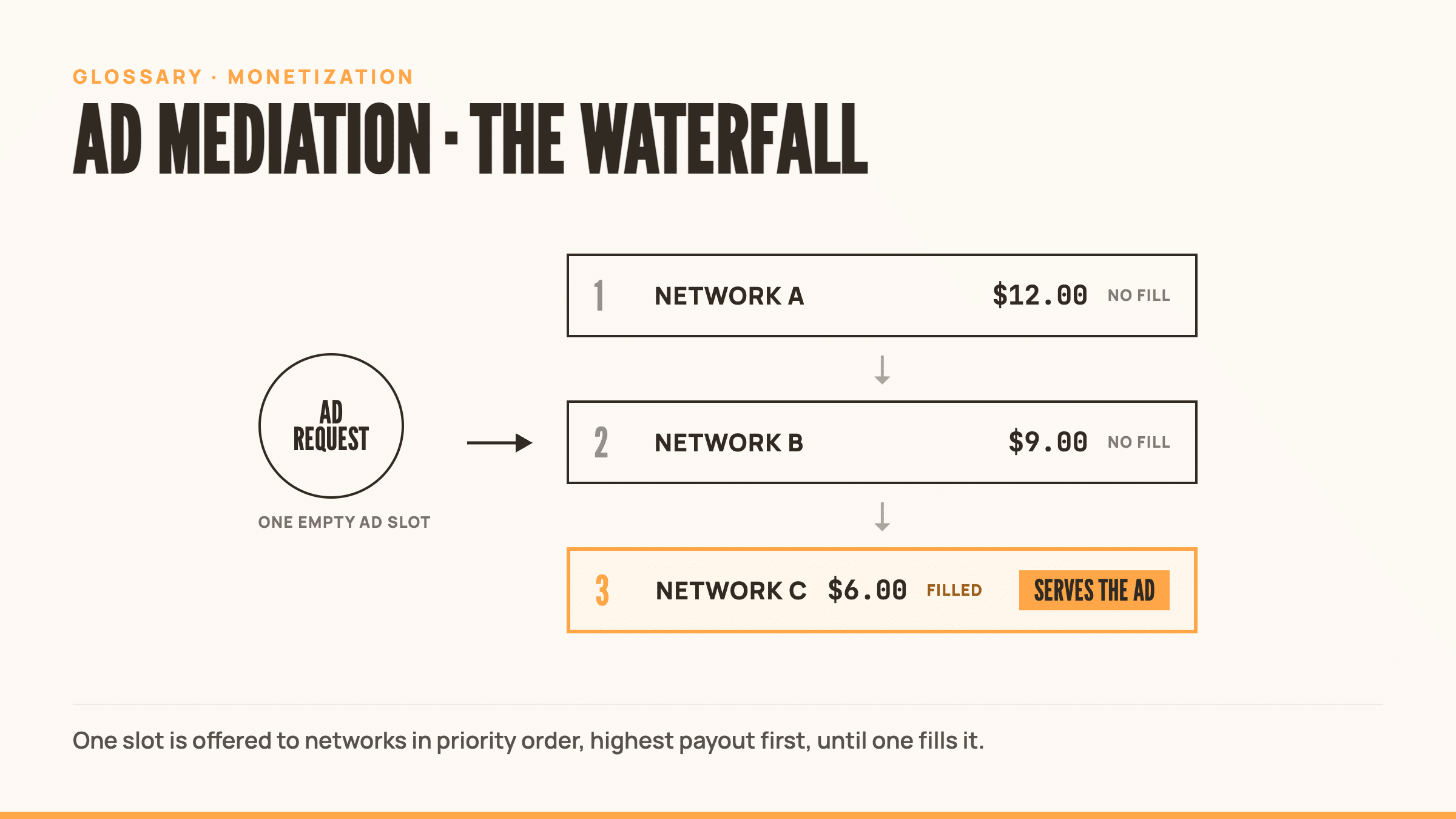
Networks are arranged in a priority sequence based on historical eCPM. The top network gets first shot at filling the request. If it passes, the next network in line gets the opportunity.
How it works:
- Request goes to highest-priority network
- Network fills or passes within timeout period
- If pass, request moves down the waterfall
- First network to fill wins
Limitation: Historical eCPM means yesterday’s data drives today’s decisions. A network could pay more right now, but the waterfall will never know because it already sent the request elsewhere.
Bidding (Header Bidding)
Networks compete in real-time for every impression. All networks submit bids simultaneously. Highest bid wins.
How it works:
- Request goes to all networks at once
- Networks submit bids in real-time
- Highest bidder wins
- Ad serves immediately
Advantage: Every impression goes to whoever values it most right now. No guessing based on historical averages.
Google transitioned to bidding-only in January 2024. The industry is moving this direction. ironSource (now Unity) was an early mover in in-app bidding: its LevelPlay platform launched as the first in-app bidding solution open to all developers, without DAU minimums or pre-approval.
Hybrid
Combines waterfall and bidding. Some networks participate in real-time bidding. Others sit in the waterfall at fixed eCPM levels.
Why hybrid? Not all networks support bidding yet. A hybrid setup lets you run bidding where possible and waterfall as fallback.
Most mediation platforms now support all three methods.
Key Benefits
Simplified Integration
One SDK instead of five. One implementation instead of managing multiple network integrations. Development time drops from weeks to days.
Increased Revenue
Competition between networks drives higher CPMs. Proper optimization can lift eCPM meaningfully without changing your ad placements, though the exact gain depends on your networks, geography, and ad formats. The IAB Tech Lab’s MRAID standard lets rich-media ad creative render consistently across any MRAID-compliant SDK, which keeps ad quality steady as mediation shifts traffic between networks.
Better Control
Unified dashboard for all networks. Adjust settings, analyze performance, and optimize without jumping between platforms.
Risk Diversification
Multiple networks mean less dependency on any single source. If one network has issues, others fill the gap.
Centralized Reporting
eCPM, fill rate, ARPDAU, and revenue all in one place. Track performance across networks without spreadsheet gymnastics.
Optimization Best Practices
Track the Right Metrics
- eCPM (effective cost per mille): Revenue per 1,000 impressions
- ARPDAU (average revenue per daily active user): Revenue divided by DAU
Analyze both daily. eCPM shows network performance. ARPDAU shows overall monetization health.
Test Network Configurations
A/B test waterfall order, bidding floors, and network inclusion. What worked last month might not work today.
Set Bidding Floors Strategically
Too high and you lose fill rate. Too low and you leave money on the table. Test increments of $0.50 to find the sweet spot.
Monitor Fill Rates
High eCPM means nothing if your fill rate is 40%. Balance eCPM against fill to maximize total revenue.
Review Network Performance Weekly
Networks fluctuate. The top performer last week might be bottom tier this week. Regular reviews catch shifts early.
Segment by Geography
Different regions have different ad market dynamics. Optimize waterfall and bidding floors per region for maximum yield.
Common Mistakes
Setting it and forgetting it: Ad markets change constantly. Static configurations lose money.
Optimizing for eCPM alone: High eCPM with low fill rate = less revenue than moderate eCPM with high fill.
Not testing bidding floors: Default floors are rarely optimal. Test to find your maximum yield point.
Ignoring regional differences: North America and Southeast Asia have completely different ad market dynamics. Treating them the same costs revenue.
Over-prioritizing one network: Even if one network performs great, diversification protects against sudden policy changes or account issues.
Related Terms
- eCPM – Effective cost per thousand impressions
- ARPDAU – Average revenue per daily active user
- Fill Rate – Percentage of ad requests successfully filled
- Ad Network – Platform that connects advertisers with publishers
- RTB (Real-Time Bidding) – Auction model where ad impressions are bought/sold in real-time
- Programmatic Advertising – Automated buying and selling of ad inventory
External Resources
- What is Mobile Ad Mediation – Game Biz Consulting
- Mobile Ad Mediation for Game Monetization – Xenoss
- Top Ad Mediation Platforms – Udonis Blog
Frequently Asked Questions
What does ad mediation mean?
Ad mediation is a system that lets you work with multiple ad networks through a single SDK integration instead of integrating each network separately. The mediation platform manages requests, prioritizes networks, and runs the auction logic that decides which network fills each ad.
What’s the difference between ad mediation and an ad network?
Ad networks provide the actual ad inventory advertisers pay for. Ad mediation sits on top of multiple ad networks and manages them through one integration, deciding which network gets each impression. You use mediation to optimize across networks, not as a replacement for them.
Should I use waterfall or bidding?
Bidding generates higher revenue in most cases because networks compete in real time for every impression instead of relying on historical eCPM. If some of your networks don’t support bidding yet, a hybrid setup lets you run bidding where possible and waterfall as fallback.
How many ad networks should I integrate?
Start with 3-5 major networks. More networks add complexity without always adding more revenue. Diversification protects you if one network has issues, but over-integrating spreads your optimization effort thin.
What eCPM increase can I expect from optimization?
Properly optimized mediation can deliver roughly 10-15% eCPM increases. Results vary by game genre, geography, and ad placement strategy, so treat that range as a planning benchmark, not a guarantee.