
glossary
Hybrid Casual Games
Quick Definition: Mobile games that start with hyper-casual simplicity but morph into mid-core depth as you play. Easy to start, hard to put down. — 01. What are Hybrid Casual Games? Hybrid casual games blend two worlds: the instant accessibility of hypercasual with the strategic depth of midcore. You download. You play in seconds. No […]
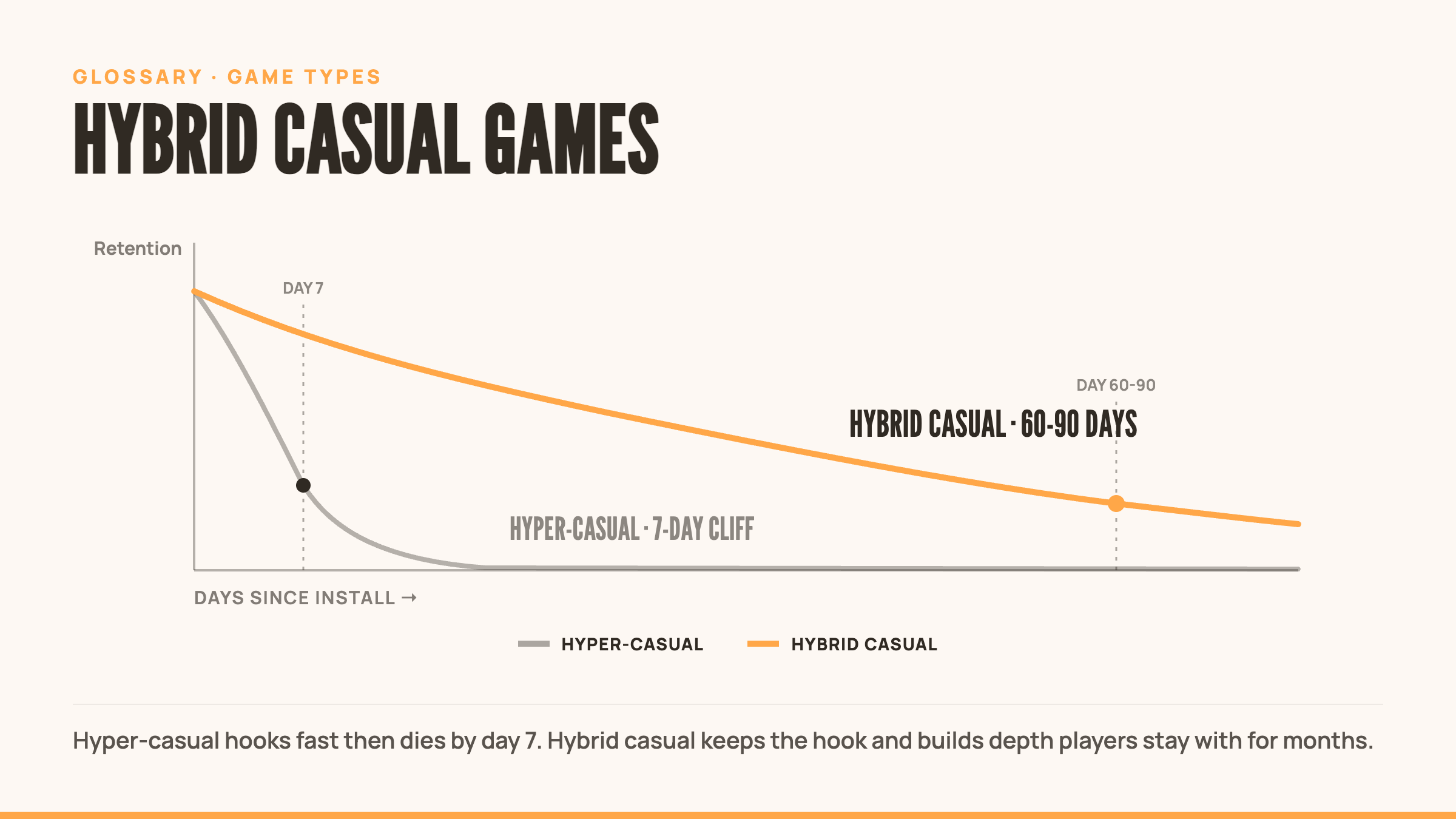
Quick Definition: Mobile games that start with hyper-casual simplicity but morph into mid-core depth as you play. Easy to start, hard to put down.
What are Hybrid Casual Games?
Hybrid casual games blend two worlds: the instant accessibility of hypercasual with the strategic depth of midcore.
You download. You play in seconds. No tutorial walls.
Then something shifts. Progression systems emerge. Strategy matters. Complexity builds without overwhelming.
The game grows with you. Sessions get longer. Retention stretches from days to months.
Target retention: 60-90 days. Compare that to hypercasual’s typical 7-day cliff.
Key Characteristics
Accessibility First
Simple core loop. One-finger controls. Zero barriers to entry.
Progressive Depth
- Session 1: Pure reflex, instant gratification
- Session 10: Strategic choices, resource management
- Session 50: Complex builds, competitive play
Hybrid Monetization
IAA (in-app advertising) meets IAP (in-app purchases).
Ads fuel the free experience. Purchases remove friction and unlock depth.
Core Features
- PvP modes for competitive retention
- Elaborate progression systems (upgrades, unlocks, collections)
- Meta-game loops beyond core gameplay
- Social elements (leaderboards, clans, tournaments)
Why They’re Growing
The numbers tell the story.
Global mobile game consumer spend held around $107-110B a year in 2022-2023 (data.ai), roughly flat to slightly declining overall. Hybrid casual’s growth is a share-of-category story, not an overall-market boom.
Hybrid casual revenue jumped 30% in 2023 alone, topping $2.1B, while the broader mobile games market was flat to down.
Why Players Love Them
Easy entry. No commitment. Then the hook sets.
Hyper-casual gets boring. Mid-core feels intimidating. Hybrid casual lives in the sweet spot.
Why Studios Love Them
Better retention than hyper-casual. Broader appeal than mid-core. Dual monetization unlocks higher LTV.
One game serves casual browsers and hardcore grinders.
Monetization Evolution
Old model: Pick a lane. IAA or IAP. Not both.
Hybrid casual: Why choose?
IAA Strategy
Rewarded video ads for progression boosts. Interstitials between sessions. Ads feel like part of the economy.
IAP Strategy
Remove ads. Speed progression. Unlock premium content. Battle passes. Cosmetics.
Players who convert spend more because they’re already invested. 60+ day retention means months of monetization opportunities.
Examples
Archero
Roguelike meets bullet hell. Simple shooting. Deep builds. Randomized progression.
Project Makeover
Match-3 puzzles. Home renovation meta. Story hooks. Simple core, complex wrapper.
Angry Birds 2
Classic physics slingshot. Added progression, clans, competitive modes. Free-to-play pivot to hybrid casual.
Clash Royale
Real-time PvP. Card collection. Easy to learn, competitive depth. Supercell’s hybrid casual masterpiece.
Common Mistakes
Mistake 1: Too Much, Too Fast
Adding mid-core complexity in session one. Players bounce before the hook sets.
Fix: Earn the right to add depth. Let players master basics first.
Mistake 2: Weak Core Loop
No amount of progression fixes boring gameplay. Core loop must stand alone.
Fix: Make session one fun. Everything else is retention insurance.
Mistake 3: Monetization Overload
Aggressive IAA + aggressive IAP = player resentment. Balance matters.
Fix: Let players choose their path. Don’t punish free players. Don’t under-monetize payers.
Mistake 4: Ignoring Either Audience
Casual players quit if it gets too complex. Mid-core players quit if it stays too simple.
Fix: Design two parallel paths. Casual track for browsers. Hardcore track for grinders.
Related Terms
- Hyper-Casual Games: Pure simplicity, instant play, minimal retention
- Mid-Core Games: Strategic depth, session commitment, core gamer audience
- IAA (In-App Advertising): Monetization through ads
- IAP (In-App Purchases): Monetization through direct purchases
- LTV (Lifetime Value): Total revenue per player over their lifecycle
- Retention: How long players keep playing
- Meta-Game: Progression systems beyond core gameplay loop
External Resources
- Hybrid Casual Games Revolutionizing Mobile Gaming in 2024
- The Rise of Hybrid Casual Games – Appier
- The Hybrid Casual Gaming Boom Will Get Hotter in 2024
Frequently Asked Questions
What are hybrid casual games?
Hybrid casual games blend the instant accessibility of hyper-casual with the strategic depth of mid-core. You download and play in seconds with no tutorial walls, then progression systems and strategy build in without overwhelming you. Target retention is 60-90 days, compared to hyper-casual’s typical 7-day cliff.
What’s the difference between hybrid casual and hyper-casual?
Hyper-casual prioritizes instant accessibility, with sessions lasting minutes and retention lasting days. Hybrid casual starts in that same place, then builds: sessions extend, retention stretches to months, and monetization combines ads and purchases instead of relying on ads alone.
Are hybrid casual games more profitable?
Potentially, yes. Longer retention means more monetization opportunities, and dual revenue streams from IAA and IAP increase LTV compared to hyper-casual’s ads-only model. Production costs are higher, though, and marketing has to communicate both accessibility and depth.
How long should the casual phase last before introducing depth?
There’s no fixed rule. Some games introduce depth after 3-5 sessions, others wait for 10 or more. Test with data, watch where players churn, and introduce complexity when engagement peaks, not when it dips.
Can any hyper-casual game become hybrid casual?
No. The core loop has to support depth. Endless runners struggle to add meaningful progression, while puzzle and match-3 games naturally layer complexity and meta-game wrappers. If the core loop is shallow by design, adding systems feels tacked on.
Last updated: December 2025