

glossary
IAA (In-App Advertising)
Quick Definition: Monetization strategy where games make money by showing ads to players instead of (or alongside) selling in-game items. — 01. What is IAA In-app advertising (IAA) turns your players into your revenue stream. Instead of charging for downloads or pushing in-app purchases, you show ads. Players get free gameplay. You get paid when […]
Quick Definition: Monetization strategy where games make money by showing ads to players instead of (or alongside) selling in-game items.
What is IAA
In-app advertising (IAA) turns your players into your revenue stream. Instead of charging for downloads or pushing in-app purchases, you show ads. Players get free gameplay. You get paid when they watch.
Total mobile advertising spend across all app categories hit $402 billion in 2024, an 11% jump from 2023. Mobile game-specific ad revenue is a smaller slice of that total, estimated in the $80-110 billion range. The model works because it removes friction. Players download free, play free, stay free. You monetize their attention.
How IAA Works
Players engage with ads during natural game breaks or in exchange for rewards. Ad networks (Unity, AppLovin, Meta) bid for those ad placements in real-time. You get paid per impression, click, or completed view depending on the format.
The math is simple. More players = more ad views = more revenue. That’s why IAA games prioritize retention and session length over conversion funnels. Keep them playing, keep them watching.
Ad Formats
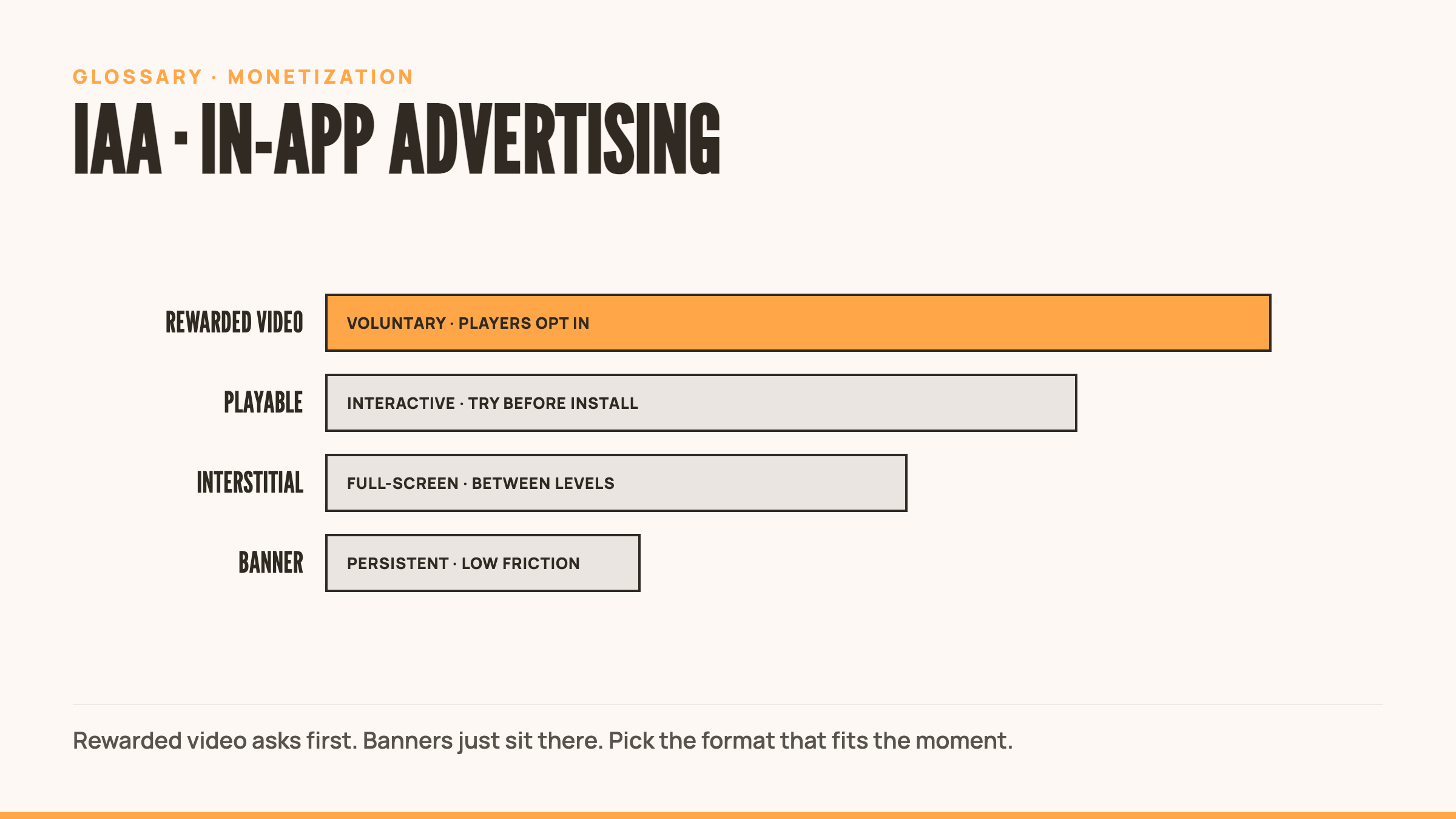
Rewarded Video
Player watches a full ad (15-30 seconds) in exchange for in-game currency, extra lives, or power-ups. High engagement. High eCPM. Best fit for hybrid monetization because it feels like a fair trade.
Interstitial
Full-screen ads between levels or game sessions. High visibility. Can be skippable or non-skippable. Use sparingly or risk killing retention.
Playable Ads
Interactive mini-versions of other games. Players try before they install — see real playable examples across genres. Higher engagement than standard video ads. Lower fill rates.
Banner Ads
Small, persistent ads at the top or bottom of the screen. Low eCPM. Low user friction. Background revenue while players focus on gameplay.
Offerwalls
Lists of tasks players complete (install this app, reach level 5) in exchange for rewards. High monetization potential. Requires active player engagement.
Hybrid Monetization (IAA + IAP)
72% of game makers plan to implement or advance hybrid monetization. That means combining IAA with IAP (in-app purchases). Why? Because different players spend differently.
Some players will never spend money. They’ll watch ads all day. Others hate ads and will pay to remove them or buy premium items. Hybrid lets you monetize both.
Rewarded video is the bridge. Paying players use it to supplement purchases. Non-payers use it as their primary progression mechanic. Everyone stays engaged.
Common Mistakes
Showing too many interstitials. You’ll tank retention faster than you’ll make revenue. Players delete games that interrupt flow.
Ignoring ad quality. Low-quality ads (scammy, misleading, or broken) hurt your game’s reputation. Work with reputable ad networks.
Treating all players the same. Segment by behavior. Don’t blast ads at players who already spend money. Let them play in peace.
Optimizing for eCPM alone. High eCPM means nothing if players churn. Watch retention metrics alongside monetization.
Going all-in on IAA for the wrong genre. Strategy games and RPGs skew toward IAP. Hyper-casual and casual lean IAA. Know your audience.
Related Terms
- IAP (In-App Purchases) – Monetization via selling virtual goods
- eCPM – Effective cost per thousand impressions
- Retention – Percentage of players who return after install
- LTV (Lifetime Value) – Total revenue generated per player over their lifetime
External Resources
- BigAbid: IAA Glossary Entry
- Mistplay: In-App Advertising for Mobile Games
- Mapendo: IAP vs IAA User Acquisition
Frequently Asked Questions
What is an example of in-app advertising?
Rewarded video where a player watches 15-30 seconds for in-game currency, a full-screen interstitial between levels, a playable mini-demo, or a persistent banner ad.
How does in-app advertising work?
Ad networks like Unity, AppLovin, and Meta bid for your ad placements in real time. You get paid per impression, click, or completed view depending on the format.
Is IAA better than IAP?
Neither is universally better. IAA works best for games with high player volume and strong retention. IAP works best for games with engaged players willing to spend. Hybrid captures both.
How many in-app ads is too many?
Watch your retention curves. If Day 1 retention drops after adding ads, you’ve crossed the line. Start conservative and test incrementally.