

glossary
F2P (Free-to-Play)
F2P (Free-to-Play) is a business model where games are free to download and play, with revenue generated through in-app purchases (IAP), advertising, or hybrid monetization strategies.
Quick Definition
F2P (Free-to-Play) is a business model where games are free to download and play, with revenue generated through in-app purchases (IAP), advertising, or hybrid monetization strategies.
What is F2P
Free-to-play games have zero upfront cost. Players download, install, and play without paying a cent.
The catch? The game makes money after they’re hooked. Through cosmetics, battle passes, ads, gacha mechanics, or subscriptions. The entire experience is built around converting free players into paying users, or monetizing attention through ads.
96% of all mobile game downloads were free-to-play in 2025, per Sensor Tower. This model dominates mobile gaming because it removes the biggest barrier: asking someone to pay before they’ve played.
Monetization Strategies
In-App Purchases (IAP)
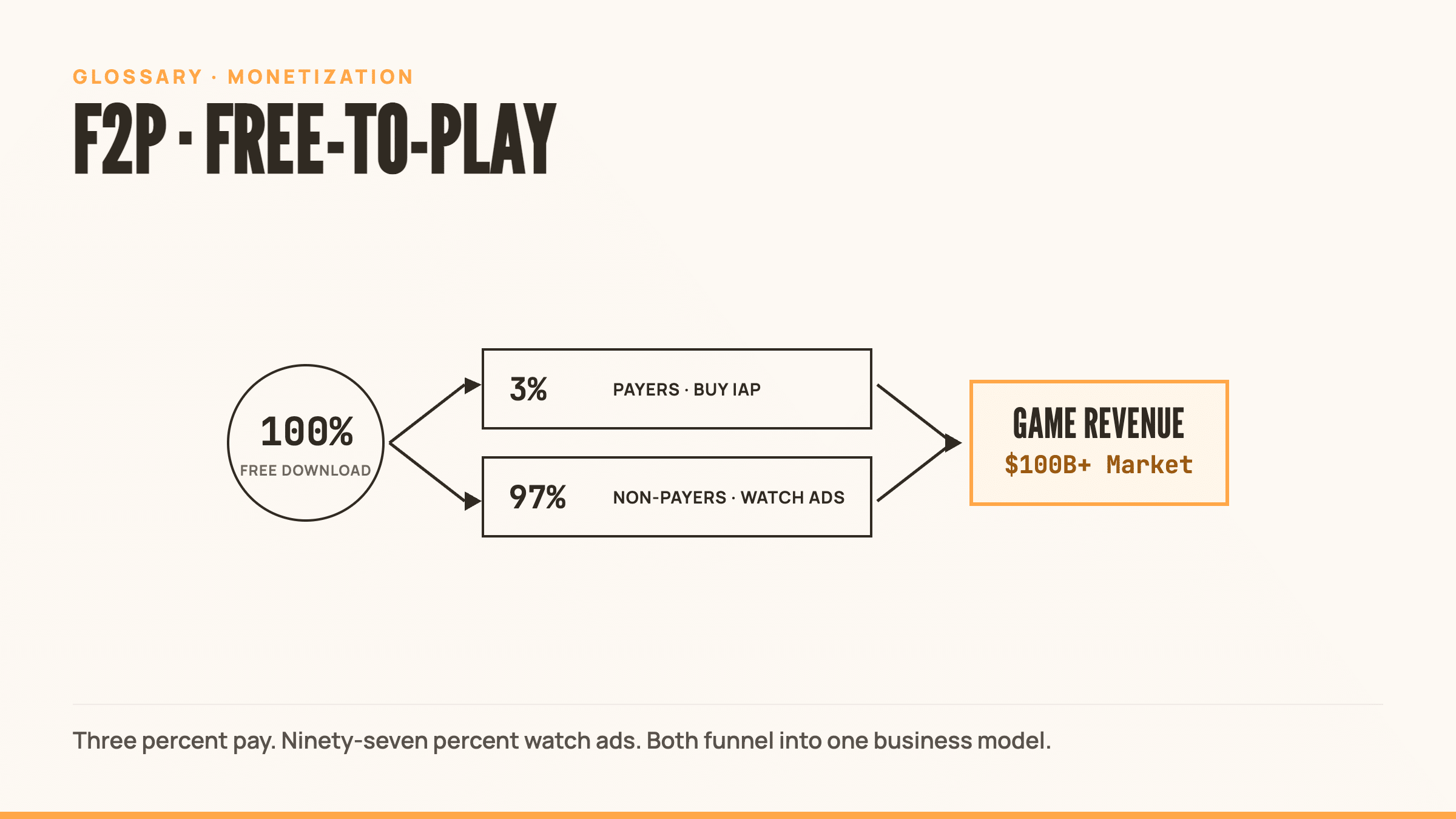
Players buy virtual currency, items, skins, or power-ups. Only 3% of F2P players spend money on IAP. But that 3% funds the entire operation.
Common IAP types:
- Consumables: Lives, coins, boosters (used once)
- Non-consumables: Permanent upgrades, character unlocks
- Cosmetics: Skins, emotes, visual customization
- Gacha/Loot Boxes: Randomized rewards (high controversy, banned in some regions)
Advertising
The other 97% of players get monetized through ads. Rewarded video ads, interstitials, banner ads. Players watch ads for in-game rewards, or ads get inserted between levels.
Ad monetization works at scale. Millions of non-payers still generate revenue through impressions and clicks.
Battle Passes
Seasonal progression systems where players pay for premium rewards. Popularized by Fortnite, now standard in competitive F2P games.
Subscriptions
Monthly fees for VIP perks, exclusive content, or ad removal. Recurring revenue model layered on top of IAP and ads.
Hybrid Models
Most successful F2P games mix multiple monetization methods. IAP for whales, ads for non-payers, battle passes for mid-tier spenders, subscriptions for recurring revenue.
Market Size
Global mobile game revenue reached $82 billion in 2025, per Sensor Tower.
The overwhelming majority of that revenue comes from F2P titles. Games like PUBG Mobile, Genshin Impact, and Candy Crush generate billions annually without charging for the download.
F2P has become the default business model for mobile games. Premium paid games are a shrinking niche.
Why F2P Works
Zero Friction to Start
No price tag means no hesitation. Players download instantly. You get massive install volume, then monetize the engaged subset.
Whale Economics
3% of players generate the majority of revenue. F2P games are built to identify and serve high-value users willing to spend hundreds or thousands. See LTV.
Virality
Free games spread faster. Players invite friends with zero cost barrier. Network effects compound.
Continuous Revenue
Premium games make money once. F2P games make money daily, weekly, monthly. Live operations and seasonal content keep players engaged and spending.
Common Mistakes
Predatory Monetization
Too aggressive, too fast. Players feel manipulated and churn. Pay-to-win mechanics kill retention. Intrusive ads ruin experience.
Ignoring the 97%
Non-payers still matter. They populate lobbies, create content, invite friends. Treat them as freeloaders and you kill the ecosystem.
Boring Core Loop
Monetization can’t save a bad game. If the core gameplay isn’t engaging, no one sticks around long enough to convert.
Regulatory Blindness
Loot boxes are banned in Belgium. In the Netherlands, courts have ruled specific loot box mechanics (like FIFA’s purchasable, tradeable packs) illegal under gambling law, though there’s no blanket ban and the rulings are still being contested on appeal. Other regions are watching. Build monetization that survives regulatory scrutiny.
Related Terms
- IAP (In-App Purchase) – Virtual goods purchased inside the game
- Whale – High-spending players who fund F2P games
- Gacha – Randomized reward mechanics
- LTV (Lifetime Value) – Total revenue a player generates over their lifetime
- ARPDAU (Average Revenue Per Daily Active User) – Key F2P monetization metric
- Battle Pass – Seasonal progression monetization
External Resources
- Strategies for Mobile F2P Monetization: Successful Implementations
- How Do Free Games Make Money?
- F2P Mobile Games Revenue Statistics
Frequently Asked Questions
How do F2P games make money if they’re free?
Through in-app purchases, advertising, subscriptions, and battle passes. Only 3% of players spend on IAP, but that 3% generates the majority of revenue. The other 97% get monetized through ads.
What’s the difference between F2P and freemium?
F2P is the dominant term in gaming. Freemium gets used more broadly across apps and services. In practice they mean the same thing: free to start, monetized through optional purchases or ads.
Why do only 3% of F2P players spend money?
Most players engage casually and don’t feel compelled to pay. F2P games are built to identify the subset of highly engaged users willing to spend, and that small percentage funds the entire player base.
Are F2P games pay-to-win?
Some are. Pay-to-win gives paying players a competitive edge over non-payers. It works in some genres like strategy and RPG but kills retention in competitive genres like shooters and MOBAs.
Last Updated: 2025-12-22