

glossary
Bid Request
Quick Definition: A data package sent by a publisher’s ad server to potential advertisers when an ad impression becomes available. Contains everything needed to decide whether to bid and how much to pay. 01. What is a Bid Request When someone opens an app or website, an ad space becomes available. That moment triggers a […]
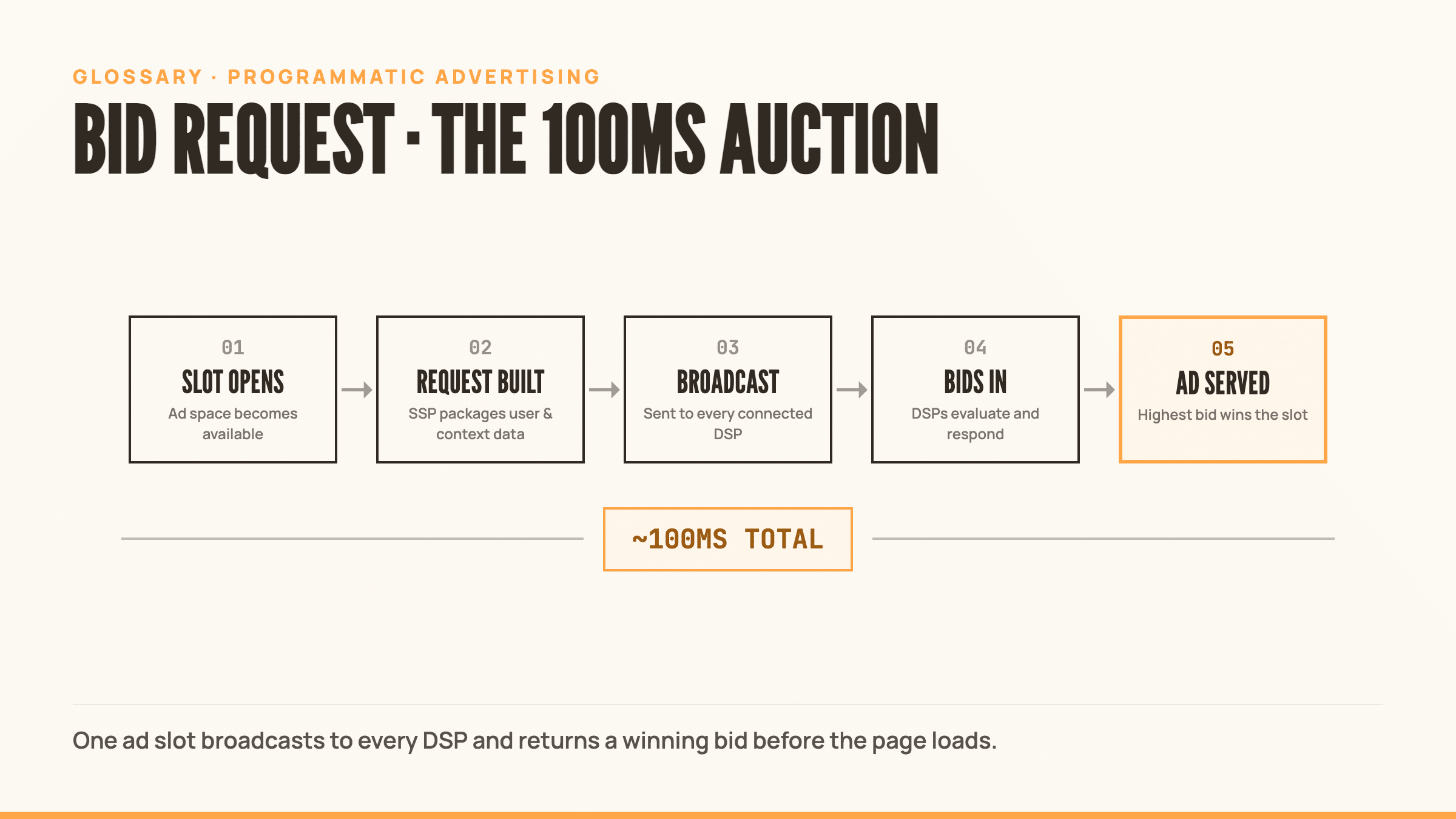
Quick Definition: A bid request is the data package a publisher’s ad server sends to potential advertisers when an ad impression becomes available. It contains everything needed to decide whether to bid and how much to pay.
What is a Bid Request
When someone opens an app or website, an ad space becomes available. That moment triggers a bid request.
The publisher’s supply-side platform (SSP) packages details about the impression. User demographics. Browsing history. Device specs. Ad placement details. Then broadcasts it to demand-side platforms (DSPs) representing advertisers.
This happens before the page finishes loading. Advertisers have milliseconds to decide if they want that impression and what they’ll pay for it. The OpenRTB protocol from the IAB Tech Lab standardizes bid request formats across the industry.
How It Works
Someone opens your game. An ad slot appears on screen.
The SSP creates a bid request describing that exact moment. Who’s viewing. What device they’re on. What they’ve done recently. Where the ad will appear.
That request goes to an ad exchange. The exchange forwards it to dozens of DSPs simultaneously.
Each DSP runs the request through targeting rules, first-party data, and predictive models. If it matches campaign criteria, they submit a bid.
The whole process takes about 100 milliseconds.
Bid Request Components
User Data
- Demographics (age, gender, location)
- Behavioral signals (browsing history, app usage)
- Device info (OS, model, screen size)
- User ID or device ID
Impression Details
- Ad format (banner, video, playable)
- Placement location (feed, interstitial, rewarded)
- Dimensions and specs
- Floor price (minimum bid)
Context
- Publisher app or site
- Content category
- Time of day
- Geographic location
Technical Specs
- Supported file types
- Connection type (WiFi, cellular)
- Language settings
- Privacy flags (COPPA, GDPR)
These specifications follow IAB OpenRTB standards to ensure compatibility across platforms.
The RTB Process
- Impression Available – User opens app, ad slot appears
- Bid Request Created – SSP packages all relevant data
- Broadcast to DSPs – Ad exchange distributes request
- Evaluation – DSPs check targeting, budgets, performance data
- Bid Submission – Interested DSPs submit bid amounts
- Auction – Highest bid wins. Most open exchanges shifted to first-price auctions after 2019 (some walled gardens and legacy paths still run second-price)
- Ad Served – Winning creative loads and displays
Total time: ~100ms from impression to ad display. AdExchanger tracks how bid request technology evolves with privacy regulations.
Common Mistakes
Ignoring bid request data quality. Garbage in, garbage out. Bad signals mean wasted spend on wrong audiences.
Over-bidding on low-quality impressions. Just because you can bid doesn’t mean you should. Filter aggressively.
Not setting floor prices. Publishers leaving money on the table. DSPs paying more than necessary.
Assuming all bid requests are equal. Context matters. A rewarded video impression beats a banner nobody sees.
Forgetting privacy compliance. GDPR, COPPA, and ATT change what data you get. Build for reality, not 2019.
Related Terms
- Real-Time Bidding (RTB) – The auction system bid requests enable
- Supply-Side Platform (SSP) – Creates and sends bid requests
- Demand-Side Platform (DSP) – Receives and evaluates bid requests
- Ad Exchange – Marketplace connecting SSPs and DSPs
- Programmatic Advertising – Automated buying powered by bid requests
External Resources
- AppsFlyer: Real-Time Bidding Glossary
- StackAdapt: What is Real-Time Bidding
- IAB Tech Lab: OpenRTB Standards
Frequently Asked Questions
How fast does a bid request happen?
About 100 milliseconds from the moment the impression becomes available to the ad showing on screen. That covers the SSP packaging the request, DSPs evaluating it, and an auction resolving a winner.
What happens if no one bids on a request?
The ad slot shows a house ad, a PSA, or stays blank. Publishers lose potential revenue in that moment, which is why setting a floor price on inventory matters.
Do all ad impressions use bid requests?
No. Direct deals and programmatic guaranteed buys skip the auction entirely. Bid requests power open marketplace buying, where inventory goes to the highest real-time bid.
What’s the difference between first-price and second-price auctions?
In a first-price auction the winner pays exactly what they bid. In a second-price auction the winner pays just above the second-highest bid (essentially the runner-up’s price plus a cent). Most exchanges moved to first-price after an industry-wide shift in 2019.
Why do some bid requests arrive with no user data?
Privacy settings, ad blockers, or opted-out tracking strip the audience signals from a request. You still get impression details like placement and device type, just without the behavioral data. Bid accordingly.