

glossary
SSP (Supply-Side Platform)
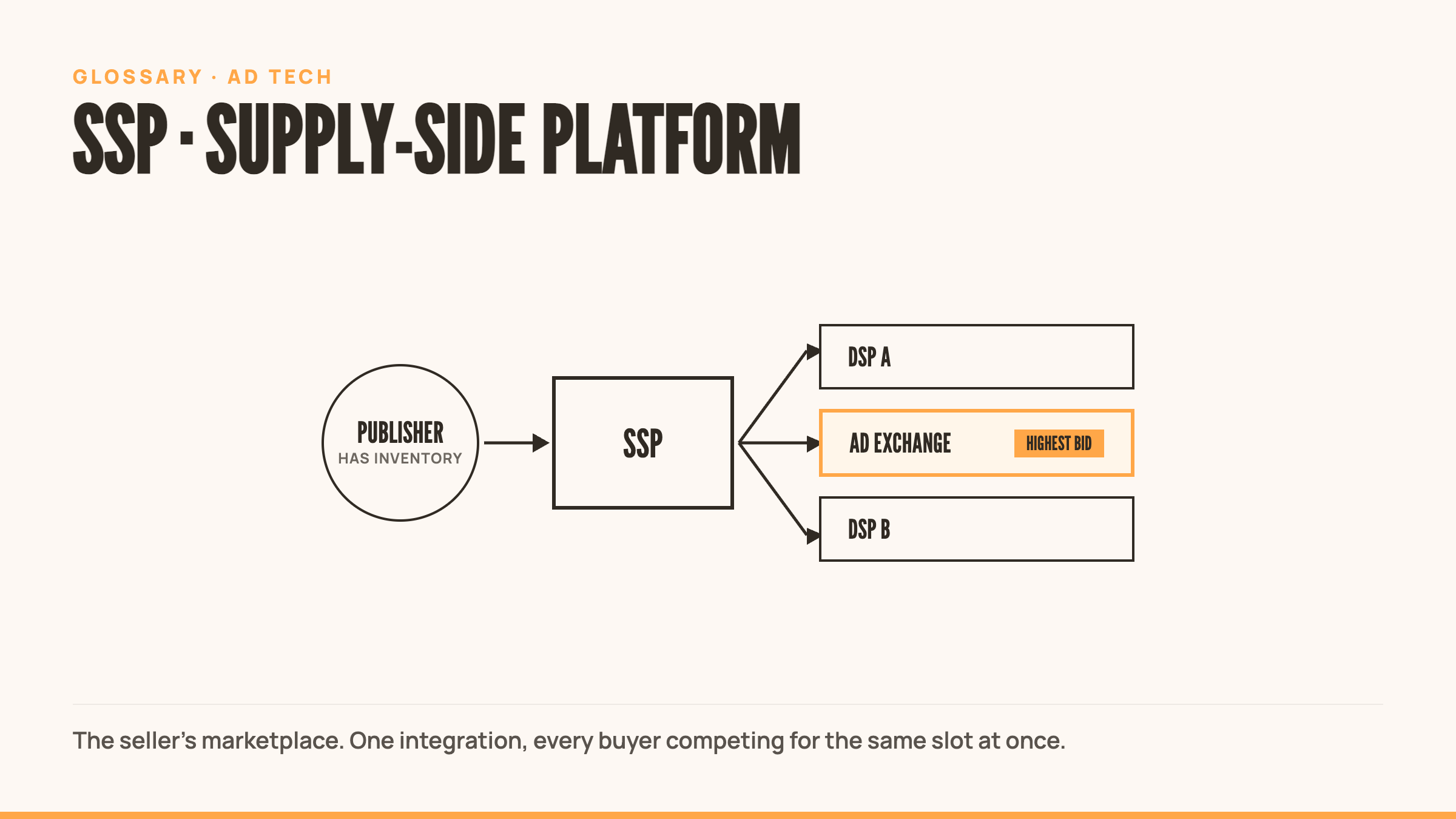
A Supply-Side Platform (SSP) is ad tech that lets publishers automate the sale of their ad inventory. Think of it as the seller’s marketplace in programmatic advertising.
Category: Ad Tech Related: DSP, Ad Exchange, Programmatic Advertising
Quick Definition
A Supply-Side Platform (SSP) is ad tech that lets publishers automate the sale of their ad inventory. Think of it as the seller’s marketplace in programmatic advertising.
What is an SSP?
Publishers have ad space to sell. Advertisers want to buy it. SSPs automate that entire process.
An SSP connects publishers to multiple ad exchanges, DSPs, and ad networks simultaneously. Publishers set their inventory rules once, and the SSP handles the rest—finding buyers, managing auctions, optimizing yield.
Without an SSP, publishers would need to manage relationships with dozens of ad buyers manually. With one, they plug in once and let the platform handle the heavy lifting. The IAB’s programmatic guide explains how SSPs fit into the programmatic ecosystem.
How SSPs Work
Here’s the flow:
- Publisher integrates the SSP (usually via SDK for mobile apps)
- User opens the app—triggers an ad request
- SSP sends inventory details to connected ad exchanges and DSPs
- Real-time auction happens (milliseconds)
- Highest bid wins
- Ad serves to the user
- Publisher gets paid
All of this happens faster than you can blink. The SSP’s job is to maximize what publishers earn per impression while keeping fill rates high.
Mobile SSP Features
Mobile SSPs come with tools built for app monetization:
Geolocation Targeting Serve ads based on where users are. Coffee shop ad in Manhattan, surf gear in San Diego.
Responsive Ads Automatically adjust creative formats to fit different screen sizes and orientations.
Audience Segmentation Target specific user types based on behavior, demographics, or in-app actions.
SDK Integration Publishers drop the SDK into their app. The SSP handles everything else—ad calls, rendering, tracking.
Yield Optimization Machine learning adjusts floor prices and auction strategies to maximize revenue per session. ironSource (now part of Unity) pioneered advanced yield optimization for mobile publishers.
SSP vs DSP
| SSP | DSP | |———|———| | For publishers | For advertisers | | Sells ad inventory | Buys ad inventory | | Maximizes revenue | Minimizes cost | | Manages supply | Manages demand | | Connects to multiple buyers | Connects to multiple sellers |
Think of them as two sides of the same marketplace. SSPs represent sellers. DSPs represent buyers. Ad exchanges connect them.
In mobile gaming, you interact with both. Your game uses an SSP to monetize free players with ads. Your UA team uses a DSP to buy ads on other games.
Market Size
The SSP market is massive and growing fast.
$117.32B by 2033 (13.36% CAGR from 2024)
Global mobile ad spending alone is projected in the $400-450B range for 2025 (estimates vary by methodology), fueled by the explosion of free-to-play games and ad-supported apps.
Translation: Publishers have more inventory than ever. Advertisers want access to it. SSPs are the infrastructure making that exchange possible at scale. AdExchanger tracks SSP consolidation and market trends.
Common Mistakes
Assuming SSPs and DSPs Are the Same Thing They’re opposite sides of the marketplace. SSPs sell. DSPs buy.
Thinking SSPs Guarantee High Revenue An SSP gives you access to buyers. But your inventory quality, audience, and floor prices determine what you actually earn.
Not Testing Multiple SSPs Different SSPs have different demand sources. Many publishers use multiple SSPs to maximize competition for their inventory.
Ignoring Fill Rate Maximizing CPM means nothing if your fill rate tanks. Balance yield optimization with keeping ads flowing.
Related Terms
- DSP (Demand-Side Platform) – The buyer’s side of programmatic advertising
- Ad Exchange – The marketplace connecting SSPs and DSPs
- Programmatic Advertising – Automated ad buying and selling
- RTB (Real-Time Bidding) – The auction mechanism behind programmatic ads
- Mediation Platform – Layer that manages multiple SSPs
External Resources
- Amazon Ads: Supply-Side Platform Guide
- Clearcode: What is a Supply-Side Platform?
- Moloco: Performance Marketing Glossary
Frequently Asked Questions
What does SSP stand for?
SSP stands for Supply-Side Platform: ad tech that lets publishers automate the sale of their ad inventory across multiple exchanges, DSPs, and ad networks at once.
What’s the difference between an SSP and a DSP?
They’re opposite sides of the same marketplace. An SSP represents publishers and sells inventory, aiming to maximize revenue. A DSP represents advertisers and buys inventory, aiming to minimize cost. In mobile gaming you typically touch both: an SSP to monetize your own app, a DSP to buy UA on other games.
Do I need an SSP if I’m just running UA?
No. SSPs exist for publishers monetizing their own ad inventory. If you’re buying installs, you need a DSP, not an SSP.
How do SSPs make money?
They take a cut of each ad transaction, typically 10-20% of the winning bid, in exchange for connecting a publisher’s inventory to real-time auctions with advertisers.