

glossary
ARPU (Average Revenue Per User)
ARPU (Average Revenue Per User) measures how much revenue each user generates over a specific time period. It’s the total revenue divided by the number of active users.
Quick Definition
ARPU (Average Revenue Per User) measures how much revenue each user generates over a specific time period. It’s the total revenue divided by the number of active users.
What is ARPU?
ARPU tells you the average value of each player in your game. It’s a core monetization metric that reveals whether your revenue model is working.
Track ARPU monthly to understand revenue trends. A climbing ARPU means your monetization is getting stronger. A falling ARPU signals problems with pricing, engagement, or content quality.
ARPU captures all revenue streams. In-app purchases, subscriptions, ad revenue. Everything counts.
How to Calculate ARPU
The formula is simple:
ARPU = Total Revenue / Total Active Users
Use a consistent time period. Monthly is standard.
Example:
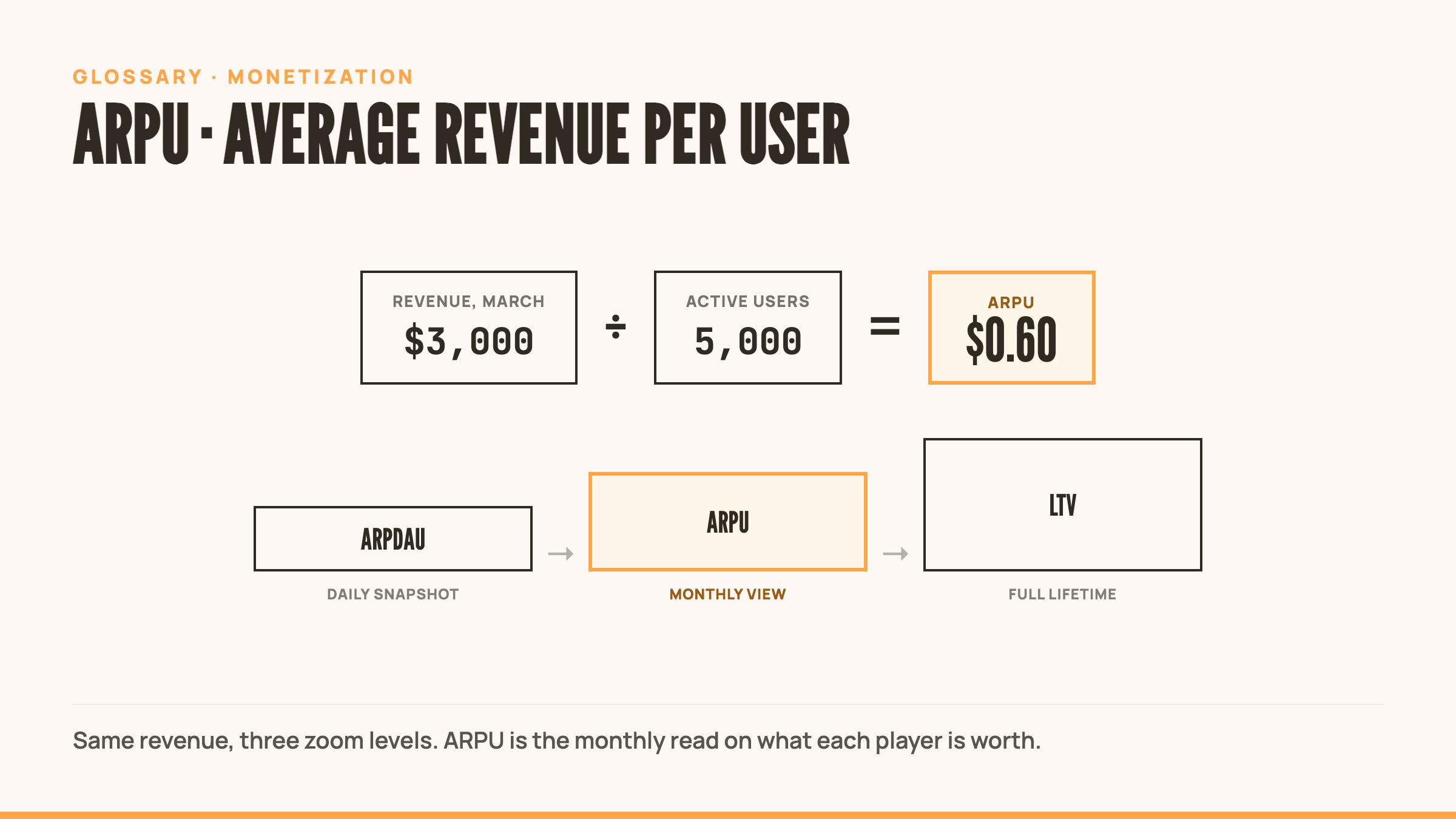
- Revenue in March: $3,000
- Active users in March: 5,000
- ARPU = $3,000 / 5,000 = $0.60
Each user generated 60 cents that month.
What counts as revenue:
- In-app purchases (IAP)
- Subscription fees
- Ad revenue
- Any money the game generated
What counts as an active user: Use your game’s definition of “active.” Most studios use MAU (Monthly Active Users) for monthly ARPU calculations.
ARPU vs ARPDAU vs LTV
These three metrics measure different things:
ARPU (Average Revenue Per User)
- Time frame: Usually monthly
- Users counted: All active users in that period
- Best for: Understanding monthly monetization strength
ARPDAU (Average Revenue Per Daily Active User)
- Time frame: Daily
- Users counted: Daily active users
- Best for: Day-to-day monetization tracking and quick tests
LTV (Lifetime Value)
- Time frame: Entire player lifetime
- Users counted: Total revenue per user over their full engagement
- Best for: Long-term profitability and UA spend decisions
Think of them as zoom levels. ARPDAU is daily snapshots. ARPU is monthly view. LTV is the full picture.
ARPU Benchmarks
ARPU varies wildly by game type, market, and monetization model.
Mobile gaming averages:
- US and other Tier-1 markets (US/EU/JP) run well above the global blend. Treat any single ARPU number as directional, not a target.
- Top-grossing titles: PUBG Mobile hit approximately $67 ARPU among gaming apps globally, per Statista (2022 data). Dated, but it shows the ceiling for top performers.
- Casual games: Often $0.50-$3 ARPU (Tier-1 markets, monthly window)
- Midcore/hardcore: $5-$20+ ARPU (Tier-1 markets, monthly window)
Factors that drive ARPU:
- Monetization model (IAP vs ads vs hybrid)
- Player engagement levels
- Content update frequency
- Market segment (casual vs hardcore)
- Geographic mix (US/Europe vs emerging markets)
Don’t compare your puzzle game’s ARPU to a strategy RPG. Different genres, different economics.
How to Improve ARPU
1. Optimize pricing Test different price points. Higher isn’t always worse. Some players will pay more for the right offer.
2. Improve retention Longer sessions mean more chances to monetize. Fix the leaks in your engagement loop.
3. Better segmentation Whales need different offers than casual spenders. Personalize based on behavior.
4. Add more content New levels, characters, events. More quality content drives more spending.
5. Tune ad placements For ad-supported games, placement and frequency matter. Too few leaves money on the table. Too many kills retention.
6. Live ops and events Limited-time offers create urgency. Events drive engagement and spending.
7. Better onboarding If players don’t understand your monetization, they won’t spend. Make it clear and valuable.
Common Mistakes
Averaging across different cohorts New users monetize differently than veterans. Mixing them hides important trends.
Ignoring churn High ARPU with high churn is a death spiral. You’re squeezing players before they leave.
Focusing only on whales Top 1% of spenders drive most revenue, but alienating the other 99% kills your game long-term.
Not tracking ARPU by source Organic users often have different ARPU than paid. Know which channels bring valuable players.
Comparing different time periods inconsistently Month-over-month ARPU changes need context. Seasonality, new content releases, and cohort mix all matter.
Related Terms
- ARPDAU (Average Revenue Per Daily Active User)
- LTV (Lifetime Value)
- MAU (Monthly Active Users)
- DAU (Daily Active Users)
- Conversion Rate (Percentage of users who spend)
- ARPPU (Average Revenue Per Paying User)
External Resources
- Calculate and Increase ARPU and ARPDAU (Udonis)
- Main Metrics: Average Revenue Per User (devtodev)
- Average Revenue Per User (ARPU) Glossary (Stash)
Frequently Asked Questions
How is ARPU calculated?
ARPU = Total Revenue / Total Active Users, tracked over a consistent period (monthly is standard). Example: $3,000 in revenue divided by 5,000 active users gives you $0.60 ARPU. Revenue includes IAP, subscriptions, and ad revenue.
What is the meaning of ARPU?
ARPU stands for Average Revenue Per User. It’s the core monetization metric that tells you the average value of each player in your game, and whether your revenue model is actually working.
What is the difference between LTV and ARPU?
ARPU measures revenue per user over a set period, usually a month. LTV measures total revenue per user across their entire time playing your game. Think of ARPU as a monthly snapshot and LTV as the full picture used for UA spend decisions.
What is a good ARPU?
It depends entirely on genre and market. Casual games often run $0.50-$3 ARPU, midcore and hardcore titles hit $5-$20+, and top-grossing games can exceed $60. Compare against your own genre and market, not a blanket industry number.