

glossary
User Acquisition (UA)
Quick Definition: The process of acquiring new users for mobile games through paid marketing activities designed to generate installs and drive ROI-positive growth. — 01. What is User Acquisition? User acquisition is how mobile games find players who actually matter. It’s the engine that turns ad spend into installs, installs into sessions, and sessions into […]
Quick Definition: The process of acquiring new users for mobile games through paid marketing activities designed to generate installs and drive ROI-positive growth.
What is User Acquisition?
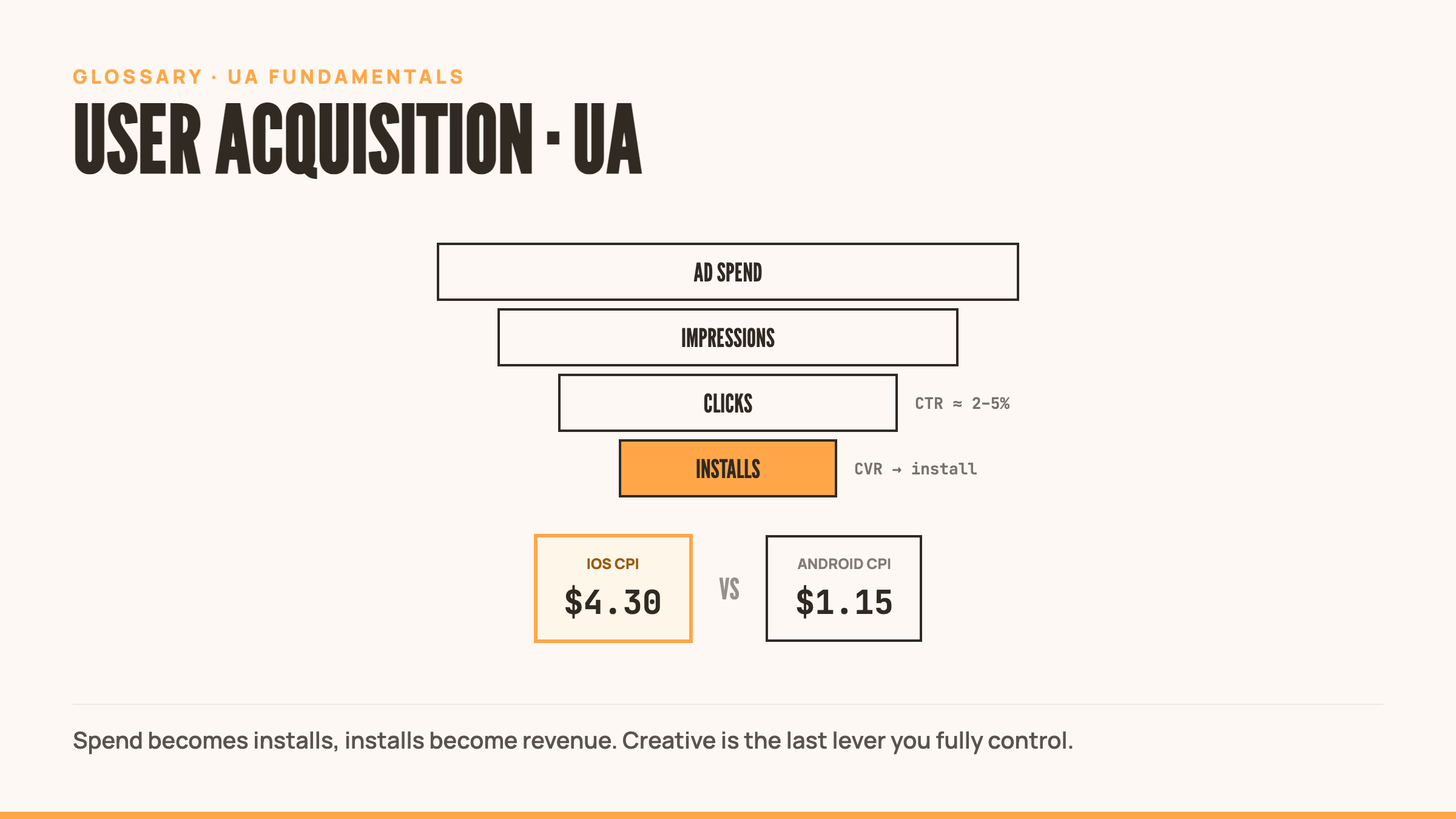
User acquisition is how mobile games find players who actually matter.
It’s the engine that turns ad spend into installs, installs into sessions, and sessions into revenue. Every studio with growth ambitions runs UA. The question is whether they do it well.
UA isn’t about buying installs. Anyone can do that. It’s about finding users who play, purchase, and contribute to long-term growth. The difference between a $1 install that churns in 24 hours and a $5 install that generates $50 in LTV is the difference between burning money and building a business.
The mechanics are straightforward. You create ads, target audiences across channels, optimize for performance, and scale what works. But the execution is brutal.
Post-IDFA, mobile attribution got harder. CPIs climbed. The old playbook died when Apple cut off the user graph. Now you’re paying roughly $4.30 per iOS install versus roughly $3 on Android, and you can’t even see half the signal you used to rely on. Both figures swing hard by region and genre: North America runs multiples of LATAM or Southeast Asia, and a casino title can cost several times what a casual game does.
Creative became the last controllable variable. When you can’t micro-target like you used to, your ad has to work harder. That’s why creative fatigue kills campaigns faster than bad targeting ever did.
Modern UA teams live in this tension. Produce more creatives to fight fatigue. Explore new concepts to find winners. Scale the hits before they burn out. Repeat daily.
UA Channels and Methods
Paid Social Meta (Facebook/Instagram), TikTok, Snapchat. High volume, creative-dependent, prone to fatigue.
Ad Networks AppLovin, Unity, ironSource, Google Ads. Programmatic buying, ML-driven optimization, scaled reach.
Influencers Streamers, YouTubers, TikTok creators. Authentic engagement, hard to measure, inconsistent results.
App Store Optimization (ASO) Organic discovery through search and featuring. Free installs, limited control, slow iteration.
Cross-Promotion Use one game to promote another. Cheap CPI, limited scale, requires existing portfolio.
Most serious UA teams run multi-channel strategies. You test across platforms, measure incrementality, and allocate budget to whatever delivers ROAS.
Key Metrics
ROAS (Return on Ad Spend) Revenue generated divided by ad spend. The ultimate measure of campaign success. If you’re not tracking ROAS, you’re flying blind.
CPI (Cost Per Install) How much you pay for each install. Benchmarks vary heavily by platform, region, and genre. iOS averages around $4.30, Android around $3. What matters is whether those installs pay back.
LTV (Lifetime Value) Total revenue a user generates over their lifetime. The ceiling on what you can afford to pay for acquisition. If your LTV is $10 and your CPI is $12, you lose money on every install.
ARPDAU (Average Revenue Per Daily Active User) Revenue divided by daily active users. Measures monetization efficiency. Higher ARPDAU means you can afford higher CPIs.
The math is simple. If LTV exceeds CPI by enough margin to cover overhead and generate profit, you scale. If not, you fix creative, targeting, or monetization until the unit economics work.
The Modern UA Challenge
IDFA deprecation changed everything.
Apple’s ATT framework cut off the user-level data that powered ML-driven targeting. Overnight, CPIs jumped. Attribution windows shortened. Optimization models lost signal.
The entire industry had to adapt. Some teams leaned into probabilistic attribution. Others doubled down on creative testing. Everyone had to get comfortable with less certainty.
Creative became the last lever you fully control. You can’t micro-target like 2019. You can’t A/B test audiences with surgical precision. But you can still ship better ads.
The problem is creative fatigue. Ads burn out in weeks. Sometimes days. Performance drops. CPIs climb. You need fresh concepts constantly.
Manual creative production can’t keep pace. Agencies take weeks. Internal teams bottleneck. Meanwhile, your live campaigns are bleeding performance.
This is where systems matter — technology built for fast creation, smart exploration, consistent discovery. The studios winning UA today built processes that produce volume without sacrificing quality.
UA Strategy Best Practices
Test at volume One creative per week doesn’t cut it. You need 10, 20, 50 concepts in-market to find the outliers. Most will fail. That’s the game.
Separate explore and exploit Run BAU campaigns to scale proven winners. Run explore campaigns to find new ones. Don’t mix them. Exploration needs budget and patience.
Kill losers fast If a creative isn’t working in 48 hours, it probably won’t. Cut it. Reallocate budget to winners.
Build creative systems Manual production doesn’t scale. Build templates, iterate formats, automate what you can with modern creative generation tools. Speed matters more than perfection.
Track cohort-level economics Install volume means nothing without LTV. Know your Day 7, Day 30, Day 90 retention and revenue by cohort.
Own your creative strategy Agencies can execute, but you need internal expertise to guide what gets made. Creative isn’t outsourceable strategy.
Common Mistakes
Optimizing for CPI instead of ROAS Cheap installs that don’t monetize lose money. Optimize for revenue, not vanity metrics.
Running the same creatives too long Creative fatigue is real. Refresh concepts before performance cliffs.
Ignoring creative volume Testing one concept per month guarantees mediocrity. Volume creates options.
Treating UA and creative as separate functions They’re the same function. UA without strong creative is just expensive traffic.
Chasing platform tricks instead of building systems Hacks expire. Processes compound. Invest in systems that produce winning creatives consistently.
Related Terms
- CPI (Cost Per Install)
- ROAS (Return on Ad Spend)
- LTV (Lifetime Value)
- Creative Fatigue
- Playable Ads
External Resources
- Unity: User Acquisition Glossary
- AppLovin: User Acquisition Definition
- Udonis Blog: User Acquisition Strategy for Mobile Games
Frequently Asked Questions
What do you mean by user acquisition?
User acquisition is the process of acquiring new users for mobile games through paid marketing activities designed to generate installs and drive ROI-positive growth. It’s not about buying installs, it’s about finding users who play, purchase, and contribute to long-term growth.
What does UA mean in gaming?
UA stands for User Acquisition, the paid marketing function responsible for turning ad spend into installs, installs into sessions, and sessions into revenue across channels like paid social, ad networks, influencers, and ASO.
How much should we spend on UA?
It depends on your unit economics. If LTV exceeds CPI with a healthy margin, spend until you hit diminishing returns. If not, fix monetization first before scaling spend.
How many creatives should we test per month?
As many as you can produce with quality. Top-performing studios test dozens of concepts monthly, since volume is what creates discovery of winning ads.
What’s the biggest UA mistake mobile game studios make?
Treating creative production as a bottleneck instead of a system. Slow creative kills UA performance faster than bad targeting does.