

glossary
Frequency Capping
Frequency Capping limits how many times a unique user sees your ad within a set period. The guardrail that keeps you from burning through goodwill and budget showing the same creative 47 times to someone who already ignored it.
Quick Definition
Frequency Capping limits how many times a unique user sees your ad within a set period. The guardrail that keeps you from burning through goodwill and budget showing the same creative 47 times to someone who already ignored it.
What is Frequency Capping
Frequency capping sets a maximum number of ad impressions per user over a defined timeframe (daily, weekly, monthly). Once a user hits that cap, they stop seeing that specific ad or campaign.
Platforms track this through cookies, device IDs, or probabilistic models. You set the rules. The ad network enforces them.
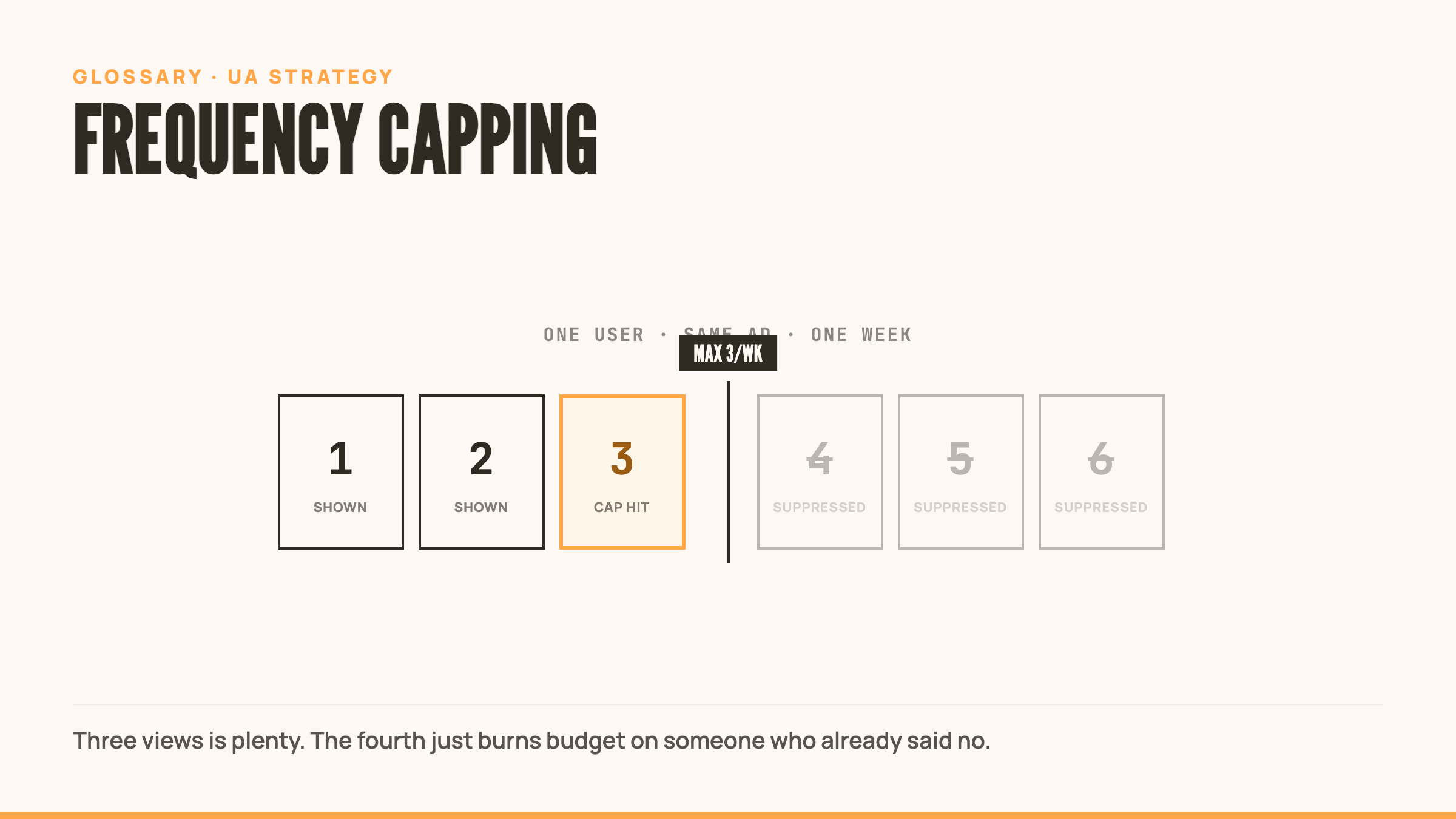
Example: Cap at 3 impressions per week means each user sees your ad max 3 times in 7 days, then the system moves on.
Why It Matters
64% of US adults say they always or mostly take action to avoid ads on free, ad-supported video streaming (Nielsen, 2023). Hammer them too hard and you accelerate that behavior.
Frequency capping prevents three expensive mistakes:
- Ad fatigue – Users tune out or actively avoid brands that spam them
- Wasted spend – Showing the same creative 10+ times to someone who didn’t convert on impression 3 burns budget
- Shortened campaign lifespan – Overexposure kills creative effectiveness faster
Smart caps extend how long a creative performs before fatigue sets in. You get more runway from each winning ad.
Recommended Caps by Campaign Type
Different objectives need different frequencies. These ranges are a practitioner starting point, not a sourced industry benchmark — test and adjust against your own data:
Awareness Campaigns
5-7 impressions per week
Building brand recognition needs repetition. Users need multiple exposures to remember you. But past 7 weekly impressions, diminishing returns kick in hard.
Performance Campaigns (CPI, CPA)
2-3 impressions per week
Performance lives and dies on efficiency. If someone didn’t convert after 2-3 exposures, showing them the same ad again rarely changes outcomes. Move that budget to fresh users.
Retargeting
1-2 impressions per week
These users already know you. Light touches work better than aggressive follow-ups. Stay visible without being creepy.
Mobile Best Practices
Mobile sessions are short and frequent. Users open apps multiple times daily.
Aim for once every few sessions. If someone plays your game 5 times today, they don’t need to see your ad in every session.
Think in bursts:
- Show the ad
- Give breathing room
- Show again after meaningful time gap
Mobile users are particularly sensitive to repetition. The same vertical video they scrolled past at 9am feels annoying when it shows up again at 9:15am.
Cookieless Challenges
Third-party cookies are dying. Roughly 30% of internet users worldwide (32% in the US) use ad blockers, and browser-level privacy protections like Safari’s Intelligent Tracking Prevention and Firefox’s Enhanced Tracking Protection independently restrict third-party cookie tracking on top of that.
What this means for frequency capping:
Platforms are shifting to probabilistic modeling and first-party data. Instead of perfect tracking via cookies, they’re making educated guesses based on device fingerprints, login data, and behavioral patterns.
The result: Less precise frequency control, especially across different platforms and devices.
What you can do:
- Lean harder on platform-native frequency caps (Meta, Google, AppLovin)
- Use first-party data where possible
- Accept some margin of error in cross-platform frequency
- Test lower caps to compensate for tracking gaps
Cookieless doesn’t mean frequency capping disappears. It means the guardrails are less exact.
Common Mistakes
Setting caps too high
“10 impressions per week” usually means 7 wasted impressions. Most conversion decisions happen in the first 2-3 exposures.
No caps at all
Platforms will happily show your ad 20+ times to the same high-engagement user while ignoring fresh prospects. That’s waste.
Same cap across all campaign types
Awareness and performance need different frequencies. One-size-fits-all caps kill efficiency.
Ignoring creative fatigue signals
If CTR drops 40% after week 2, your frequency cap won’t save you. Cap controls exposure, but worn-out creative still performs badly — the real fix is fresh supply through agentic creative generation, not a tighter cap.
Setting caps without testing
Start conservative (2-3/week), measure performance, adjust up if data supports it. Don’t guess.
Related Terms
- Ad Fatigue – When users stop responding to overexposed creatives
- Creative Fatigue – Performance decay as creatives age and saturate audiences
- Reach – Number of unique users who see your ad
- Impressions – Total ad views (includes repeats to same users)
- Retargeting – Showing ads to users who already interacted with your brand
External Resources
- Amazon Ads: Frequency Capping Guide
- AppsFlyer: Frequency Capping Glossary
- Improvado: Understanding Frequency Capping
Frequently Asked Questions
What is frequency capping?
Frequency capping sets a maximum number of times a unique user can see your ad within a set period, like 3 times per week. Once a user hits the cap, the ad network stops showing them that ad or campaign.
What is a good frequency cap?
There’s no universal number, but a reasonable starting point is 2-3 impressions per week for performance campaigns and 5-7 per week for awareness campaigns. Retargeting works best even lighter, around 1-2 per week.
What is frequency capping in Facebook ads?
Meta lets you set a maximum number of impressions per user at the campaign or ad set level, controlling how often the same person sees ads from that campaign within your chosen time window.
What is a high frequency cap?
Anything meaningfully above the recommended ranges, for example 10+ impressions per week on a performance campaign. Most conversion decisions happen in the first 2-3 exposures, so a high cap usually just means wasted impressions on people who already decided not to act.