

glossary
Creative Fatigue
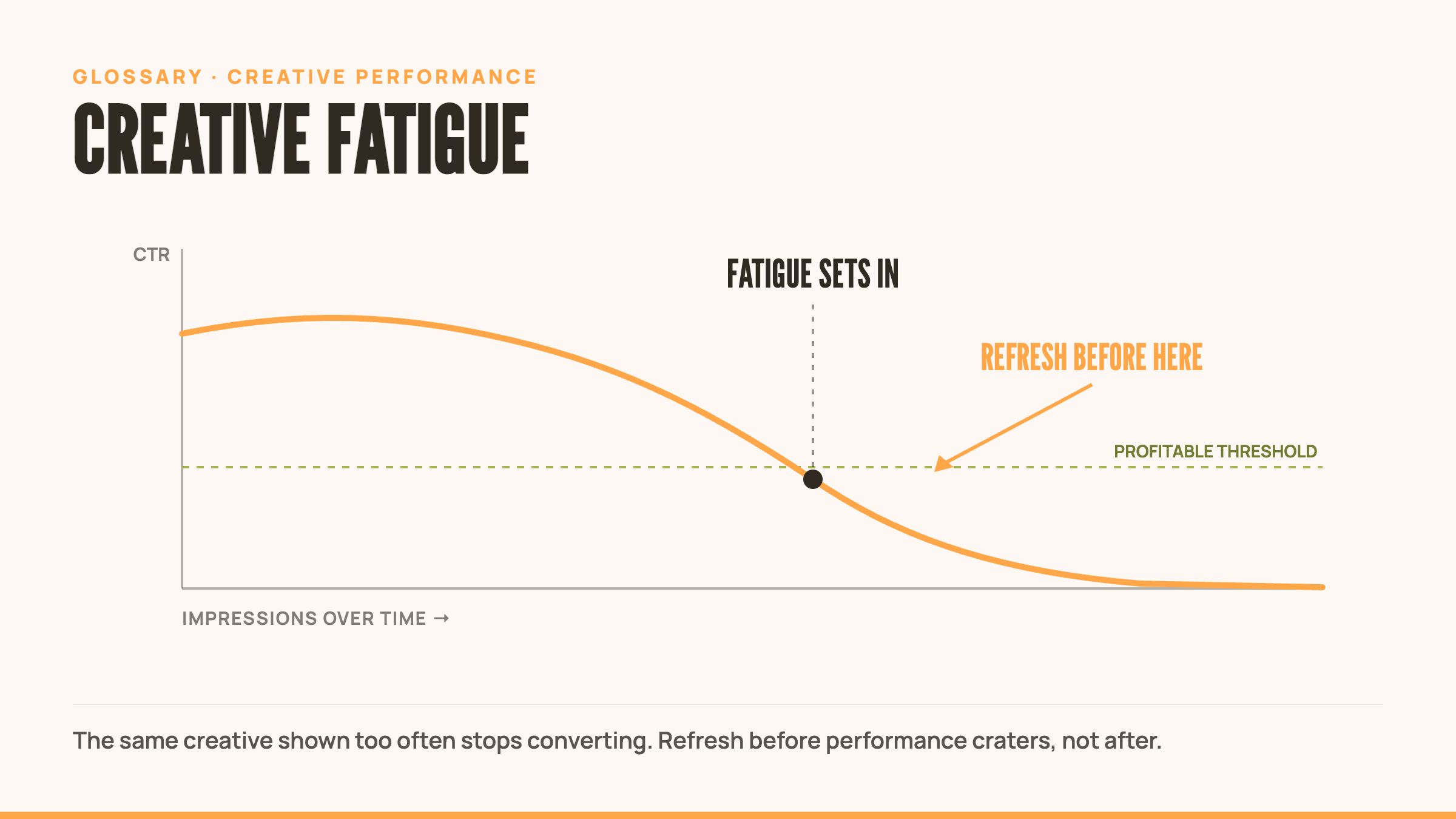
Creative fatigue occurs when ad creatives lose effectiveness because users have seen the same visual elements too many times. Your CTR drops, your costs spike, and what worked last week stops working this week.
Quick Definition
Creative fatigue occurs when ad creatives lose effectiveness because users have seen the same visual elements too many times. Your CTR drops, your costs spike, and what worked last week stops working this week.
What is Creative Fatigue?
Creative fatigue is the performance killer hiding in plain sight.
It happens when your target audience sees your ad creative so many times that they stop engaging with it. The visual elements become wallpaper. They scroll past without thinking. Your click-through rate drops. Your cost per install climbs. The creative that crushed it two weeks ago is now bleeding budget.
This isn’t about bad creative. The ad could be brilliant. But repetition kills effectiveness faster than quality creates it.
Here’s what happens: You launch a video ad. Week one, it performs well. CTR is strong, CPI is reasonable, installs are flowing. Week two, you notice CTR starting to dip. Week three, costs are up 30% and you’re scrambling to figure out why. Week four, the creative is dead.
The timeline can be even shorter. In mobile gaming, creatives can fatigue in 3-7 days. TikTok demands weekly or even daily rotation. Facebook gives you a bit more breathing room at 2-4 weeks, but not much.
The math is brutal. When creative fatigue hits, CTR can decline double digits week-over-week. Costs can double. And because it happens gradually, teams often miss the early warning signs until performance has already tanked.
The root cause is simple: frequency. When the same user sees the same ad too many times, they tune out. Marketers call this “banner blindness” for display ads, but it applies to video ads, playable ads, and every format in between.
Creative fatigue doesn’t mean your creative was bad. It means your audience is done with it.
The challenge for UA teams is that creative fatigue conflicts with another truth: finding winning creatives is hard. When you finally get one that works, you want to scale it. But scaling means more impressions, which means more frequency, which means fatigue.
This is the trap. The creatives that work best fatigue fastest because they get the most exposure.
Key Statistics and Warning Signs
Typical Creative Lifespan:
- Mobile gaming: 3-7 days before fatigue sets in
- TikTok: Weekly or daily rotation required
- Facebook/Meta: 2-4 weeks before refresh needed
Performance Warning Signs:
- CTR declines double digits week-over-week
- CPI or CPA increases without changes to targeting or budget
- Costs can double as creative effectiveness declines
- Impression volume stays steady but conversions fall
Frequency Thresholds:
- Industry standard: Cap at 3-7 impressions per user over 30 days
- Higher frequency = faster fatigue
If you see CTR declining while frequency climbs, creative fatigue is already happening.
Creative Fatigue vs Ad Fatigue
These terms get used interchangeably. They shouldn’t.
Ad fatigue is the general concept that users get tired of seeing ads. It’s broad. It can refer to platform fatigue, campaign fatigue, or just overall ad overload.
Creative fatigue is specific. It’s about the visual elements of the ad itself. The same hook, the same character, the same motion graphics, the same gameplay clip. When users see identical or near-identical creative elements repeatedly, they stop responding.
The distinction matters because the solutions are different.
Ad fatigue might be solved by adjusting frequency caps, changing your targeting, or pulling back spend. Creative fatigue requires new creatives. Different visuals, different messaging, different angles.
You can have fresh targeting and perfect frequency management, but if your creative is stale, performance will still tank. That’s creative fatigue.
Why Mobile Games Are Hit Hardest
Mobile game UA runs on volume. You need installs at scale. That means aggressive spending, tight targeting, and rapid creative rotation.
The problem: mobile game audiences are finite. If you’re targeting mid-core strategy gamers in the US aged 25-45, there are only so many of them. You hit the same users repeatedly. Frequency climbs fast.
Add in the creative demands of mobile gaming. Video ads need to show gameplay. Playable ads need to represent the core loop. You can’t just swap out a headline or change the CTA button. Refreshing mobile game creatives means new gameplay footage, new characters, new hooks, new concepts.
That takes time and budget. But creative fatigue doesn’t wait.
Mobile games also compete in crowded ad auctions. Meta, TikTok, AppLovin, Unity. Every network is flooded with game ads. Users see dozens of mobile game ads per day. Your creative needs to stand out, but standing out gets harder when users have seen your ad three times this week.
The feedback loop is vicious. You find a winning creative. You scale it. It fatigues. Performance drops. You scramble for new creatives. Production is slow. You over-rely on the few creatives still working. They fatigue faster. Repeat.
This is why creative fatigue is the defining problem in mobile game UA. It’s not a bug. It’s a feature of the system.
Prevention Strategies
1. Set Frequency Caps
Limit how many times a single user sees your ad. Industry standard is 3-7 impressions per user over 30 days. Platforms like Meta and TikTok let you configure this. Use it.
Frequency caps won’t stop creative fatigue, but they slow it down. You’re buying time.
2. Rotate Creatives Constantly
Don’t wait for performance to drop. Build rotation into your workflow. Have multiple creatives running at once. Swap in fresh creatives before the old ones die.
On TikTok, plan for weekly or daily rotation. On Facebook, aim for every 2-4 weeks.
3. Create at Volume
You can’t rotate creatives you don’t have. The solution to creative fatigue is production volume. More creatives, faster, powered by agentic creative generation instead of manual production alone. Build a system that lets you create and test at scale.
This is where most teams break. Manual creative production can’t keep up with the speed of fatigue.
4. Test Variations, Not Just New Concepts
You don’t always need a completely new creative. Sometimes a variation works. Change the hook, swap the background music, adjust the first 3 seconds. Test iteratively.
Variations are faster to produce than net-new concepts. That speed matters.
5. Monitor Performance Daily
Don’t wait for weekly reports. Check CTR, CPI, and frequency daily through ongoing creative performance analysis. Catch fatigue early. The earlier you spot it, the less budget you waste.
Common Mistakes
Riding winners too long. You found a creative that works. You scale it hard. It fatigues. Performance craters. You’ve now blown budget on a dead creative because you waited too long to refresh.
Not tracking frequency. If you don’t monitor how often users see your ads, you’re flying blind. Frequency is the leading indicator of creative fatigue.
Blaming the platform. When performance drops, teams blame the ad network or the algorithm. Sometimes it’s creative fatigue. Check your creatives first.
Waiting for perfect creatives. Teams spend weeks perfecting one creative. By the time it’s ready, they need three more. Perfect is the enemy of fast. Get creatives out, test them, learn, iterate.
Ignoring the 3-7 day window. Mobile game creatives fatigue fast. If you’re refreshing monthly, you’re already too late.
Related Terms
- Ad Fatigue – Broader concept of users tiring of ads across a campaign
- Creative Testing – Process of testing multiple creatives to find winners
- ROAS – Return on Ad Spend, the metric creative fatigue destroys
- Video Ads – Ad format particularly susceptible to creative fatigue
External Resources
- AppsFlyer: Creative Fatigue in Mobile Marketing
- Funnel.io: Ad Fatigue Guide
- Motion: Ad Fatigue Explained
Frequently Asked Questions
What is creative fatigue?
Creative fatigue happens when your target audience has seen your ad creative so many times they stop engaging with it. CTR drops, CPI climbs, and the ad that crushed it two weeks ago starts bleeding budget. It’s not about bad creative, it’s about repetition.
Is creative fatigue real?
Yes, and the numbers back it up. CTR can drop 10-15% week-over-week once fatigue sets in, and costs can double. In mobile gaming, creatives can fatigue in as little as 3-7 days because audiences are finite and you hit the same users repeatedly.
Why does my ad say creative fatigue?
Ad platforms flag creative fatigue when frequency climbs and performance metrics like CTR start declining for a specific ad. It’s the platform’s way of telling you the same users have seen this creative enough times that it’s losing effectiveness.
How do I combat creative fatigue?
Set frequency caps, rotate creatives constantly instead of waiting for performance to drop, and build production volume so you always have fresh options ready. Monitor CTR and CPI daily, not weekly, to catch fatigue before it burns budget.