

glossary
CPI (Cost Per Install)
CPI (Cost Per Install) is the price you pay for each app installation from your ad campaign. It’s the core metric that determines whether your UA spend is sustainable or burning cash.
Quick Definition
CPI (Cost Per Install) is the price you pay for each app installation from your ad campaign. It’s the core metric that determines whether your UA spend is sustainable or burning cash.
What is CPI?
CPI tells you exactly what each new user costs to acquire. When you run a campaign, you agree to pay a certain amount every time someone installs your app from your ad. That predetermined rate is your CPI.
This matters because CPI is the first line of defense between profitable growth and expensive failure. If your CPI is $3 but your average user only generates $2 in LTV, you’re losing money on every install. If your CPI is $3 and your LTV is $10, you’ve got room to scale.
UA managers track CPI obsessively because it moves fast. A creative that pulls $2 CPI on Monday might pull $5 on Friday when creative fatigue sets in. A campaign that works in Brazil at $0.50 CPI could cost $6 in the US. Platform matters too. Android installs typically run cheaper than iOS, but iOS users often convert better.
CPI sits at the center of every UA decision. Should you scale this campaign? CPI tells you. Is this creative worth running? CPI decides. Can you afford to compete in this geo? CPI has the answer.
The metric itself is simple. The strategy around it is not. Managing CPI means balancing volume with efficiency, testing new creatives before the old ones burn out, and knowing when a high CPI is worth it because LTV justifies the spend.
Every UA team has a target CPI range. Stay under it and you can scale. Go over it and you’re either cutting spend or praying your retention numbers save you. CPI doesn’t lie. It just tells you what growth costs.
How to Calculate CPI
The formula is dead simple:
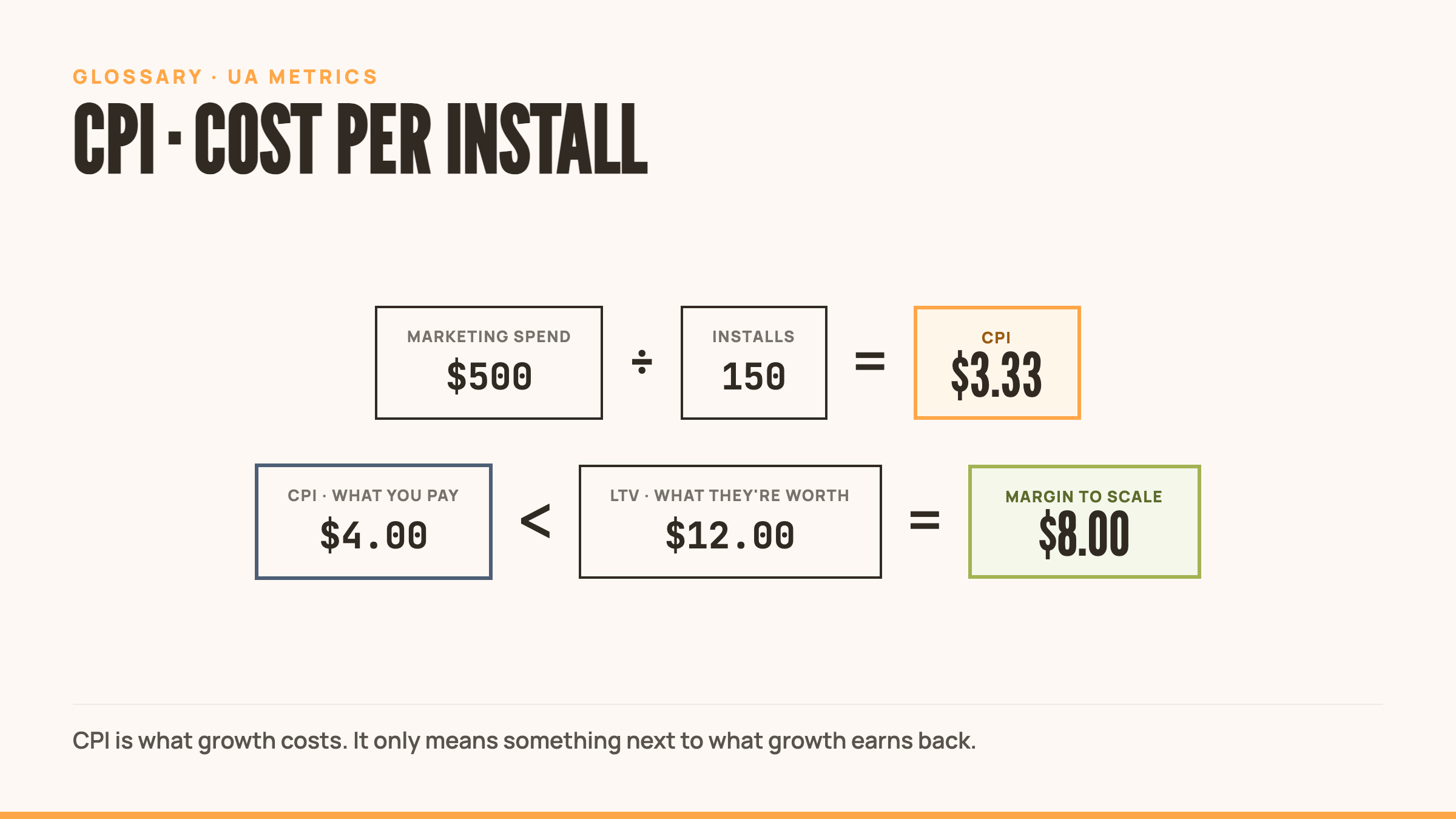
CPI = Total Marketing Spend ÷ Number of Installs
Example:
You spend $500 on a Facebook campaign. You get 150 installs.
$500 ÷ 150 = $3.33 CPI
That’s what each user cost you. Now compare that to your LTV and you know if the campaign is profitable.
Factors Affecting CPI
CPI isn’t fixed. It swings based on where, how, and what you’re running.
Geography
North American users cost more. LATAM users cost less. A campaign in the US might run $5.30 CPI while the same campaign in Brazil runs $0.30. Higher CPIs often come with higher LTV, but not always.
Platform
Android installs typically cost less than iOS. Android might run $1.20 CPI while iOS hits $3.60. iOS users tend to spend more in-app, which can justify the higher acquisition cost.
Vertical
Casual games usually have lower CPIs than midcore or strategy games. A hyper-casual title might acquire users at $0.50, while a complex RPG could pay $8+ for the right player.
Ad Format
Playable ads often drive higher-quality installs but may cost more upfront. Video ads can scale volume but quality varies. Static ads are cheap but rarely convert well in competitive markets.
Auction Competition
CPI spikes when multiple advertisers compete for the same audience. Holiday seasons, new game launches, and major app releases all push CPIs up as demand for ad inventory increases.
Creative Quality
Fresh, engaging creatives pull lower CPIs. Fatigued creatives cost more as users scroll past ads they’ve seen before. This is why creative refresh cycles matter.
CPI Benchmarks
Real-world CPI benchmarks vary widely by region and platform. These aren’t guarantees, but they show the range you’re working with.
Regional Variance:
- North America: ~$5.30 average CPI
- LATAM: ~$0.30 average CPI
Platform Variance (2026):
- Android: ~$2.97 average CPI
- iOS: ~$4.22 average CPI
Per Game Growth Advisor’s 2026 UA benchmarks, iOS runs 30-50% higher than Android across most genres, driven by better iOS monetization. These platform averages also mask heavy variance by genre. Casino games on iOS can run north of $11, while casual titles sit closer to $2.50.
Your actual CPI depends on your creative quality, targeting precision, and how competitive your category is. A well-optimized campaign with sharp creatives can beat these averages. A weak campaign burns cash well above them. Benchmarks like these drift year to year, so treat them as directional.
CPI vs Other Metrics
CPI vs CPM (Cost Per Mille)
CPM charges per 1,000 impressions. You pay whether users install or not. CPI only charges when someone actually installs. CPM is impression-focused. CPI is conversion-focused.
CPI vs CPA (Cost Per Action)
CPA tracks cost per specific action like a purchase or registration. CPI only cares about the install. CPI gets users in the door. CPA measures what they do after.
CPI vs eCPI (Effective Cost Per Install)
CPI is the agreed rate you pay. eCPI is what you actually paid after the campaign runs. If you bid $3 CPI but only spent $2.50 per install on average, your eCPI is $2.50.
CPI vs LTV (Lifetime Value)
CPI tells you what you paid. LTV tells you what you earned. The gap between them determines profitability. If CPI is $4 and LTV is $12, you win. If CPI is $6 and LTV is $5, you lose.
How to Reduce CPI
Lowering CPI without tanking install quality is the eternal UA challenge. Here’s what works.
Improve Creative Quality
Fresh, engaging creatives pull more installs at lower cost. Test new concepts through structured creative research and ideation. Retire fatigued ads. Explore bold ideas before safe ones stop working.
Tighten Targeting
Broader audiences cost more because you’re paying for users who don’t convert. Narrow targeting to high-intent users reduces wasted spend.
Test New Formats
Playable ads, video ads, and interactive formats perform differently across audiences. What bombs on one network might crush on another.
Optimize Bidding Strategy
Automated bidding can overpay. Manual bidding gives control but requires monitoring. Test both and measure which delivers better CPI without killing volume.
Expand to Cheaper Geos
If North America burns budget, test LATAM, Southeast Asia, or Eastern Europe. Lower CPIs can fund creative testing while you optimize premium markets.
Refresh Creative Faster
Creative fatigue kills performance. Rotate new creatives in before old ones spike CPI. Fast, agentic creative production keeps CPIs stable.
Common Mistakes
Chasing Low CPI at the Expense of Quality
A $0.50 CPI means nothing if those users churn in 24 hours. Cheap installs that don’t convert destroy LTV and waste budget.
Ignoring eCPI
Focusing only on bid CPI while ignoring actual eCPI hides inefficiency. Always measure what you actually paid, not just what you agreed to pay.
Comparing CPI Across Geos Without Context
A $6 CPI in the US might be great. A $6 CPI in Brazil is a disaster. Benchmarks only matter within the same market.
Running Fatigued Creatives Too Long
Watching CPI climb from $3 to $8 as creative fatigue sets in burns budget. Kill underperformers fast and replace them with fresh concepts.
Optimizing CPI in Isolation
CPI matters, but only in relation to LTV, retention, and ROAS. A high CPI that delivers high-LTV users beats a low CPI that brings users who churn immediately.
Related Terms
- ROAS (Return on Ad Spend)
- LTV (Lifetime Value)
- User Acquisition
- IPM (Installs Per Mille)
- Creative Fatigue
- eCPI (Effective Cost Per Install)
External Resources
Frequently Asked Questions
What’s a good CPI for mobile games?
There’s no universal number. It depends on your LTV. If your average user generates $10 in LTV, a $3 CPI leaves room to scale. If LTV is $5, you need CPI under $2 to stay profitable.
Why is my CPI increasing?
Creative fatigue is the usual culprit. Users have seen your ad too many times and stop clicking. Seasonal competition and audience saturation also push CPI up. Refresh creative and test new audiences before it spikes further.
What’s the difference between CPI and eCPI?
CPI is the rate you agree to pay. eCPI (effective CPI) is what you actually paid once the campaign runs. Bid $4 CPI but the platform delivers installs averaging $3.50, and your eCPI is $3.50. Always track eCPI to see your real cost.
Is a high CPI always bad?
No. A high CPI is fine if LTV justifies it. Paying $10 CPI for users worth $30 in LTV beats paying $2 CPI for users who churn immediately. Profitability matters more than a low headline number.