
glossary
Lookalike Audiences
Algorithmic targeting that finds new users who share characteristics with your existing customers. Upload a seed audience, the platform finds similar users at scale.
Category: Targeting & Audiences Relevance: Medium (shifting landscape) Last Updated: 2025-12-22
Quick Definition
Lookalike audiences are algorithmic targeting that finds new users who share characteristics with your existing customers. Upload a seed audience, the platform finds similar users at scale.
What are Lookalike Audiences
Lookalike audiences were the cornerstone of paid acquisition for years. The concept is simple: give Facebook (or Google, or TikTok) a list of your best customers, and the algorithm finds more people like them.
The platform analyzes your seed audience for patterns. Demographics, behaviors, interests, app usage. Then it scans its user base to find matches. The result is a targeting segment that mirrors your existing players without manual audience building.
For mobile games, this meant uploading lists of players who installed your game, completed tutorial, made purchases, or hit specific milestones. The algorithm did the rest.
How They Work
The process is straightforward.
First, you create a source audience. This can be:
- Customer lists (email, phone, user IDs)
- Website visitors (via pixel tracking)
- App users (installs, events, purchases)
- Engagement audiences (video views, page likes)
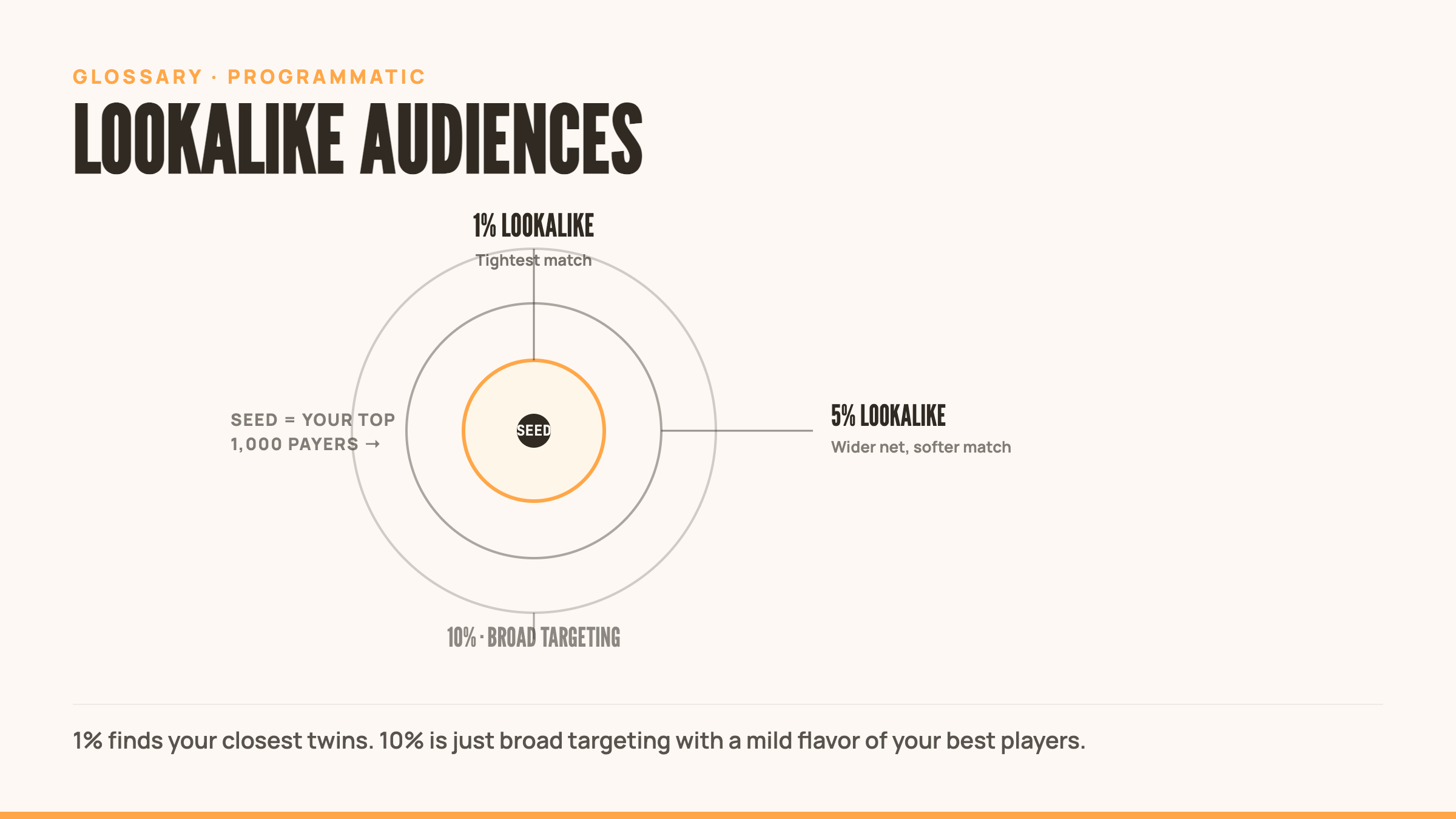
Then you choose your lookalike percentage. A 1% lookalike targets the most similar users in a country. 2-5% expands the net but dilutes similarity. 10% is basically broad targeting with a slight flavor of your source.
The algorithm builds the segment automatically. You set budgets, launch campaigns, and let it run.
Meta requires at least 100 people in your source audience. They recommend 1,000-5,000 for best results. Bigger sources give the algorithm more signal to work with.
Mobile-Specific Applications
Mobile games ran lookalikes hard because in-app events gave platforms rich behavioral data.
Upload your Day 7 retention cohort. Create a lookalike. The algorithm finds users with similar engagement patterns before they even install your game.
Upload your payers. Get a lookalike of people likely to spend. Run that against your top-performing creatives and watch CPI drop while LTV holds.
The holy grail was lookalikes of high-LTV players. Not just people who paid once, but whales who kept coming back. Platforms could identify those patterns at scale.
For a few years, this was the playbook. Then ATT hit and everything changed.
Platform Changes
The lookalike landscape shifted dramatically.
Meta still offers lookalikes, but they’re not the default anymore. Advantage+ campaigns and Broad targeting often outperform manual lookalikes now. The algorithm has enough signal from creatives and early performance data that it doesn’t need your seed list.
Google shut down Similar Segments entirely in 2023 — new similar audiences stopped generating that May, and existing ones were pulled from every campaign by August. Replaced them with Optimized Targeting and Demand Gen campaigns that figure out audiences on their own. The message was clear: we don’t need your help anymore.
TikTok still runs lookalikes, but with the same trend. Broad targeting with strong creative often wins.
The shift makes sense. Platforms have more data than your seed audience. They see patterns across millions of apps. Your 5,000-person list is a rounding error compared to what they already know.
Best Practices
If you’re still using lookalikes, here’s what works:
Start with 1% lookalikes. Most similar, highest conversion rates. Test broader percentages only if 1% delivers at scale but you need more reach.
Use high-quality seeds. Don’t upload everyone who ever opened your app. Use your best players. Day 30 retention. Payers. Level 10 completers. Quality of source matters more than size.
Test against Broad. Run Broad targeting alongside your lookalikes. Platforms might surprise you. Their algorithms might already know what your lookalike was trying to teach them.
Refresh your seeds. Audiences decay. A lookalike built from 2023 payers doesn’t reflect 2025 player behavior. Update quarterly at minimum.
Layer creatives strategically. Lookalikes narrow your reach. If your creative is already doing heavy lifting (playable ads with strong hooks), you might not need the extra targeting layer.
Common Mistakes
Uploading garbage seeds. Everyone who visited your website once is not a quality source. The algorithm learns from what you give it. Feed it noise, get noise back.
Assuming lookalikes still win by default. The playbook changed. Test everything. Broad often wins now, especially with strong creative.
Not testing multiple seed sources. Payer lookalikes and engagement lookalikes behave differently. Test both. The best source might surprise you.
Ignoring creative quality. No targeting saves bad creative. Lookalikes don’t fix weak hooks or unclear value props. They amplify what’s already working.
Over-relying on old tactics. What worked in 2021 doesn’t necessarily work in 2025. The platforms evolved. Your strategy should too.
Related Terms
- Broad Targeting – No audience restrictions, algorithm decides
- Custom Audiences – Your existing customer lists
- Advantage+ Campaigns – Meta’s automated campaign type
- Optimized Targeting – Google’s replacement for Similar Segments
- Seed Audience – Source list used to build lookalikes
External Resources
- Shopify: Lookalike Audiences Guide
- Leadsbridge: How to Use Facebook Lookalike Audiences
- Be Found Online: Lookalike Audiences in 2024
Frequently Asked Questions
What is a lookalike audience?
A lookalike audience is algorithmic targeting that finds new users who share characteristics with your existing customers. You upload a seed audience, like your best players or payers, and the platform analyzes it for patterns, then scans its user base to find matches.
How do I create a lookalike audience?
You start with a source audience, such as a customer list, app event data, or engagement audience. Then you choose a lookalike percentage, from 1% (most similar) up to around 10% (closer to broad targeting), and the platform builds and runs the segment.
Are lookalike audiences still worth using in 2026?
It depends on your setup. Test them against Broad targeting. Some teams still see wins with high-quality seeds, while others find Broad plus strong creative outperforms. The answer is in your own data, not theory.
Should I use 1% or 5% lookalikes?
Start with 1%. It’s the most similar to your seed and delivers the highest conversion rates. Only expand to 2-5% if you’re hitting scale limits and need more reach, since broader percentages dilute match quality.
Why did Google remove Similar Segments?
Google shut down Similar Segments entirely in 2023 and replaced them with Optimized Targeting and Demand Gen campaigns that build audiences automatically using creative signals and early performance data. Meta still offers lookalikes, but Advantage+ and Broad targeting now often outperform manual lookalike lists.