

glossary
Probabilistic Matching
Probabilistic Matching is a statistical attribution method that assigns likelihood scores to campaigns when deterministic matching fails. Instead of saying “Campaign X caused this install,” it says “Campaign X probably caused this install with 70% confidence.”
Quick Definition
Probabilistic Matching is a statistical attribution method that assigns likelihood scores to campaigns when deterministic matching fails. Instead of saying “Campaign X caused this install,” it says “Campaign X probably caused this install with 70% confidence.”
Used when there’s no shared identifier between ad click and app install.
What is Probabilistic Matching
When someone clicks your ad and installs your game, mobile attribution should be simple. Match the click ID to the install ID. Done.
But what happens when there’s no ID to match?
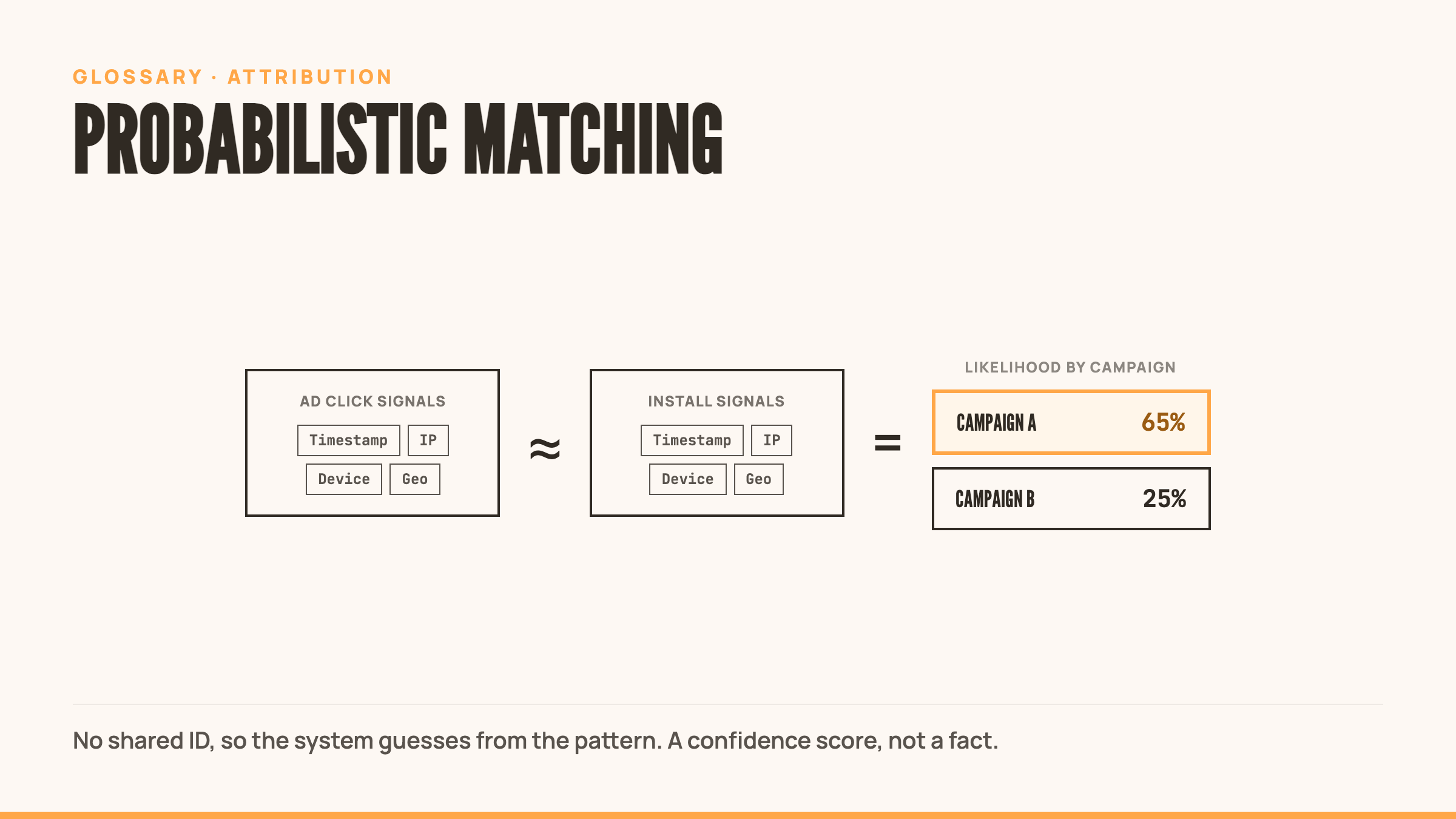
That’s where probabilistic matching comes in. It looks at patterns instead of identifiers. Device type, IP address, time of day, user agent, location data. It builds a probability distribution across campaigns and says “based on these signals, Campaign A has a 65% chance of driving this install, Campaign B has a 25% chance.”
You get a best guess. Not certainty.
How It Works
Probabilistic matching compares data points from two events:
Event 1: Ad Click
- Timestamp
- IP address
- Device model
- OS version
- Geographic location
- Browser/user agent
Event 2: App Install
- Timestamp
- IP address
- Device model
- OS version
- Geographic location
The system calculates how likely each campaign is to have generated that install based on signal overlap. More matching signals mean higher confidence. Fewer matches mean lower confidence.
The key difference from deterministic matching: no persistent identifier links the two events. You’re matching patterns, not IDs.
Probabilistic vs Fingerprinting
This is where things get messy.
True probabilistic matching generates a probability distribution without creating a persistent identifier. It evaluates each attribution independently.
Fingerprinting combines device signals into a unique, persistent ID that tracks users across sessions and apps. That ID becomes a de facto tracking mechanism.
In theory, they’re different. In practice, the line blurs.
Many attribution vendors labeled their fingerprinting tech as “probabilistic attribution” after Apple banned fingerprinting under ATT. Same process, different name. The underlying technology didn’t change. Just the marketing copy.
The difference that matters:
- Probabilistic: Statistical inference per attribution event
- Fingerprinting: Persistent cross-app tracking via device signature
Apple prohibits fingerprinting. Whether probabilistic matching crosses that line depends on implementation. The enforcement is unclear.
Apple’s Stance (ATT)
Apple’s App Tracking Transparency framework explicitly prohibits fingerprinting. Apple’s guidelines state that using device signals to identify users or devices is not allowed.
The problem: Apple hasn’t clearly defined where probabilistic matching ends and fingerprinting begins. The guidance is vague. The enforcement is inconsistent.
Confusion across the industry followed.
Some MMPs claim their probabilistic methods comply with ATT. Others avoid it entirely. Apple has rejected some apps for fingerprinting violations, but the criteria aren’t public.
What we know:
- Fingerprinting is banned
- Probabilistic matching operates in a gray zone
- Many mobile app marketers remain unclear on whether probabilistic methods count as fingerprinting
If you’re using probabilistic attribution, understand the risk. Apple could decide your implementation violates ATT. The rules are fuzzy. The stakes are high.
Common Mistakes
Assuming Probabilistic = ATT Compliant
Probabilistic matching isn’t automatically allowed under ATT. If your vendor is building persistent device fingerprints, you’re in violation. Ask how they implement it.
Treating Probabilistic Data Like Deterministic Data
A 60% confidence score is not the same as a deterministic match. Don’t optimize campaigns assuming probabilistic data is ground truth. It’s a best guess with error margins.
Not Auditing Your MMP’s Methods
Many vendors rebranded fingerprinting as probabilistic without changing the tech. Ask your MMP directly: Are you creating persistent identifiers? How do you handle ATT compliance?
Ignoring Privacy Regulations
Probabilistic matching may violate GDPR or other privacy laws depending on implementation. Data collected without consent for tracking can create legal exposure.
Related Terms
- Mobile Attribution – Parent category for all attribution methods
- MMP (Mobile Measurement Partner) – Platforms that implement probabilistic matching
- ATT (App Tracking Transparency) – Apple’s framework that restricts fingerprinting
- SKAdNetwork – Apple’s privacy-preserving alternative to traditional attribution
- IDFA – The deterministic identifier Apple deprecated with ATT
External Resources
- Singular: Probabilistic Attribution Glossary
- Branch: Probabilistic Modeling Explained
- Liftoff: Probabilistic Attribution vs Fingerprinting
Frequently Asked Questions
What is the difference between deterministic and probabilistic matching?
Deterministic matching links a click to an install through a shared identifier, an exact match. Probabilistic matching has no shared ID, so it builds a confidence score from signals like device type, IP, and timing instead.
Is fuzzy matching probabilistic?
They’re related but not identical. Fuzzy matching finds approximate matches between data points. Probabilistic matching specifically assigns a statistical likelihood score across multiple signals, which fuzzy matching can feed into but isn’t the same as.
Is probabilistic matching allowed under ATT?
Maybe. Apple bans fingerprinting but hasn’t clearly defined where probabilistic matching ends and fingerprinting begins. If your method creates persistent device identifiers, it’s likely prohibited.
How accurate is probabilistic matching?
It depends on signal strength. Confidence scores typically range from 40% to 90%. Less accurate than deterministic matching, but useful when no shared ID exists.