

glossary
IDFA (Identifier for Advertisers)
Quick Definition: Apple’s device identifier for ad tracking and attribution on iOS. Pre-iOS 14.5, marketers had it by default. Post-ATT, users control access with opt-in rates around 14-26%. — 01. What is IDFA IDFA is a unique, random identifier Apple assigns to every iOS device. Looks like this: `AEBE52E7-03EE-455A-B3C4-E57283966239`. It’s anonymous. No personal info attached. […]
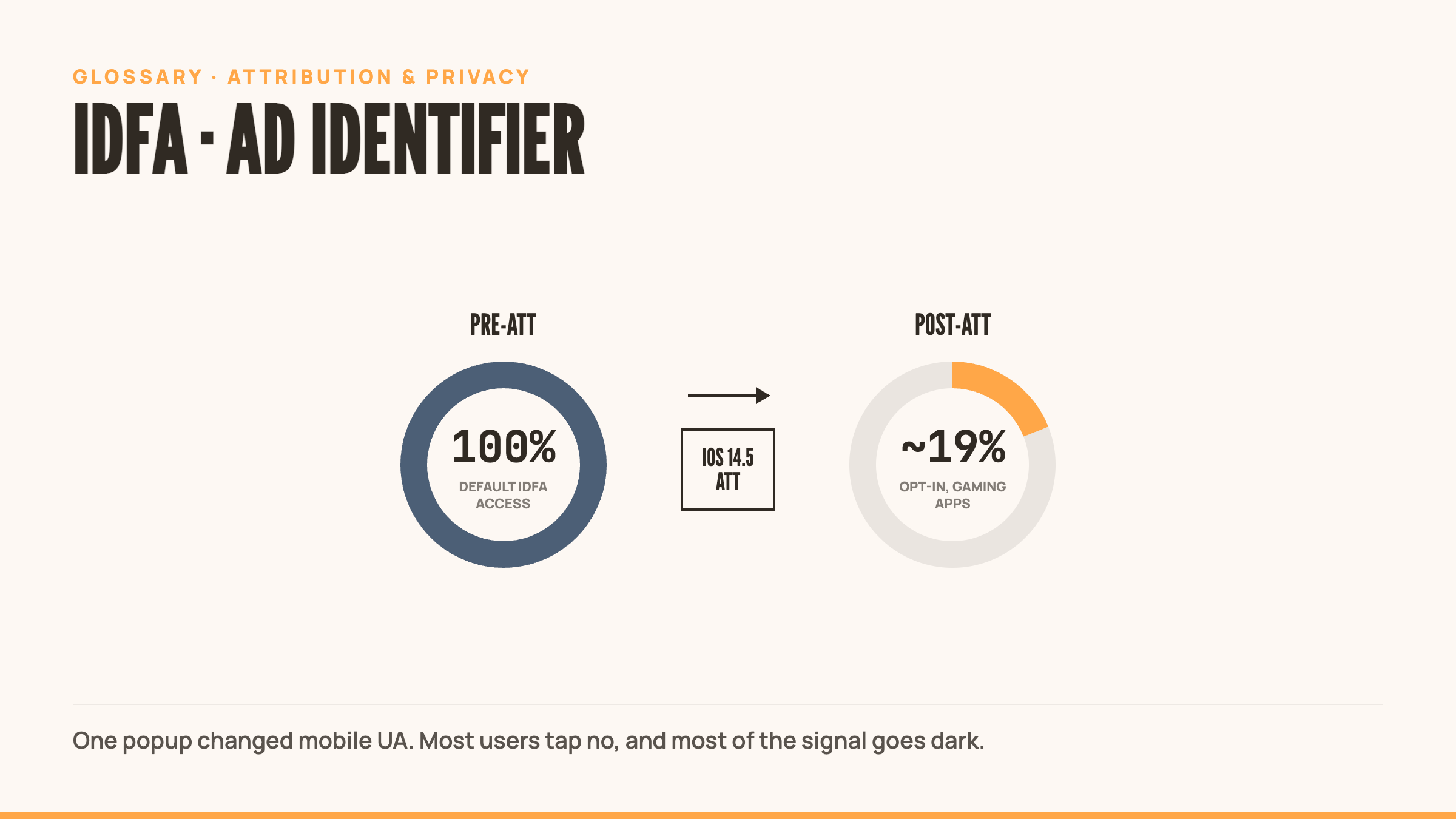
Quick Definition: Apple IDFA is the device identifier Apple assigns for ad tracking and attribution on iOS. Pre-iOS 14.5, marketers had it by default. Post-ATT, users control access, and opt-in rates now run roughly 35-50% aggregate depending on measurement methodology, up from the low-20s% in 2021-2022.
What is IDFA
IDFA is a unique, random identifier Apple assigns to every iOS device. Looks like this: AEBE52E7-03EE-455A-B3C4-E57283966239.
It’s anonymous. No personal info attached. Just a string that lets ad platforms track user behavior across apps without knowing who you actually are.
The idea: advertisers can measure campaigns, attribute installs, and retarget users without accessing names, emails, or anything sensitive.
Users can reset their IDFA anytime in Settings. When they do, it’s like getting a new identity. Previous tracking breaks.
How It Was Used (Pre-ATT)
Before iOS 14.5, IDFA was available by default. Every app could access it without asking permission.
This powered the entire mobile UA ecosystem:
Attribution: Match ad impressions to installs. Know which campaigns drove which users.
Retargeting: Show ads to users who installed your game but haven’t played in a week.
Audience Building: Build lookalike audiences based on high-value user behavior.
Performance Measurement: Track ROAS, CPI, LTV with device-level precision.
It was the backbone of how performance marketing worked in mobile gaming.
iOS 14.5+ Changes
April 2021. Apple dropped ATT (App Tracking Transparency).
Now apps must ask permission to access IDFA. That popup: “Allow [App] to track your activity across other companies’ apps and websites?”
Most users say no.
If a user declines, you don’t get their IDFA. You get a string of zeros instead. Attribution becomes murky. Retargeting becomes impossible at the device level.
This broke how UA worked for a decade.
Current Opt-In Rates
Opt-in has climbed since ATT launched, not fallen. Adjust’s 2025 benchmark data puts the aggregate opt-in rate around 34-35%, up from roughly 21% in 2022. AppsFlyer reports an even higher ~50% global opt-in rate as of Q1 2024, a 10-point increase since the April 2021 launch. The gap between the two numbers comes down to methodology, but both agree on direction: users are opting in more as the prompt becomes familiar and apps improve their pre-permission messaging.
Gaming apps: On the narrower “immediate opt-in” measure (the yes/no answer right at the prompt, before any pre-permission framing), Adjust’s Q2 2024 data puts gaming at roughly 19% vs. 12% for non-gaming apps. Games still outperform the broader app market on this stricter metric, even as aggregate opt-in rates run higher across the board.
Opt-in rates vary meaningfully by region, genre, and how the pre-permission prompt is framed. Treat any single global number as directional, not universal.
Translation: If you run iOS UA campaigns today, you’re still flying blind on a majority of users. Even at the higher end of current estimates, roughly half to two-thirds of iOS users decline tracking. You don’t know which ad they saw. You don’t know if they came from your campaign or organic search.
That’s why probabilistic attribution, SKAdNetwork, and incrementality testing became critical post-ATT.
Alternatives When IDFA Unavailable
When you can’t get IDFA, you work with what Apple allows:
SKAdNetwork (SKAN): Apple’s privacy-safe attribution framework. Gives you campaign-level data with delays and limits. No user-level tracking.
Probabilistic Attribution: MMPs match fingerprints (IP address, device type, timestamp) to guess which user clicked which ad. Less accurate than IDFA, but better than nothing.
Aggregated Reporting: Platforms like Meta and Google provide aggregated campaign metrics without device-level data.
Contextual Targeting: Target based on app category, time of day, geography instead of user behavior.
Incrementality Testing: Run holdout groups to measure true campaign lift vs. organic baseline.
None of these replace deterministic IDFA tracking. They’re workarounds in a privacy-first world.
Common Mistakes
Assuming IDFA access: Building attribution models that rely on high IDFA availability. Even at current, higher opt-in rates, most iOS users still decline. Plan for the majority being unavailable.
Ignoring SKAN: Dismissing SKAdNetwork as “too limited” and not investing in SKAN-optimized campaigns. SKAN is imperfect but necessary.
Over-relying on last-click: When IDFA is unavailable, last-click attribution breaks down. You need probabilistic models and incrementality testing.
Not testing incrementality: Running UA without measuring true lift. You might be buying installs that would’ve happened organically.
Forgetting Android: IDFA is iOS-only. Android uses GAID (Google Advertising ID), which still works without ATT-style restrictions (for now).
Related Terms
ATT (App Tracking Transparency): Apple’s iOS 14.5+ framework requiring user permission to access IDFA
GAID (Google Advertising ID): Android’s equivalent to IDFA
SKAdNetwork (SKAN): Apple’s privacy-safe attribution API for iOS campaigns
Deterministic Attribution: Device-level tracking with exact identifiers like IDFA or GAID
Probabilistic Attribution: Fingerprint-based matching when device IDs aren’t available
Incrementality Testing: Measuring campaign lift by comparing exposed vs. unexposed user groups
External Resources
Frequently Asked Questions
Can I still run iOS UA campaigns without IDFA?
Yes. You work with aggregated data, SKAdNetwork, and probabilistic models instead. Campaigns run fine, but attribution gets messier without device-level tracking.
Do games have higher IDFA opt-in rates?
Yes. Gaming apps see around 19% opt-in versus roughly 12% for non-gaming apps. Still a minority of users, but meaningfully better than the non-gaming average.
What happens if a user resets their IDFA?
They get a new identifier, and previous tracking tied to the old one stops working. Retargeting lists lose that user entirely, as if they were a brand-new install.
Is IDFA going away completely?
Not yet. Apple gated it behind user permission rather than killing it outright. As long as some users opt in, IDFA still has value for attribution and retargeting on the users who do.