

glossary
Mobile Attribution
Mobile attribution tracks which marketing activities drive app installs and post-install events. Without it, you’re running UA blind.
Quick Definition
Mobile attribution tracks which marketing activities drive app installs and post-install events. Without it, you’re running UA blind.
What is Mobile Attribution
Mobile attribution connects the dots between your ad spend and user actions. When someone installs your game after seeing an ad, attribution tells you which campaign, creative, and channel made it happen.
This matters because half your budget is wasted. Attribution shows you which half.
For mobile games, attribution goes deeper than installs. It tracks retention, in-app purchases, level completions, and lifetime value. You need to know if that $50K spend on TikTok drove installs that churned in 24 hours or whales that paid back 5x.
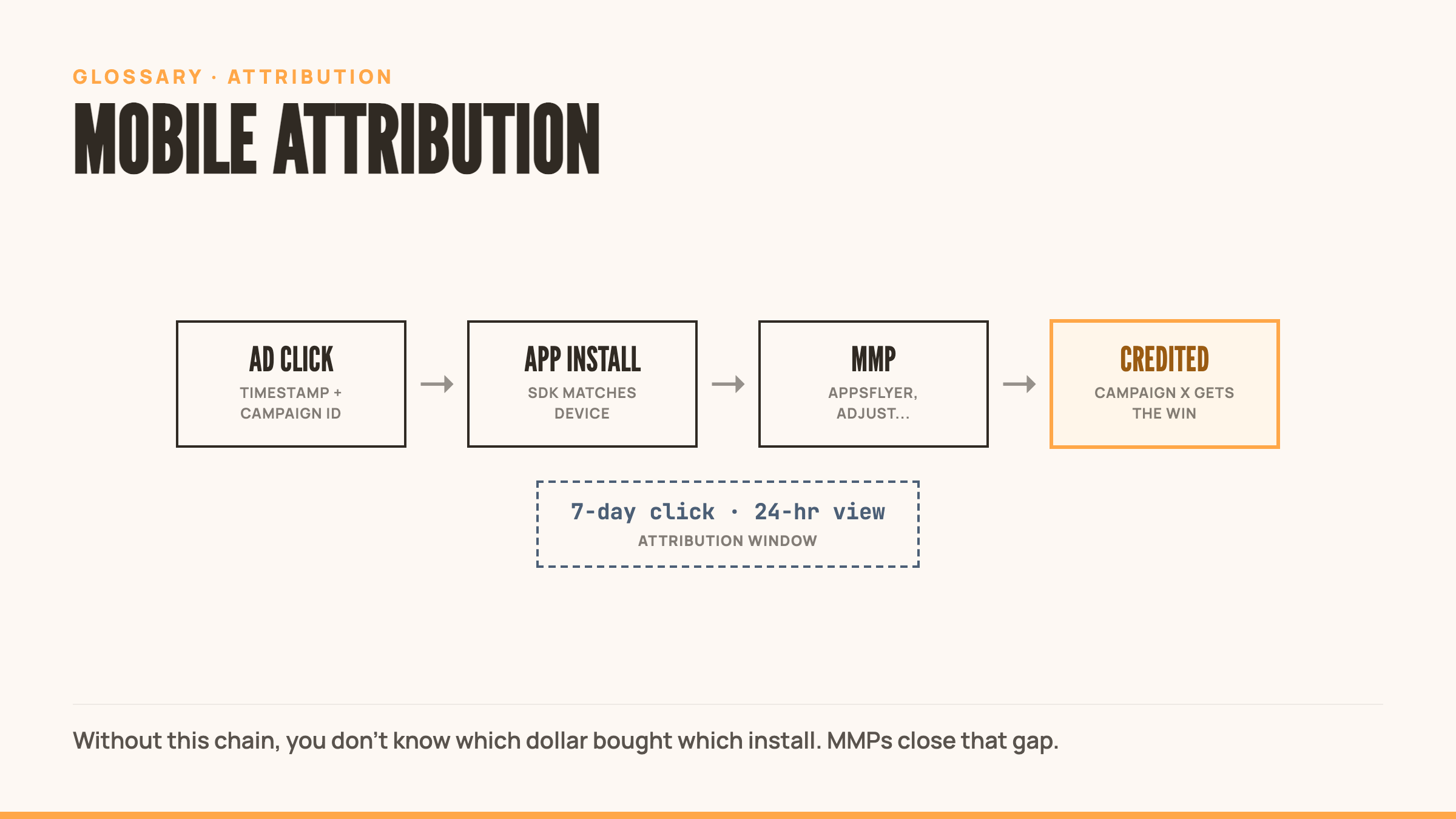
Mobile Measurement Partners (MMPs) like AppsFlyer, Adjust, Branch, and Singular handle the technical complexity. They sit between your ads and your app, tracking every touchpoint.
How It Works
Attribution relies on three core mechanisms:
Tracking Links Your ad networks generate unique click URLs. When a user taps an ad, the MMP records the timestamp, campaign ID, creative variant, and device information. If that user installs within the attribution window (usually 7 days for clicks, 24 hours for views), it counts as a conversion.
SDKs You integrate the MMP’s SDK into your app. On first launch, the SDK fingerprints the device and matches it against recent ad clicks. This fires the attribution event back to the MMP and your analytics stack.
Device Identifiers Historically, attribution used IDFA (iOS) and GAID (Android) for deterministic matching. Post-ATT, iOS attribution shifted to probabilistic fingerprinting and Apple’s SKAdNetwork framework.
The MMP aggregates this data across channels. Your dashboard shows which campaigns drive installs, which creatives convert, and which sources deliver high-LTV users.
Attribution Models
Different models assign credit differently. Choose based on your funnel complexity.
Last-Click Attribution 100% credit to the final touchpoint before install. Simple, biased toward bottom-funnel channels. Ignores the TikTok ad that started the journey.
First-Click Attribution All credit to the first interaction. Good for measuring awareness campaigns. Terrible for understanding conversion paths.
Linear Attribution Equal credit across all touchpoints. Fair but blunt. Treats a fleeting banner impression the same as a demo video watch.
Time-Decay Attribution More credit to recent touchpoints. Assumes proximity to conversion matters most. Works well for longer consideration cycles.
Multi-Touch Attribution (MTA) Sophisticated weighting across the entire journey. Requires significant data volume. Most useful for games with complex funnels and multi-channel strategies.
For most mobile games, last-click works until your spend hits $100K/month. Then consider time-decay or MTA.
Privacy Changes (iOS 14.5+)
Apple’s App Tracking Transparency (ATT) framework killed deterministic iOS attribution in 2021.
Pre-ATT Reality IDFA was always-on. Attribution was deterministic. You knew exactly which ad drove which install.
Post-ATT Reality Users must opt in to tracking. Opt-in rates now average around 35% industry-wide, up from the mid-20s in ATT’s early years, though the rate swings hard by vertical (gaming categories like hyper-casual and sports opt in well above average, education apps well below). For the majority who don’t opt in, you’re working with:
- Probabilistic fingerprinting: Match installs based on IP, device type, and timestamp. Less accurate, especially for common device configurations.
- SKAdNetwork (SKAN): Apple’s privacy-preserving framework. Provides aggregated, delayed conversion data. No user-level tracking. No deep linking to specific campaigns.
SKAN limitations hit hard:
- 24-48 hour reporting delay
- Limited conversion values (6 bits = 64 possible values)
- No view-through attribution
- Campaign IDs capped at 100 per account
Android remains largely deterministic via GAID, though Google’s Privacy Sandbox threatens similar restrictions.
What This Means for UA iOS attribution got expensive and imprecise. You’re optimizing on smaller data sets with longer feedback loops. Creative testing takes longer. Incrementality testing matters more.
Best Practices
1. Choose the Right MMP AppsFlyer dominates Android (48.51% market share). Adjust, Branch, and Singular all work. Pick based on your ad network integrations and analytics stack compatibility.
2. Set Attribution Windows Correctly Standard: 7-day click, 1-day view. Shorten for hyper-casual (1-day click). Extend for strategy games with longer consideration (14-day click).
3. Track Post-Install Events Installs are vanity metrics. Track D1/D7/D30 retention, first purchase, level 10 completion, whatever predicts LTV in your game.
4. Use Cohort Analysis Group users by install date and source. Track retention and revenue curves over time. A campaign that looks profitable on Day 1 might crater by Day 7.
5. Run Incrementality Tests Attribution shows correlation. Incrementality tests show causation. Pause campaigns and measure the lift. Some channels ride organic waves.
6. Implement Deep Linking Send users to the exact content they clicked. If someone taps an ad for a limited-time bundle, drop them on the bundle purchase screen. Conversion rates double.
Common Mistakes
Trusting Self-Attributed Networks Blindly Facebook and Google report their own conversions. Cross-reference with your MMP. Discrepancies reveal attribution gaming.
Ignoring View-Through Attribution VTA credits impressions even without clicks. Useful for brand awareness, dangerous for performance. Someone who saw your ad three days ago might have installed organically.
Over-Attribution Attribution windows that are too long inflate channel performance. A user who clicked your ad, ignored it for 6 days, then saw a friend playing your game gets credited to the ad. Tighten your windows.
Under-Investing in SKAN Optimization iOS still matters despite ATT. Learn SKAN’s constraints. Use conversion value schemas strategically. Accept longer optimization cycles.
Not Reconciling Spend Your ad network says you spent $10K. Your MMP says you got 5K installs. Your bank statement says $12K. Reconcile weekly or burn budget on phantom installs.
Related Terms
- Mobile Measurement Partner (MMP): Third-party platform that tracks attribution across ad networks
- SKAdNetwork (SKAN): Apple’s privacy-centric attribution framework for iOS 14.5+
- App Tracking Transparency (ATT): iOS framework requiring user consent for tracking
- IDFA (Identifier for Advertisers): Apple’s device-level tracking ID (now opt-in only)
- GAID (Google Advertising ID): Android’s device-level tracking ID (still deterministic)
- Deep Linking: Routing users to specific in-app content based on ad click source
- Incrementality Testing: Measuring true lift by pausing campaigns and comparing results
- View-Through Attribution (VTA): Crediting ad impressions (not just clicks) for conversions
External Resources
Frequently Asked Questions
What is a mobile app attribution tool?
A mobile app attribution tool, or Mobile Measurement Partner (MMP), sits between your ads and your app and tracks every touchpoint. Platforms like AppsFlyer, Adjust, Branch, and Singular handle the technical complexity of connecting ad spend to installs and post-install events.
Do I need an MMP if I only run Meta ads?
Yes. Meta’s attribution is self-reported and optimized for Meta’s own interests, not yours. An MMP provides independent verification and cross-channel insights you can’t get from a single ad network’s dashboard.
What’s the difference between attribution and analytics?
Attribution tells you which ads drove installs. Analytics tells you what users do after installing. You need both, and most MMPs integrate with analytics platforms like Amplitude, Mixpanel, or your own BI stack.
How accurate is SKAN attribution?
Less accurate than pre-ATT deterministic tracking. Expect roughly 10-15% of iOS installs to go unattributed, and aggregated data limits creative-level optimization. It’s what we have to work within for now.
What’s a good attribution window?
Start with 7-day click, 1-day view. Shorten to 3-day or 1-day click for hyper-casual games, and extend to 14-day for games with longer consideration cycles like strategy or RPG. Review quarterly based on actual conversion timing data.