

glossary
View-Through Attribution (VTA)
View-Through Attribution credits conversions that happen after a user sees an ad but doesn’t click it. The user saw your creative, kept scrolling, then installed later. VTA captures that impact.
Quick Definition
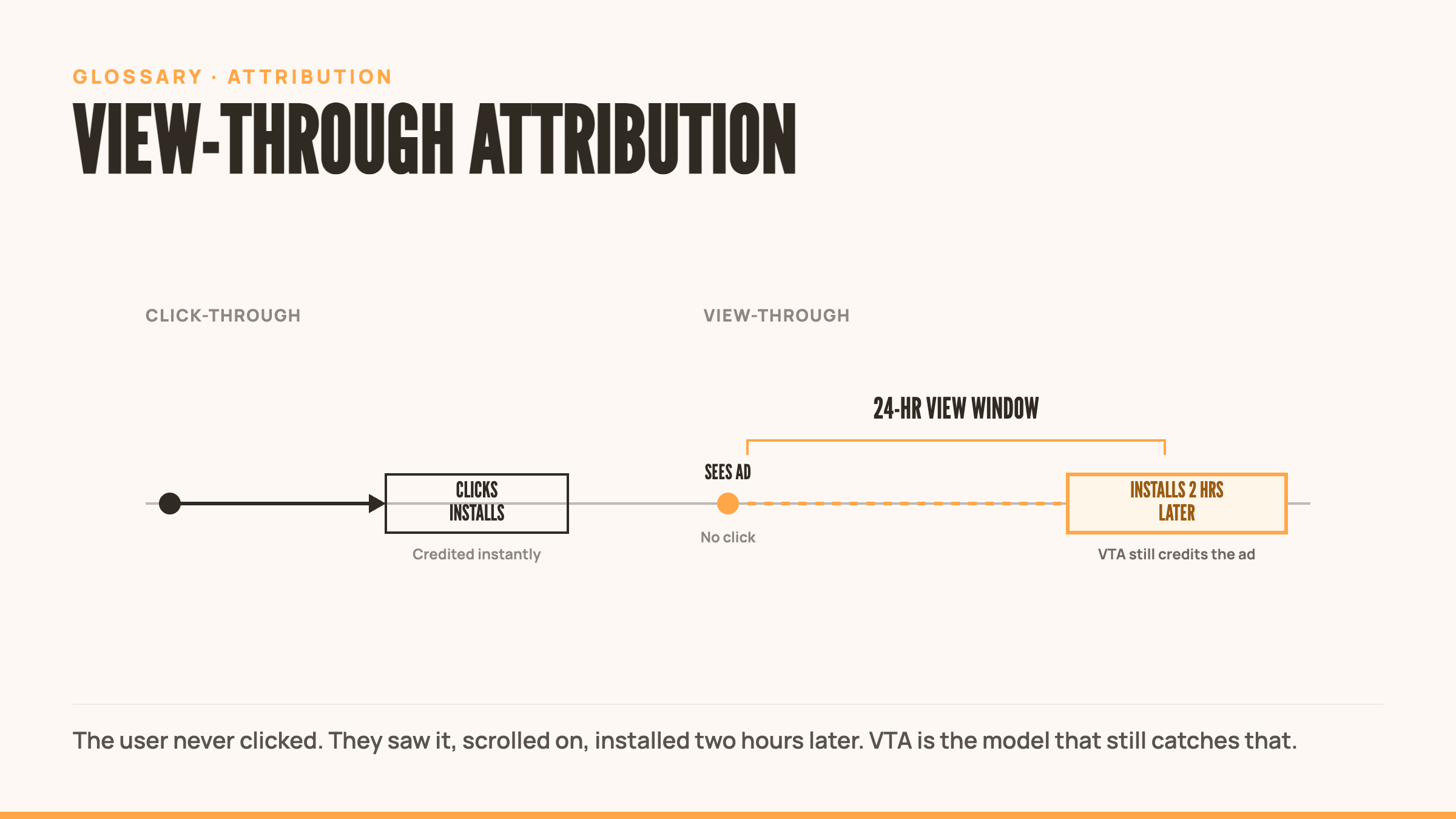
A view through conversion happens when a user sees your ad, doesn’t click it, then installs later anyway. View-Through Attribution credits that conversion back to the ad that started it. VTA captures impact clicks alone would miss.
What is VTA
Most attribution tracks clicks. Click the ad, install the game, conversion counted. Simple.
But that’s not how people actually behave.
A player sees your playable ad on Instagram. Looks interesting. They keep scrolling. Two hours later, they’re thinking about that puzzle mechanic. They search for your game. They install.
Click-through attribution would miss that completely. The ad drove the install, but there’s no click to track.
VTA solves this by tracking viewable impressions. If someone saw your ad (actually saw it, not just had it load below the fold), then installed within a defined window, VTA gives the ad credit.
Attribution Windows
VTA works within time limits. After the window closes, the connection breaks.
Standard VTA window: 24 hours Range across platforms: 1 hour to 7 days
Most setups run dual windows:
- 7-day click-through window (industry standard)
- 24-hour view-through window (catches the non-clickers)
Why the difference? Clicks show stronger intent. Views are softer signals. The shorter window keeps attribution cleaner.
VTA vs Click-Through Attribution
Click-Through Attribution (CTA) only counts users who clicked your ad. Direct cause and effect. Easy to measure, easy to trust.
VTA counts users who saw the ad but didn’t click. Harder to measure, easier to question.
The tension: VTA inflates conversion numbers. Some of those “view-through conversions” would have installed anyway. They saw your ad, sure. But did the ad actually drive the decision?
The reality: Both matter. CTA underestimates ad impact by missing everyone who doesn’t click. VTA shows the fuller picture of creative influence.
Use them together. Track both. Optimize for the metric that matches your goal.
When to Use VTA
VTA matters most for products with longer consideration cycles.
High-value VTA categories:
- E-commerce (browse, think, buy later)
- Fintech (research, compare, decide)
- Streaming apps (saw the ad, remembered the show)
- Strategy games (complex mechanics need time to sink in)
Low-value VTA categories:
- Hypercasual games (instant decisions, clicks tell the story)
- Impulse purchases (if they want it, they click)
VTA also matters for brand campaigns where the goal is awareness, not immediate action. You’re planting seeds, not harvesting clicks.
Privacy Considerations
iOS ATT changed everything.
Before ATT, deterministic attribution worked across devices. Unique identifiers tracked users from impression to install. VTA was clean.
After ATT, most iOS users opted out. No IDFA, no deterministic tracking.
Now VTA on iOS relies on:
- SKAdNetwork: Apple’s privacy-first framework. Limited conversion data, no user-level tracking.
- Probabilistic matching: Statistical guesses based on aggregated data. Less precise, more directional.
Android still allows device IDs (for now). VTA works traditionally there. But privacy regulations are tightening globally. Expect more SKAdNetwork-style restrictions.
The shift means VTA data is fuzzier than it used to be. You’re trading precision for privacy. Adjust expectations accordingly.
Common Mistakes
1. Trusting view-through conversions like click-through conversions
They’re not the same. VTA includes users who would have converted anyway. Weight VTA data lower in your analysis.
2. Using VTA windows that are too long
A 7-day VTA window captures too much noise. The longer the window, the weaker the signal. Stick to 24 hours unless you have a specific reason to extend it.
3. Double-counting conversions
If a user sees an ad, clicks a different ad, then installs, who gets credit? Make sure your attribution model has clear rules. Last-click? Multi-touch? Define it.
4. Ignoring platform differences
VTA on iOS post-ATT is not VTA on Android. iOS data is modeled, Android is deterministic. Don’t compare them directly.
5. Optimizing creative for views instead of outcomes
High viewability doesn’t mean high performance. An ad can be 100% viewable and still drive zero installs. Optimize for conversions, not just impressions.
Related Terms
- Click-Through Attribution (CTA): Attribution based on ad clicks
- Attribution Window: Time frame for crediting conversions to ad exposure
- SKAdNetwork: Apple’s privacy-focused attribution framework for iOS
- Deterministic Attribution: Precise tracking using device IDs
- Probabilistic Attribution: Statistical modeling when device IDs unavailable
- Viewability: Whether an ad was actually seen (not just loaded)
- Multi-Touch Attribution: Crediting multiple touchpoints in the conversion path
External Resources
- AppsFlyer: View-Through Attribution
- Adjust: View-Through Attribution
- Singular: View-Through Attribution
Frequently Asked Questions
Should I trust view-through conversions as much as click-through conversions?
No. VTA conversions are softer signals; some of those users would have installed anyway. Use VTA to understand creative influence, not as your primary performance metric.
What VTA window should I use?
24 hours for most campaigns. Extend to 48-72 hours only if your product has a longer consideration cycle, like fintech or strategy games.
Does VTA work on iOS after ATT?
Kind of. It’s modeled data now through SKAdNetwork and probabilistic matching, not deterministic tracking. You get directional insights, not precise numbers. Android VTA is still more reliable.
What if my view-through conversions are 10x higher than click-through?
Your VTA window is probably too long, or your targeting is too broad. Tighten the window to 24 hours and check if you’re showing ads to users already considering your game.