

glossary
Last-Click Attribution
Last-click attribution assigns 100% of conversion credit to the final touchpoint before a user converts. It’s simple to implement but ignores everything that happened earlier in the journey. Your awareness campaigns get zero credit, your mid-funnel content is invisible, and budget decisions get made on incomplete data.
Quick Definition
Last-click attribution assigns 100% of conversion credit to the final touchpoint before a user converts. It’s simple to implement but ignores everything that happened earlier in the journey. Your awareness campaigns get zero credit, your mid-funnel content is invisible, and budget decisions get made on incomplete data.
What is Last-Click Attribution?
Last-click attribution is the measurement model that refuses to see the full picture.
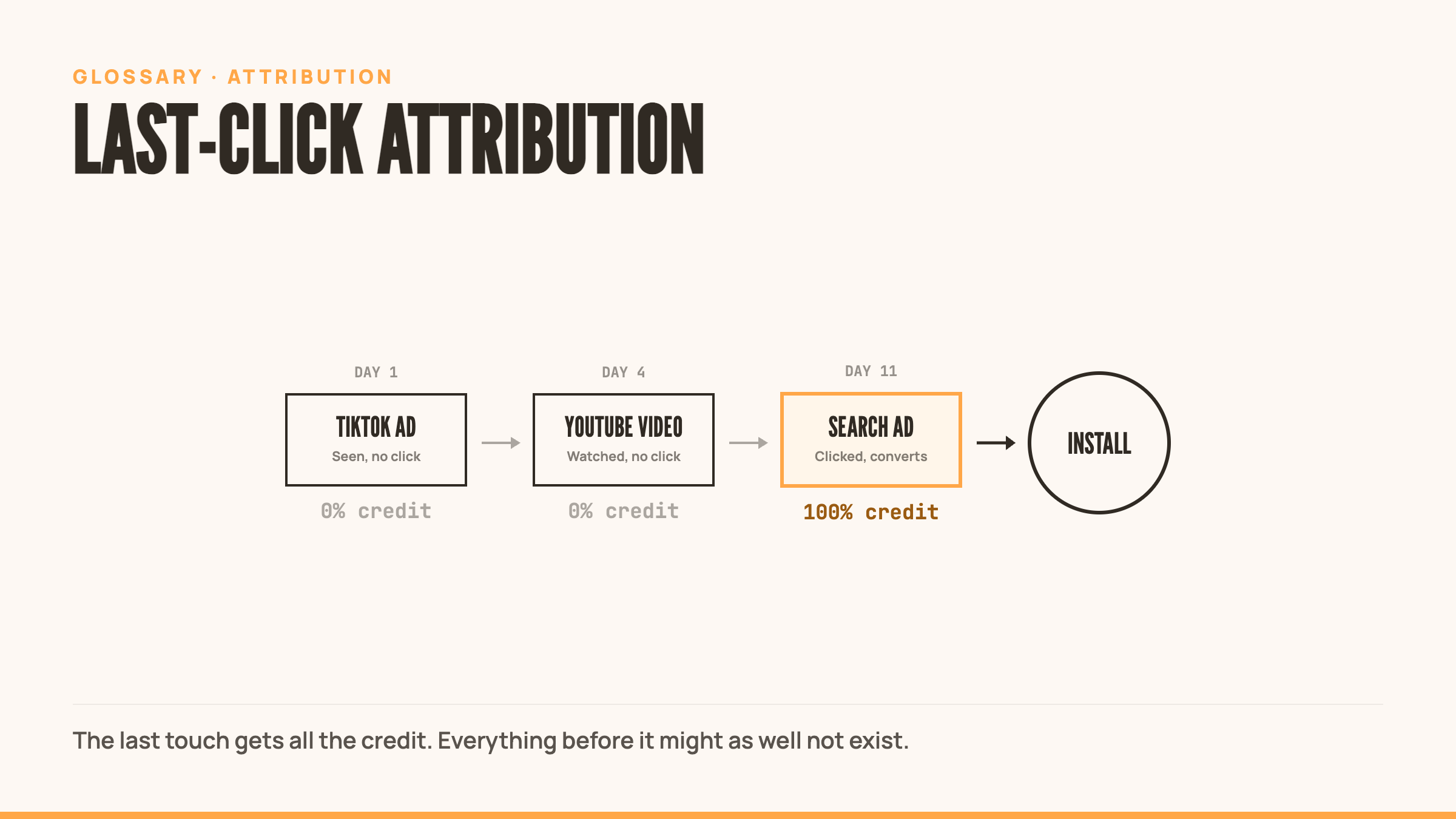
It works like this: A user sees your TikTok ad. Doesn’t click. Three days later, they see your YouTube video. Still doesn’t convert. A week later, they Google your game, click your search ad, and install. Last-click attribution gives 100% of the credit to that final search ad.
Everything else? Might as well not exist.
The appeal is obvious. Last-click is simple. Easy to implement. Easy to explain. You can point at a channel and say “this drove installs.” Executives love clean stories.
The problem is the story is wrong.
Most user journeys in mobile gaming involve multiple touchpoints. A user sees your video ad, watches a streamer play your game, reads a review, then finally installs after seeing a retargeting ad. Last-click gives all the credit to retargeting and tells you to cut the video budget.
That’s not insight. That’s data telling you to kill the campaigns that create demand in the first place.
Here’s what last-click attribution actually measures: which channel happened to be last. Not which channel was most valuable. Not which combination of channels drove the install. Just which one was there at the end.
It’s like crediting the closer in baseball while ignoring the pitcher who threw eight shutout innings.
The consequences are real. You under-invest in awareness. You over-invest in bottom-funnel channels. You optimize for the last click instead of the customer journey. Your attribution model becomes a self-fulfilling prophecy: only bottom-funnel channels get budget, so only bottom-funnel channels show results.
Mobile gaming makes this worse. Game installs involve research. Users watch gameplay videos, read reviews, check app store ratings, ask friends. The journey is complex. Last-click attribution flattens all of that complexity into a single moment.
And that single moment is almost always wrong.
Key Limitations
Ignores the Full Journey
Last-click only sees the finish line. It misses every step that got the user there. If a user saw your video ad five times, engaged with your influencer content, and then clicked a search ad, last-click credits search and tells you video didn’t work.
Undervalues Awareness and Consideration
Top-funnel campaigns create demand. They introduce users to your game, build interest, and start the journey. Last-click gives them zero credit because they’re rarely the final touchpoint. Budget flows to bottom-funnel, and awareness campaigns get cut.
Budget Misallocation
When attribution is broken, budget allocation follows. Teams over-invest in retargeting and search, under-invest in brand and video. The channels that create demand get starved. Long-term growth suffers. ROAS looks good short-term but crashes long-term.
Inadequate for Complex Journeys
Mobile game installs involve multiple touchpoints across multiple devices. A user sees your ad on mobile, researches on desktop, installs on tablet. Last-click can’t track this. It sees one device, one click, one channel.
No Cross-Device Support
Users switch devices constantly. Last-click attribution breaks the moment a user moves from their phone to their laptop. The journey fragments. Attribution becomes guesswork.
When It Makes Sense
Last-click attribution isn’t always wrong. There are scenarios where it’s adequate.
Simple, short-cycle campaigns. If your user journey is genuinely one touchpoint, last-click works. A user sees your ad, clicks, converts immediately. No consideration phase, no multi-channel journey. This is rare in mobile gaming but common in other verticals.
Bottom-funnel-only campaigns. If you’re only running retargeting or branded search, last-click is fine. You’re not trying to measure awareness or consideration because you’re not running those campaigns.
Legacy systems with no alternative. Some teams are stuck with last-click because their tech stack can’t support multi-touch attribution or data-driven models. It’s not ideal, but it’s better than no attribution at all.
The mistake is using last-click by default and never questioning it.
Industry Shift Away
The industry is moving past last-click. Fast.
Three in four marketers are shifting toward holistic measurement models. Multi-touch attribution, data-driven attribution, and incrementality testing are replacing last-click as the default.
Google Ads made the shift official. For years, last-click was the default attribution model in Google Ads. In 2021, Google changed the default to data-driven attribution (DDA). The message was clear: last-click is outdated.
Data-driven attribution uses machine learning to assign credit based on actual impact. It looks at the full journey, weights touchpoints by their contribution, and adjusts in real time. It’s not perfect, but it’s a massive improvement over last-click.
Meta followed a similar path. Facebook Attribution (before it was sunset) moved away from last-click toward models that account for the full funnel.
The shift is happening because the data is undeniable. Last-click attribution leads to bad decisions. Teams that rely on it under-invest in awareness, over-invest in retargeting, and wonder why growth plateaus.
Mobile gaming is ahead of this curve. User Acquisition teams in gaming have known for years that last-click doesn’t work. The install journey is too complex, the channels too varied, the devices too fragmented. Teams that still use last-click are either constrained by legacy systems or haven’t updated their measurement strategy in five years.
Common Mistakes
Treating last-click as truth. Last-click is a model, not reality. It’s a simplified approximation of a complex journey. If you treat it as ground truth, you’ll make decisions based on incomplete data.
Cutting awareness campaigns based on last-click data. Last-click will always undervalue top-funnel. If you use it to decide budget, awareness gets cut first. Then you wonder why new user acquisition dries up six months later.
Ignoring cross-device journeys. Users don’t live on one device. If your attribution model can’t track cross-device, it’s not measuring reality. Last-click makes this problem worse by only crediting the final device.
Not testing incrementality. Attribution models tell you what happened. Incrementality tests tell you what caused it. If you’re not running lift tests or geo experiments, you don’t actually know which channels drive growth.
Using last-click because it’s easy. Easy doesn’t mean accurate. Last-click is simple to implement, but simplicity isn’t a virtue when it leads to bad decisions.
Related Terms
- Multi-Touch Attribution – Attribution model that credits multiple touchpoints in the customer journey
- Data-Driven Attribution – ML-based model that assigns credit based on actual impact
- View-Through Attribution – Credits impressions that didn’t result in clicks
- Incrementality Testing – Measurement method that isolates causal impact of campaigns
External Resources
- Marketing Evolution: Pitfalls of Last-Click Attribution
- The Frank Agency: Last-Click Attribution Model Explained
- LeadsRx: Why Last-Click Attribution is Failing Marketers in 2024
Frequently Asked Questions
Is last-click attribution ever accurate?
Only for single-touchpoint journeys, where a user sees one ad, clicks, and converts immediately. Most mobile game installs involve multiple touchpoints, so last-click misses the fuller picture in those cases.
What is an example of last-click attribution?
A user sees your TikTok ad and ignores it, watches a YouTube video and still doesn’t convert, then a week later Googles your game and clicks a search ad before installing. Last-click gives 100% of the credit to that final search ad, ignoring everything before it.
What’s the difference between last-click and first-click attribution?
Last-click credits the final touchpoint before conversion. First-click credits the very first touchpoint that introduced the user to your game. Both are single-touch models that ignore everything in between, just at opposite ends of the journey.
What’s the opposite of last-click attribution?
Multi-touch attribution, which spreads credit across every touchpoint in the journey instead of handing it all to one. Data-driven attribution takes this further by weighting each touchpoint based on its actual contribution.