

glossary
D1/D7/D30 Retention
D1, D7, and D30 retention measure the percentage of players who return to your game 1 day, 7 days, and 30 days after install. If 1,000 people install your game and 300 come back the next day, your D1 retention is 30%.
Quick Definition
D1, D7, and D30 retention measure the percentage of players who return to your game 1 day, 7 days, and 30 days after install. If 1,000 people install your game and 300 come back the next day, your D1 retention is 30%.
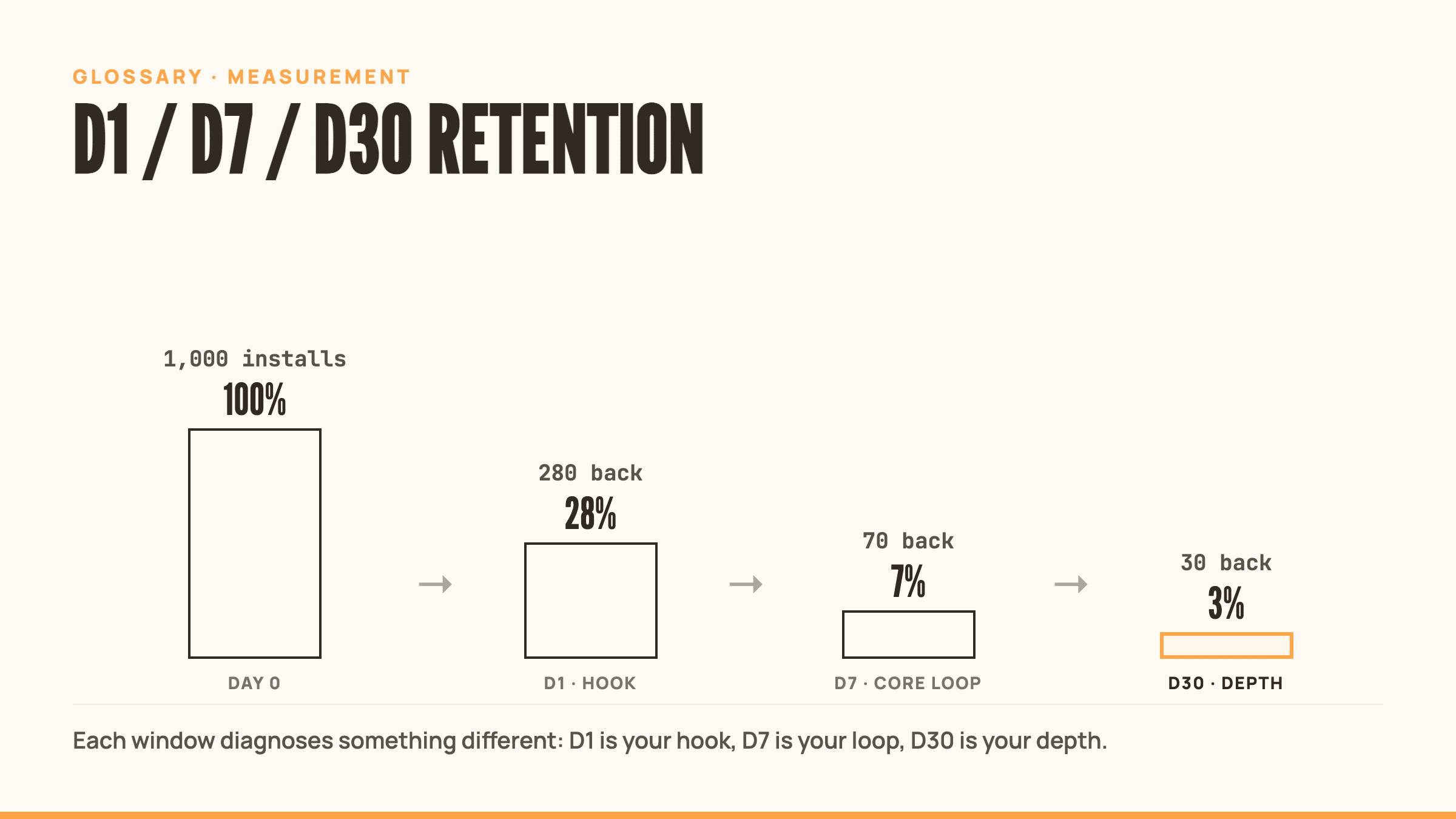
These three numbers tell you whether your game works. D1 shows if your first-time experience hooks players. D7 reveals if your core loop keeps them engaged. D30 proves you have enough content depth to build a sustainable player base.
What Are D1/D7/D30?
Retention metrics track player behavior over time. They measure what percentage of new users remain active at key milestones after their first session.
The three critical windows:
D1 (Day 1 Retention): Percentage of users active the day after install. Measures immediate hook.
D7 (Day 7 Retention): Percentage of users active 7 days post-install. Measures core gameplay appeal.
D30 (Day 30 Retention): Percentage of users active 30 days post-install. Measures content depth and long-term engagement.
The math is simple. 1,000 installs on Monday. 280 of them play again on Tuesday. D1 retention is 28%.
These metrics don’t track how much players engage. They only measure whether they come back at all. One session on day 7 counts the same as five hours of play.
What Each Metric Indicates
Each retention window diagnoses a specific part of your game experience.
D1: First-Time User Experience (FTUE)
D1 retention reveals how well your onboarding works. Does your tutorial teach without boring? Do players understand your core mechanic? Is the initial experience compelling enough to build a habit?
A weak D1 means players bounced before they understood what your game offers. They installed, played once, and never felt the pull to return.
Strong D1 retention comes from nailing three things: fast time-to-fun, clear value proposition, and an emotional hook in the first session.
D7: Core Gameplay Quality
D7 shows whether your core loop holds up. Players made it through onboarding. Now they’re evaluating the actual game. Is the gameplay fun? Are the mechanics satisfying? Does the art, story, or progression keep them interested?
This is where games with strong marketing but weak gameplay die. You can acquire users with great creatives, but if the core experience doesn’t deliver, D7 retention tanks.
D7 retention separates good concepts from good games.
D30: Content Depth and Metagame
D30 measures staying power. Players understand your game and enjoy the core loop. The question now is whether you have enough content, systems, and progression to keep them engaged long-term.
This is where metagame matters. Guild systems, competitive modes, seasonal content, live ops. The games that retain at D30 give players reasons to stick around beyond the core loop.
D30 retention predicts LTV. If players stay 30 days, they’re far more likely to monetize and become long-term high-value users.
Benchmarks: What Good Looks Like
The old benchmarks don’t apply anymore. UA costs rose. Player expectations changed. What counted as “good” in 2018 is mediocre now.
Classic Benchmarks (Pre-2020)
The industry used to aim for:
- D1: 40%
- D7: 20%
- D30: 10%
These numbers are a long-standing industry rule of thumb from an era of cheaper installs and lower player standards, not a single benchmark study.
Current Reality (2025)
Most games fall well short of the headline numbers people quote. GameAnalytics’ 2025 benchmark data puts the median at:
- D1: 18-20%
- D7: 3.4-3.9%
- D28: under 3% for 75% of projects
Top-quartile studios do meaningfully better:
- D1: 26-28%
- D7: 7-8%
That gap between median and top quartile is the gap between surviving and scaling. Note GameAnalytics reports D28, not D30. Close enough to use interchangeably at this level of precision, but worth knowing if you’re matching numbers against your own dashboards.
The New Standard
With UA costs skyrocketing, the retention bar for a genuine hit keeps climbing. These are best-in-class targets, not what a typical live game hits, but what separates scalable winners from games that limp along burning budget:
- D1: 50%+ (achievable mostly for elite hypercasual/casual hits)
- D7: 15%+ (well above today’s top quartile, but the level rising UA costs are pushing toward)
- D30: 5%+ (foundation for sustainable LTV)
Variations by Genre and Platform
Retention benchmarks shift based on what you’re building and where players find you.
Platform Differences
iOS vs. Android (top-quartile studios):
- iOS D1: 31-33%
- Android D1: 25-27%
iOS players typically show 2-6 percentage points higher retention across all windows. The reasons are debated (device quality, user demographics, app store discovery differences), but the pattern holds across genres.
Regional differences: Retention also swings hard by geography. GameAnalytics’ 2025 data shows the Middle East, Europe, and Oceania retaining best, with Africa and parts of Asia trailing. Benchmark against your own player geography, not a blended global average.
Paid vs. Organic Users
Paid users retain at much higher rates than organic. Players who clicked an ad saw something that matched their intent. Organic users might have stumbled in through browsing or word-of-mouth with less context.
Blended retention numbers hide this gap. Always segment paid vs. organic when analyzing performance.
Genre Effects
Hyper-casual games spike high D1 (sometimes 50%+) but crater by D7. Midcore and strategy games often see lower D1 (20-30%) but much stronger D7 and D30 as players invest in progression systems.
Match your expectations to your genre. A puzzle game with 35% D1 might be crushing it. A narrative RPG with the same number could be in trouble.
How to Improve Each Metric
Retention problems have different fixes depending on which window is broken.
Fixing D1 Retention
Improve onboarding:
- Cut tutorial length. Get to core loop faster.
- Show value before teaching. Let players experience fun, then explain mechanics.
- Reduce friction. Every extra tap in FTUE costs you users.
Nail the first session:
- Create early wins. Players need to feel competent quickly.
- Build emotional connection. Story beats, character moments, visual hooks.
- End with momentum. Give players a reason to come back (unclaimed reward, cliffhanger, next unlock visible).
Optimize creatives for intent match:
- If your ad promises puzzle-solving but your game frontloads story, D1 retention suffers. Match creative promise to FTUE delivery.
Fixing D7 Retention
Strengthen core gameplay:
- Make mechanics more satisfying. Juice, feedback, clarity.
- Deepen strategy or skill expression. Give players room to improve.
- Add variety to combat monotony. New challenges, rotating modes.
Build progression hooks:
- Create visible goals players care about (unlock new content, rank up, complete collections).
- Space rewards to hit around day 3-5. Keep players engaged through the dangerous mid-week drop-off.
Improve social or competitive features:
- Guilds, leaderboards, co-op modes give players external motivation to return.
Fixing D30 Retention
Expand content depth:
- Add endgame systems (guilds, PvP, ranked modes).
- Launch live ops and seasonal events.
- Introduce new content regularly so players don’t exhaust what’s available.
Enhance metagame:
- Long-term progression that spans weeks (battle passes, seasonal ranks, collection completion).
- Social systems that create obligations (guild commitments, friend referrals, shared goals).
Increase monetization touchpoints:
- Players who spend stay longer. Give them valuable, fair reasons to pay.
Common Mistakes
Mistake 1: Treating All Retention as the Same Problem
D1, D7, and D30 break for different reasons. Throwing generic “engagement” fixes at retention won’t work. Diagnose which metric is weak, then target that specific experience window.
Mistake 2: Ignoring the Correlation
D1, D7, and D30 are linked. Players who churn at D1 never get a chance to churn at D7. If your D1 is 20%, you’re starting with a tiny cohort by the time D7 rolls around.
Fixing early retention amplifies all downstream metrics. Start at D1.
Mistake 3: Comparing Across Genres Blindly
A 30% D1 in hyper-casual is mediocre. A 30% D1 in a hardcore strategy game might be phenomenal. Context matters. Compare against your genre, not the entire industry.
Mistake 4: Focusing Only on Retention
Retention without monetization is a hobby. You need both. A game with 60% D1 but $0.10 LTV still dies. Balance retention optimization with monetization design.
Mistake 5: Not Segmenting by Cohort
Blending all users hides critical insights. Paid vs. organic, iOS vs. Android, different creative variants. Segment your cohorts to understand what’s actually driving retention.
Related Terms
- Churn Rate: The inverse of retention (percentage of users who don’t return)
- FTUE (First-Time User Experience): Onboarding flow that heavily influences D1 retention
- LTV (Lifetime Value): Revenue per user, strongly correlated with D30+ retention
- Cohort Analysis: Grouping users by install date to track retention over time
- MAU/DAU Ratio: Monthly active users divided by daily active users, another engagement metric
- Stickiness: How often users return within a time window (complements retention)
External Resources
- D1, D7, D30 Retention in Gaming (Solsten)
- Mobile Game Retention Benchmarks (Mistplay)
- Mobile Game Retention Benchmarks (MAF)
Frequently Asked Questions
What is D1, D7, and D30 retention?
D1, D7, and D30 retention measure the percentage of players who return to your game 1 day, 7 days, and 30 days after install. D1 shows if your first-time experience hooks players, D7 reveals if your core loop keeps them engaged, and D30 proves you have enough content depth to build a sustainable player base.
What’s a good D7 retention rate today?
Top-quartile games in 2025 see D7 retention of 6-8%, while the typical game sits closer to 3-4%. The bar studios aim for given rising UA costs is 15%+, since that level proves real product-market fit rather than just an average result.
What does D1 retention mean?
D1 retention reveals how well your onboarding works: whether your tutorial teaches without boring players, whether they understand your core mechanic, and whether the first session is compelling enough to build a habit.
What’s more important, D1 or D7?
Both matter, but D1 is your foundation since you can’t retain users at D7 if they already churned at D1. Fix D1 first, then optimize D7. That said, D7 predicts LTV better than D1, so it’s a stronger signal of long-term viability.
Can you have good D7 retention with bad D1?
Technically yes, it means your game is excellent for the small group that makes it past onboarding. But you’re leaving massive value on the table. Fix D1 to grow the cohort that experiences your great D7 retention.