

glossary
DAU/MAU (Daily & Monthly Active Users)
DAU (Daily Active Users): Unique users who open your app at least once in a day.
Quick Definition
DAU (Daily Active Users): Unique users who open your app at least once in a day.
MAU (Monthly Active Users): Unique users who open your app at least once in 30 days.
DAU/MAU Ratio: The percentage of monthly users who show up daily. Tells you how sticky your game actually is.
What are DAU/MAU?
DAU and MAU measure engagement. Not downloads. Not installs. Real humans opening your app.
DAU counts unique users per day. One person, one session minimum. Open the app ten times in a day? Still counts as one DAU.
MAU counts unique users over 30 days. Same person opening your app every day for a month? One MAU. Someone who opened it once on day one and ghosted you? Also one MAU.
WAU (Weekly Active Users) sits in the middle. Unique users over seven days. Useful for spotting weekly patterns, but less commonly tracked than DAU/MAU.
The definitions sound clean. Reality is messier. What counts as “active” varies by company. Some count any session. Others require meaningful engagement. Some mobile analytics platforms count a session when the app opens. Others need the user to do something.
Check your analytics platform’s definition before you compare your numbers to anyone else’s.
How to Calculate
DAU
Count unique users with at least one session today.
Example: 1,000 users opened your app on Monday. Your DAU for Monday is 1,000.
MAU
Count unique users with at least one session in the past 30 days.
Example: 10,000 users opened your app at least once between December 1 and December 30. Your MAU is 10,000.
DAU/MAU Ratio
Divide DAU by MAU. Multiply by 100 for percentage.
Formula: (DAU / MAU) × 100
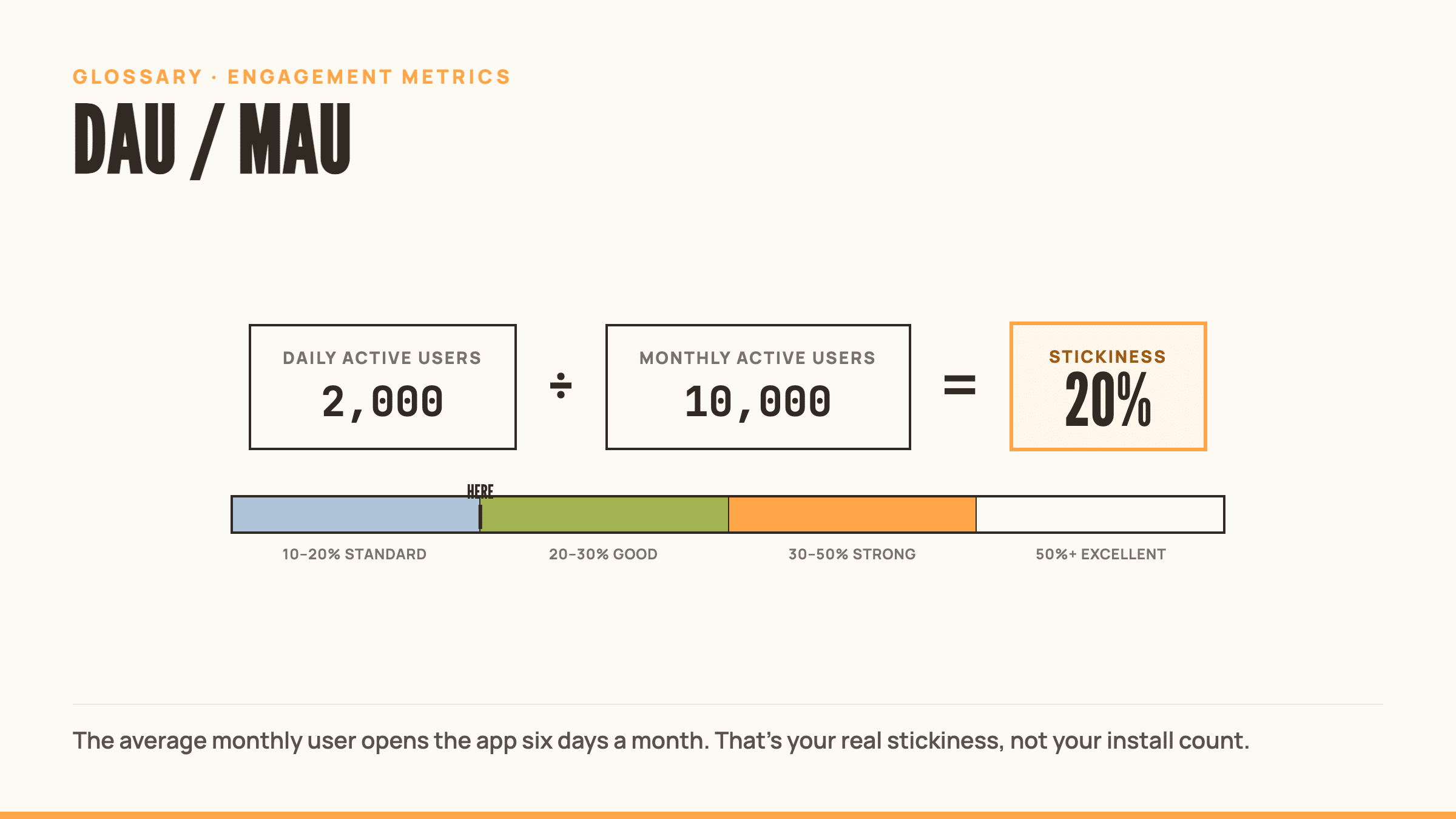
Example:
- DAU = 2,000
- MAU = 10,000
- Ratio = (2,000 / 10,000) × 100 = 20%
That 20% means your average monthly user opens the app about six days per month.
The Stickiness Ratio
DAU/MAU is your stickiness metric. Higher ratio means users come back more often.
What the numbers mean:
| Ratio | Behavior | What it Looks Like | |——-|———-|——————-| | 10-20% | Standard | Users open ~3-6 days/month | | 20-30% | Good | Users open ~6-9 days/month | | 30-50% | Strong | Users open every other day or better | | 50%+ | Excellent | Daily habit territory | | 70%+ | Extreme | WhatsApp, Instagram, messaging apps |
Most mobile apps land between 10% and 20%. Few companies break 50%. The ones that do have built true daily habits.
Why it matters: A game with 100,000 MAU at 10% stickiness has 10,000 DAU. Same MAU at 30% stickiness? 30,000 DAU. Triple the daily engagement. Triple the monetization opportunities. Same install base.
Stickiness amplifies everything else you do.
Benchmarks
Mobile app retention is brutal. Most apps lose 77% of their DAUs within three days of install. By day 30, you’re lucky to have 5% left.
Gaming benchmarks (rough averages):
- Hypercasual: 5-10% stickiness (high churn, volume play)
- Casual/midcore: 15-25% stickiness
- Social casino: 20-30% stickiness
- Strategy/RPG: 25-40% stickiness (higher if you nail live ops)
- Top-tier social: 50%+ stickiness
These are guidelines, not gospel. Your mileage will vary based on genre, monetization model, and how well you execute retention mechanics.
Why These Metrics Matter
DAU and MAU tell you if people actually use what you built. Everything else is vanity.
For UA teams:
- DAU/MAU ratio predicts LTV. Stickier users monetize better.
- Low stickiness means your CPI needs to be razor-thin or your LTV is cooked.
- High stickiness gives you room to bid aggressively on quality users.
For product teams:
- Dropping DAU/MAU ratio signals engagement problems before revenue falls off a cliff.
- Feature launches should move the stickiness needle. If they don’t, question the roadmap.
For creative teams:
- Ads that promise the actual game experience bring stickier users. Creative analysis that tracks retention signals, not just CTR, catches this before it tanks your numbers.
- Misleading creatives spike installs but tank DAU/MAU. You pay for ghosts.
For live ops:
- Daily events and rewards exist to push DAU/MAU higher.
- Every percentage point of stickiness compounds over time.
Track DAU and MAU together. In isolation, they lie. High MAU with low DAU means lots of tourists, few regulars. High DAU with low MAU means tiny engaged core, no top-of-funnel. You need both moving in the right direction.
Common Mistakes
1. Celebrating MAU without checking DAU/MAU
1 million MAU sounds incredible. If your DAU/MAU is 5%, you have 50,000 daily users and 950,000 people who barely remember you exist. Know the difference.
2. Comparing DAU/MAU across different platforms
Mobile analytics tools define “active” differently. Google Analytics counts sessions differently than Amplitude. AppsFlyer and Adjust have their own logic. Cross-platform comparison without normalizing definitions is useless.
3. Ignoring the “active” definition
Does opening the app count as active? Or do users need to complete an action? Your analytics team needs to decide. Document it. Stick to it.
4. Forgetting about WAU
Weekly Active Users (WAU) catches patterns DAU and MAU miss. Some games are weekend-heavy. DAU looks weak Monday through Thursday, spikes Friday through Sunday. WAU smooths it out and gives you a clearer picture.
5. Treating DAU/MAU as the only metric that matters
Stickiness matters. Revenue matters more. A game with 15% stickiness and great monetization beats a game with 40% stickiness and weak ARPDAU. Use DAU/MAU to diagnose engagement, not to dictate strategy in a vacuum.
Related Terms
- Retention – Percentage of users who return after install (Day 1, Day 7, Day 30)
- Session Length – How long users stay in-app per session
- Churn Rate – Percentage of users who stop using your app
- LTV (Lifetime Value) – Total revenue a user generates over their lifetime
- ARPDAU – Average Revenue Per Daily Active User
External Resources
- DAU vs. MAU: Key Differences and How to Use Them – AppsFlyer
- Understanding DAU, WAU, and MAU Metrics – Adjust
- DAU vs. MAU: App Stickiness Metrics – CleverTap
Frequently Asked Questions
What does DAU/MAU mean?
DAU is Daily Active Users, unique users who open your app at least once in a day. MAU is Monthly Active Users, unique users who open it at least once in 30 days. The DAU/MAU ratio divides one by the other to show what share of your monthly base shows up daily.
What is a good DAU/MAU ratio?
15-25% is solid for most mobile game genres. Hypercasual often sits lower at 5-10%. Strategy and RPG titles with strong live ops can hit 30-40%. Anything above 50% means you’ve built a genuine daily habit, which few games ever do.
When should I use DAU vs MAU?
DAU shows single-day engagement. MAU shows unique reach over 30 days. Track both together: high MAU with low DAU means lots of tourists and few regulars, while high DAU with low MAU means a tiny engaged core with no top-of-funnel growth.
How do you calculate DAU/MAU?
Divide your DAU by your MAU for the same period, then multiply by 100 for a percentage. A ratio of 20% means roughly one in five monthly users opens the app on a typical day. The higher the number, the stickier the game.