

glossary
ROAS (Return on Ad Spend)
ROAS measures how much revenue you earn for every dollar spent on advertising. It’s the metric that tells you if your UA campaigns are making money or burning it.
Quick Definition
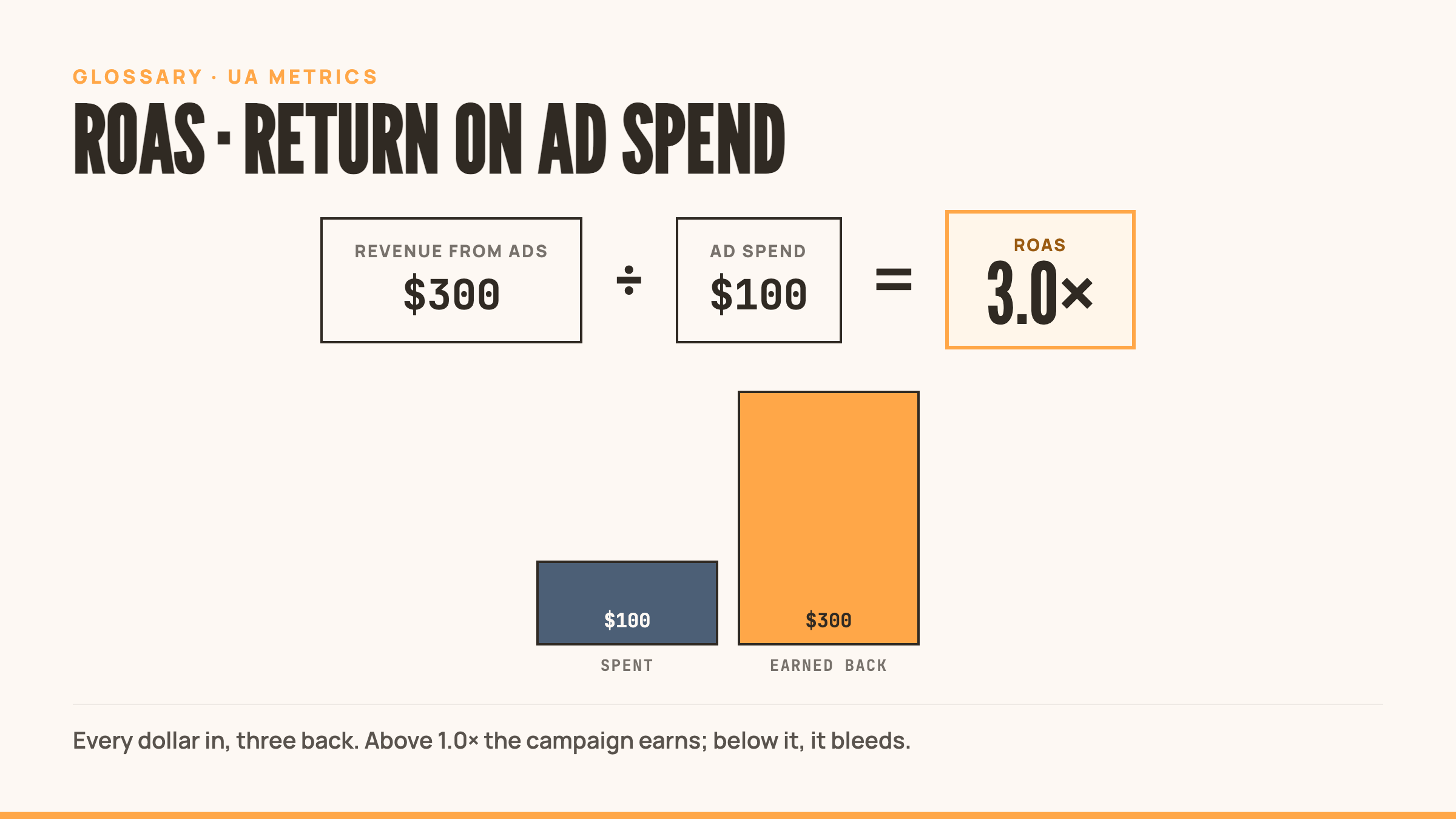
ROAS measures how much revenue you earn for every dollar spent on advertising. The ROAS formula is simple: revenue divided by ad spend. It’s the metric that tells you if your UA campaigns are making money or burning it.
What is ROAS?
ROAS is the primary efficiency metric for user acquisition campaigns in mobile gaming. It answers one question: for every dollar I spend on ads, how many dollars do I get back?
Unlike softer metrics like impressions or clicks, ROAS connects ad spend directly to revenue. You spend $1,000 on a Facebook campaign. That campaign drives installs. Those players spend money in your game. ROAS tells you how much.
This makes it the north star for UA teams managing performance budgets. When ROAS is healthy, you can scale spend. When it drops, you pull back or fix the problem.
But ROAS isn’t static. It shifts based on creative performance, audience targeting, seasonality, and game economics. A winning ad can deliver 10:1 ROAS for weeks, then creative fatigue kicks in and it drops to 3:1. Your job is to catch that decline and replace it with fresh creative that converts.
ROAS also varies by platform and ad format. Video ads on TikTok might deliver different ROAS than playable ads on Unity. Rewarded video placements perform differently than interstitials. Smart UA teams track ROAS by network, format, creative, and audience segment to understand what’s actually working.
The metric matters most when measured over the right time window. Day 1 ROAS tells you immediate conversion efficiency. Day 7 ROAS shows early retention value. Day 30 or Day 90 ROAS captures longer-term player lifetime value. Most mobile games optimize for D7 or D30 ROAS depending on monetization model.
ROAS is also the metric that justifies budget allocation. If Campaign A delivers 6:1 ROAS and Campaign B delivers 2:1, you shift budget to Campaign A. If a new creative concept tests at 8:1 ROAS, you scale it fast. ROAS is the language of performance marketing.
How to Calculate ROAS
The formula is simple:
ROAS = Revenue from Ads ÷ Cost of Ads
Example:
You spend $1,000 on a Unity Ads campaign.
That campaign drives installs. Those players generate $4,000 in in-app purchases over 30 days.
ROAS = $4,000 ÷ $1,000 = 4
This is expressed as 4:1 ROAS or 400% ROAS.
For every dollar spent, you earned four dollars back.
Attribution Window Matters
Revenue attribution depends on your measurement window:
- D1 ROAS: Revenue generated on install day
- D7 ROAS: Revenue within 7 days of install
- D30 ROAS: Revenue within 30 days of install
Longer windows capture more player value but take longer to measure. Most UA teams optimize for D7 or D30 ROAS depending on game monetization patterns.
What’s a Good ROAS?
It depends on your business model and growth stage.
Common benchmarks:
- 4:1 ROAS is a frequently cited target for sustainable UA
- 3:1 ROAS can work for growth-focused studios prioritizing market share
- 10:1 ROAS might be required for games with low lifetime value or high operating costs
But benchmarks don’t tell the whole story.
A 3:1 ROAS might be excellent if your players stick around for years and deliver high LTV. The same 3:1 might be disastrous if your retention drops after Week 1.
Growth stage matters too. Early in a game’s lifecycle, you might accept lower ROAS to build an audience and learn what works. As you scale, ROAS targets tighten to ensure profitability.
Platform and format also shift expectations. Broad awareness campaigns on YouTube might run at lower ROAS than highly targeted performance campaigns on Facebook. Playable ads often deliver higher ROAS than video because they prequalify engaged players.
The real question isn’t “What’s a good ROAS?” It’s “What ROAS do I need to hit my business goals?”
ROAS vs ROI
ROAS and ROI measure different things.
ROAS is campaign-specific. It looks at ad revenue against ad spend. It doesn’t account for development costs, server costs, team salaries, or platform fees.
ROI (Return on Investment) is business-wide. It includes all costs: production, operations, distribution, marketing. It tells you if the entire business is profitable.
A campaign can have strong ROAS but contribute to negative ROI if other costs are too high. ROAS tells you if your ads work. ROI tells you if your business works.
How to Improve ROAS
ROAS improves through better creative, sharper targeting, or higher player LTV.
1. Test more creative Creative fatigue kills ROAS. Fresh ads maintain performance. The more you test, the more winners you find — which is exactly what structured creative research and ideation is designed to accelerate.
2. Target high-value audiences Broad campaigns reach more people but often at lower ROAS. Narrow targeting finds players more likely to spend.
3. Improve retention and monetization If players stick around longer and spend more, ROAS improves without changing ad spend.
4. Optimize by platform and format Not all networks perform equally. Shift budget to channels and ad formats that deliver the best ROAS.
5. Monitor creative decay Winning ads don’t stay winning forever. Track ROAS by creative through ongoing creative performance analysis and replace ads when performance drops.
Common Mistakes
Ignoring attribution windows D1 ROAS looks terrible for games with slow monetization. D30 ROAS takes too long to optimize fast-moving campaigns. Pick the window that matches your game economics.
Optimizing for ROAS too early New campaigns need time to gather data. Cutting spend after one bad day kills learning.
Treating all ROAS equally A 5:1 ROAS on $100 spend isn’t the same as 5:1 on $100,000 spend. Scale matters.
Not tracking creative-level ROAS Aggregate ROAS hides which ads work and which don’t. Break it down by creative, audience, and platform.
Forgetting about LTV ROAS measures short-term revenue. If you’re not tracking player lifetime value, you’re optimizing blind.
Related Terms
- CPI (Cost Per Install) – What you pay to acquire each user
- LTV (Lifetime Value) – Total revenue a player generates over their lifetime
- User Acquisition – The process of acquiring new players through paid and organic channels
- Creative Testing – Testing multiple ad variations to find top performers
External Resources
- Adjust: ROAS Definition
- Unity: ROAS (Return on Advertising Spend)
- Amazon Ads: Return on Ad Spend (ROAS) Guide
Frequently Asked Questions
What’s the difference between ROAS and ROI?
ROAS measures revenue against ad spend only. ROI measures profit against total business investment, including development, operations, and every cost beyond advertising.
What ROAS should I target for my mobile game?
It depends on your LTV, retention, and business goals. 4:1 is a common starting target, but growth-stage games might accept 3:1 while mature games might need 6:1 or higher.
How long should I measure ROAS?
Most mobile games optimize for D7 or D30 ROAS, a window long enough to capture meaningful player value without waiting too long to act on it.
Can ROAS be too high?
Yes. Extremely high ROAS can mean you’re under-investing in growth. A campaign delivering 15:1 could likely scale spend and still stay profitable.