

glossary
Install Fraud
Fraudsters manipulating install attribution or faking app installs entirely to steal your ad budget. You pay for installs that either never happened or came from users who would’ve installed anyway.
Quick Definition
Fraudsters manipulating install attribution or faking app installs entirely to steal your ad budget, which is exactly what ad fraud prevention exists to stop. You pay for installs that either never happened or came from users who would’ve installed anyway.
What is Install Fraud
Install fraud drains your UA budget without delivering real users.
Bad actors use technical tricks to claim credit for installs they didn’t drive. Or they generate fake installs that look real in your dashboard but produce zero revenue.
You see cost-per-install numbers. You see install volumes. But the users behind those installs are either ghosts or would’ve found your app without the ad.
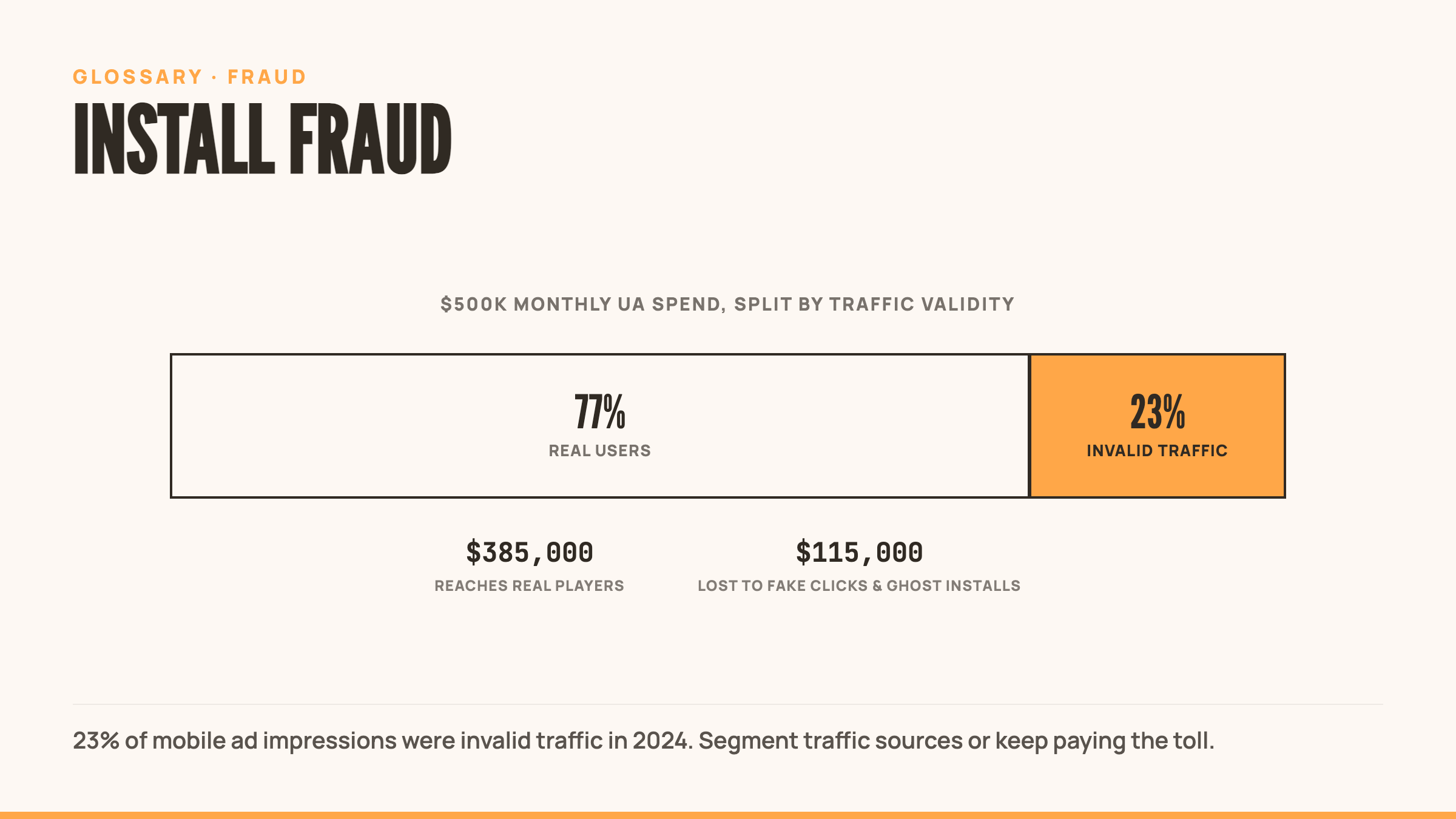
In Q1 2024, 23% of open programmatic mobile in-app ad impressions were invalid traffic, according to Pixalate. That’s not a rounding error. That’s nearly a quarter of what you’re paying for in that channel.
Types of Install Fraud
Attribution Hijacking
Stealing credit for organic installs or installs driven by other channels.
Click Injection: Malicious apps detect when a user is downloading something. They fire a fake click milliseconds before install completes. Your attribution tool sees the click, credits the fraudster.
Click Spam: Flooding attribution systems with fake clicks. When someone eventually installs organically, the fraudster’s click gets credit based on last-click attribution.
SDK Spoofing: Faking the signals your MMP looks for to verify an install. Makes a fraudulent install look legitimate to tracking systems.
Fake Installs
Manufacturing installs that never came from real users.
Device Farms: Rooms full of phones running automated scripts. Real devices, real installs, zero chance of engagement or revenue.
Ad Stacking: Loading dozens of ads in a single placement, all invisible except the top one. User sees one ad, clicks it. Fraudster charges you for 20 impressions.
Attribution Hijacking vs Fake Installs
| Attribution Hijacking | Fake Installs | |———————-|—————| | Real user, real install | No real user | | Stolen credit | Manufactured install | | You lose attribution accuracy | You lose budget entirely | | User might engage | Zero engagement guaranteed |
Attribution hijacking steals credit. Fake installs steal money.
Both wreck your data. Both make it impossible to know what’s working.
Fraud Statistics
The numbers are brutal.
23% of open programmatic mobile in-app ad impressions were invalid traffic in Q1 2024, per Pixalate. Up 15% year-over-year.
$84 billion lost to ad fraud across all digital advertising in 2023, per Juniper Research. That’s 22% of total online ad spend.
$172 billion projected by 2028, across all digital advertising.
Mobile specifically: 30% of mobile ad spend was lost to fraud in 2023, per Juniper Research. Fraudsters are following the money.
If you’re spending $500K/month on mobile UA, roughly $150K could be hitting fraud based on that 30% rate. Every month.
Prevention Methods
Use a Mobile Measurement Partner (MMP)
Adjust, AppsFlyer, Branch, Singular. They’re built to detect and filter fraud.
They won’t catch everything. But they catch a lot more than basic attribution tools.
Enable Fraud Prevention Features
Most MMPs offer fraud detection. Turn it on. Configure it properly.
Rejection rules for suspicious patterns. Device fingerprinting. Install validation.
Monitor Metrics Beyond Installs
Real users do things after installing.
Track Day 1 retention. Track first session length. Track revenue events.
If your installs spike but engagement flatlines, you’re buying fraud.
Diversify Attribution Models
Last-click attribution is easy to game.
Multi-touch attribution makes it harder for fraudsters to claim credit. Fingerprinting plus device ID creates better validation.
Audit Traffic Sources
Check which networks deliver users who actually engage.
If a network shows great CPI but terrible retention and zero revenue, cut it.
Implement Server-to-Server Callbacks
Client-side tracking is easier to spoof.
S2S postbacks validate installs on the server side, making SDK spoofing harder.
Common Mistakes
Optimizing for CPI alone: Low CPI means nothing if the users are fake. Optimize for retention and revenue.
Ignoring fraud reports: Your MMP flags suspicious activity. Review it. Act on it.
Not blacklisting bad sources: Once you identify a fraudulent sub-publisher or placement, block it. Fraudsters rely on you not paying attention.
Trusting attribution without validation: Cross-reference install data with engagement metrics. If the numbers don’t match the behavior, investigate.
Treating all installs equally: Real users behave differently than bots and device farms. Segment by quality, not just volume.
Related Terms
- Click Injection – Method of attribution hijacking
- SDK Spoofing – Faking install verification signals
- Invalid Traffic (IVT) – Non-human or fraudulent traffic
- Mobile Measurement Partner (MMP) – Tools for tracking and fraud detection
- Attribution Model – How credit for installs is assigned
- Device Farm – Facilities running automated install fraud
External Resources
- Adjust: Mobile Ad Fraud Guide
- AppsFlyer: Mobile Ad Fraud Glossary
- Mobio Group: IVT in Mobile Advertising 2024 Report
Frequently Asked Questions
How do I know if I’m buying fraudulent installs?
Check post-install engagement. Real users open the app, complete tutorials, and engage with content. Fraudulent installs show high volume with low Day 1 retention and zero revenue.
Can I eliminate install fraud completely?
No. You can reduce it significantly with the right tools and processes, but fraud evolves as fast as detection methods, so ongoing monitoring is required.
Do all ad networks have fraud?
Most networks have some level of fraud. Tier-1 networks like Meta and Google have strong internal fraud prevention. Smaller networks and programmatic exchanges tend to have higher fraud rates.
What’s the difference between IVT and install fraud?
Invalid Traffic (IVT) is the broader category, including bots, datacenter traffic, and non-human interactions across all ad formats. Install fraud is IVT specifically targeting app installs.
Should I stop UA campaigns if I detect fraud?
Pause the specific sources driving fraud instead of killing campaigns that are delivering real users. Use your MMP data to identify and block the bad actors.