

glossary
Exploit vs Explore
Exploit: Maximize revenue using what you already know works.
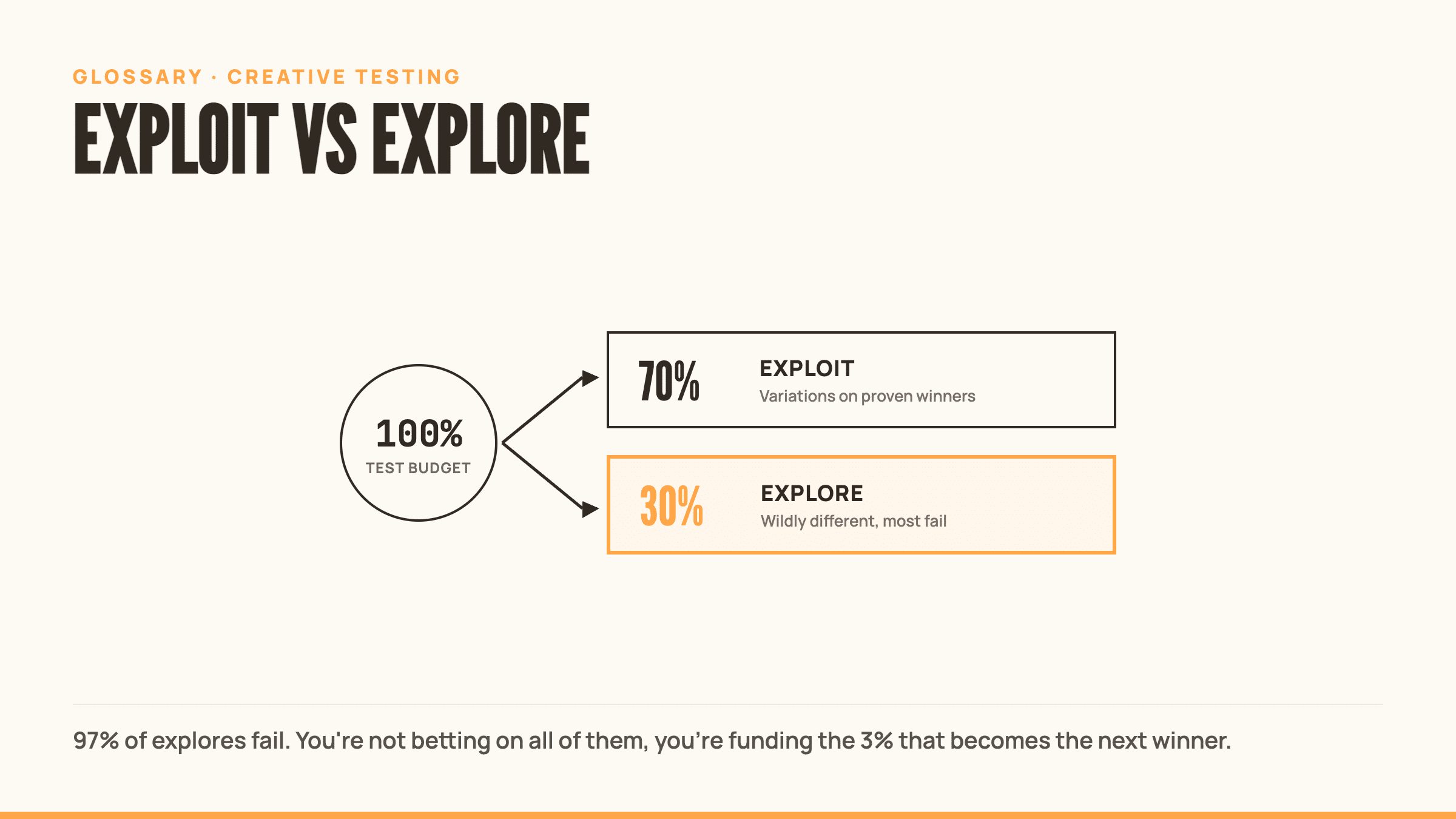
Quick Definition
Exploit: Maximize revenue using what you already know works.
Explore: Invest time testing unknowns to improve future decisions.
The tension between exploit vs explore defines creative performance in mobile gaming.
What is Exploit vs Explore?
Exploit vs Explore is a strategic framework borrowed from machine learning that addresses a fundamental problem: should you keep doing what works, or should you try something new?
Exploitation means running with proven winners. You take a creative concept that’s hitting 40% CTR and spin out variations. Same core hook, different execution. Safe, predictable, diminishing returns.
Exploration means taking real risks. You test wildly different concepts to find breakthroughs. Bold ideas that might fail spectacularly or become your next top performer.
Most teams lean too hard on one side. They either milk winners until they’re dead, or they explore randomly without a system.
The advantage belongs to teams that can do both at once.
How It Works: Meta’s Algorithm
Meta’s ad platform lives and breathes this framework.
The Explore Phase When you launch a new campaign, Meta’s algorithm enters learning mode. It tests your creative across different audiences, placements, and times. It’s spending money to gather data about what works.
This phase burns budget. Your CPA will be higher than you want. That’s the cost of learning.
The Exploit Phase Once the algorithm has enough signal (usually around 50 conversions per ad set), it shifts to exploitation. Now it knows which audiences respond and how to bid efficiently. Your CPI drops. Your volume scales.
This is where you make money.
What Triggers Re-Learning The algorithm resets to explore mode when you make significant changes:
- Swap creatives in the ad set
- Change targeting parameters
- Adjust budgets by more than 20%
- Pause for 7+ days
Every reset costs you. The algorithm has to relearn from scratch.
The Sett Perspective
In UA creative production, most studios run two tracks whether they admit it or not.
Exploit Track You have a winning playable concept. It’s driving 60% of your installs. Now you create variations: different color palettes, new level designs, tweaked mechanics through fast creative generation. Same underlying hook, fresh execution.
This keeps the networks finding new audience pockets for a proven concept. It extends the life of your winner.
Explore Track You take your match-3 game and test a completely different angle. Maybe it’s a narrative-driven concept. Maybe it’s a mini-game mash-up. Maybe it’s something nobody’s tried yet.
Most explore creatives fail. That’s the point. You’re hunting for the next breakthrough.
Most creative ideas fail in mobile gaming. The question isn’t whether you’ll fail. The question is whether you can afford to try enough times to find the ones that work. Systematic creative research and ideation turns that math in your favor.
You can’t predict a hit. But you can explore smarter.
Balancing Strategies
The right balance depends on where you are.
Mature Games with Proven Winners
- 70% exploit, 30% explore
- Milk what works while hunting for the next big thing
- Risk tolerance is lower because you have revenue to protect
New Launches or Struggling Performance
- 50% exploit, 50% explore
- You need breakthroughs, not incremental gains
- Higher risk tolerance because the status quo isn’t working
Advanced: Portfolio Approach The smartest teams use portfolio theory:
- Exploit creatives: steady baseline performance, predictable ROAS
- Incremental explores: small variations, moderate risk
- Bold explores: moonshots with 10x potential
Allocate budget across all three. Rebalance based on results.
Methods Used in Practice
- Multi-Armed Bandit: Algorithm dynamically adjusts budget allocation between creatives based on performance
- Bayesian Optimization: Uses probability distributions to decide which concepts deserve more testing
- Reinforcement Learning: Networks like AppLovin use this to route creatives to optimal placements
You don’t need to build these systems yourself. The ad networks already run them. Your job is to feed them enough volume and variety to make the math work.
Common Mistakes
Exploiting Too Long You found a winner six months ago. You’re still running variations of it. CTR has dropped from 8% to 3%. You keep squeezing because you’re scared to let go.
Creative fatigue is real. Winners die. Plan for it.
Exploring Without a System You test random ideas because someone thought they’d be cool. No hypothesis. No learning. Just throwing spaghetti at the wall.
Exploration without structure is just expensive guessing.
Killing Explores Too Early You test a bold concept for three days, it doesn’t perform, you kill it. But the algorithm was still in learning mode. You never gave it a chance to find the right audience.
Explore creatives need time and budget to prove themselves.
Forgetting Most Explores Fail Most explores will fail. If you expect every test to win, you’ll quit before you find anything.
Build a process that assumes failure and finds signal anyway.
Related Terms
- Creative Fatigue: When audiences see your ad too many times and stop responding
- Share of Voice: The percentage of impressions your creative gets across campaigns
- Learning Phase: The period when ad algorithms gather data before optimizing
- Concept Testing: Validating creative hypotheses before full production
External Resources
- The Explore-Exploit Cycle of Meta’s Algorithm – Deep dive on how Meta’s learning phases work
- Exploration vs. Exploitation in Marketing – Framework for balancing discovery and optimization
- Exploration vs. Exploitation in A/B Testing – Mathematical approaches to the tradeoff
Frequently Asked Questions
What is the difference between exploring and exploiting?
Exploiting means running with what you already know works, taking a proven creative concept and spinning out variations for steady, predictable returns. Exploring means testing unknowns, bold new concepts that might fail or might become your next breakthrough winner.
What is the difference between exploration and exploitation?
Exploration is how you learn what options exist. Exploitation is how you act on what you’ve already discovered. One builds knowledge, the other extracts value from it. Both need budget, or you either stagnate on old winners or never convert learning into revenue.
How much budget should I allocate to explore creatives?
If you have proven winners, 20-30% exploration is reasonable. If you’re struggling to scale, push it to 50%. The key is consistency. Don’t explore for one week and quit when nothing hits immediately, since explore creatives need time to prove themselves.
How do I know if I’m exploiting or exploring?
Ask whether the creative is built on a proven concept or testing something fundamentally new. If it’s a variation on a known winner, you’re exploiting. If it’s a real risk on an unproven idea, you’re exploring.