

glossary
Share of Voice (SOV)
Quick Definition: Share of Voice (SOV) measures your brand’s advertising presence as a percentage of total market advertising in your category. High SOV means you’re dominating the conversation. Low SOV means you’re invisible. — 01. What is Share of Voice? Share of Voice tells you how loud your brand is compared to competitors. It tracks […]
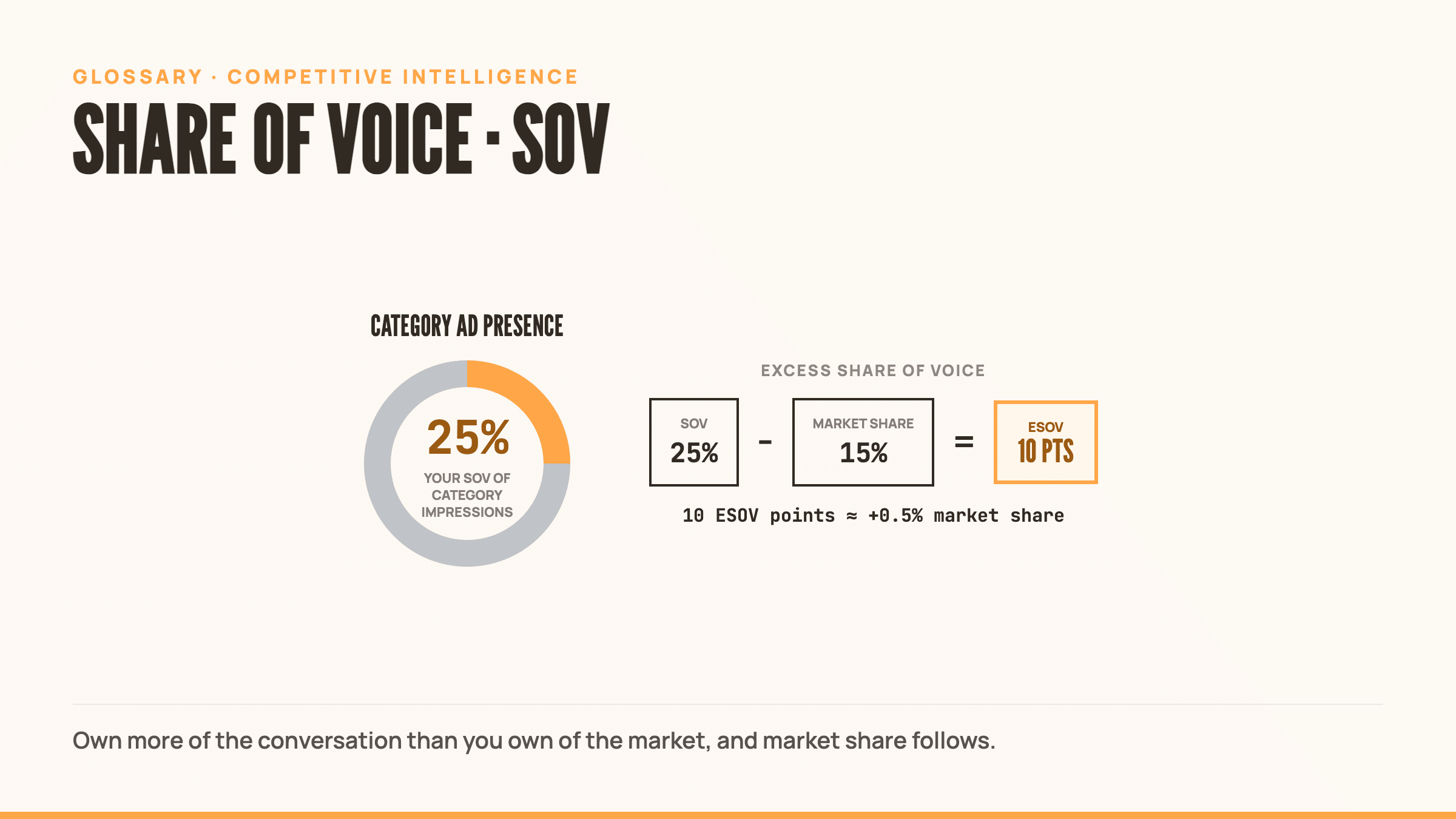
Quick Definition: Share of Voice (SOV) measures your brand’s advertising presence as a percentage of total market advertising in your category. High SOV means you’re dominating the conversation. Low SOV means you’re invisible.
What is Share of Voice?
Share of Voice tells you how loud your brand is compared to competitors.
It tracks your advertising presence across channels: digital ads, social media, search, TV, radio, print. When you own 40% of the advertising in your category, you own 40% SOV.
SOV matters because visibility drives growth. The more people see your ads, the more they remember your brand. The more they remember, the more they buy.
Most studios track SOV across specific channels. Mobile game User Acquisition teams focus on digital: Meta, AppLovin, Unity, Google, TikTok. That’s where players live.
But here’s the problem: high SOV costs money. Running enough ads to dominate a category burns budget fast. Studios need volume to win SOV without killing ROAS.
That’s where creative production speed becomes the unlock. More creatives mean more ad presence without proportionally higher spend. You’re not buying more impressions. You’re making each impression work harder through variety and exploration.
How to Calculate SOV
Formula: SOV = (Your Brand Metrics / Total Market Metrics) × 100
You can measure SOV by ad spend, impressions, engagement, or mentions.
Example by Ad Spend:
- Your monthly ad spend: $5M
- Total category ad spend: $100M
- Your SOV: ($5M / $100M) × 100 = 5%
Example by Impressions:
- Your ad impressions: 50M
- Total category impressions: 200M
- Your SOV: (50M / 200M) × 100 = 25%
Most UA teams track by impressions or spend. Impressions show visibility. Spend shows commitment.
SOV in Mobile Game Advertising
Mobile game SOV is a volume game.
Ad networks deliver impressions based on creative performance and bid strength. To dominate SOV, you need both: high-performing creatives and budget to scale them.
The challenge: creative fatigue kills SOV fast. A winning ad degrades in weeks. Players see it, ignore it, move on. To maintain SOV, you need constant creative refresh.
Studios winning SOV do two things well:
- High creative output – Dozens of new ads per week, not per month
- Smart exploration – Testing bold ideas fast to find the next winner
Sett clients use exactly this approach: scaling creative production to maintain ad presence without a proportional budget increase, which is what drives category-level SOV up over time.
The difference: when you can create dozens of playable ads in the time competitors create a handful, you own more of the conversation.
SOV and Market Share Relationship
SOV predicts market share growth.
Research shows clear patterns:
- SOV > Market Share = Growth trajectory
- SOV = Market Share = Stagnation
- SOV < Market Share = Decline
When your SOV exceeds your market share, you’re investing in future growth. You’re visible to more players than you currently have. That gap converts to installs over time.
Binet & Field’s research found that for every 10 points of excess share of voice (ESOV), brands gain approximately 0.5% market share.
ESOV = SOV – Market Share
Example:
- Your SOV: 25%
- Your market share: 15%
- Your ESOV: 10 points
- Expected market share gain: ~0.5%
The math is simple. Dominate the conversation, gain market share. Go quiet, lose ground.
How to Increase SOV
1. Increase Creative Output More ads = more impressions = higher SOV. Speed matters. Studios creating 10 creatives per week beat studios creating 10 per month.
2. Expand to New Channels Own SOV on Meta but invisible on TikTok? You’re leaving share on the table. Multi-channel presence compounds visibility.
3. Improve Creative Performance Higher CTR and engagement mean networks show your ads more. Better creatives earn more impressions at the same spend.
4. Maintain Constant Refresh Creative fatigue kills SOV. Winning ads degrade. Replace them before performance drops.
5. Scale Winning Patterns When you find a winning creative angle, exploit it. Create variations. Test different hooks. Milk the concept.
The constraint for most studios: production speed. Agencies take weeks. In-house teams hit capacity. By the time creatives launch, the opportunity shifted.
Sett removes that constraint. Studios using Sett scale creative output well beyond what manual production allows, with the same team and the same budget.
That volume translates directly to SOV dominance.
Common Mistakes
Confusing SOV with Market Share SOV measures advertising presence. Market share measures actual sales or installs. They’re related but not the same.
Tracking Only Spend SOV by spend ignores creative efficiency. You can outspend competitors and still lose SOV if your creatives perform poorly.
Ignoring Creative Fatigue High SOV today means nothing if your creatives burn out tomorrow. SOV requires constant creative refresh.
Going Too Broad Trying to dominate SOV across every channel spreads budget thin. Focus on channels where your players live.
Sacrificing ROAS for SOV SOV without profitability is just expensive noise. The goal: high SOV at sustainable ROAS. That requires creative volume and quality.
Related Terms
External Resources
Frequently Asked Questions
How do you define share of voice?
Share of Voice measures your brand’s advertising presence as a percentage of total market advertising in your category. The formula is (your brand metrics / total market metrics) x 100, tracked by ad spend, impressions, or engagement.
What is the share of voice rule?
When your SOV is larger than your market share, you have excess share of voice, or ESOV. Research from Binet and Field found that for every 10 points of ESOV, brands gain roughly 0.5% market share. Investing above your current market share is what drives growth.
What’s a good SOV for mobile games?
Depends on your market position. Leading studios often hold 30-40% SOV, while emerging games might target 10-15% to gain traction. The key is that SOV should exceed your current market share to drive growth.
Does SOV guarantee market share growth?
No guarantees in UA. But sustained SOV above market share correlates strongly with growth. Treat it as a leading indicator, not a promise.
What’s the relationship between SOV and ROAS?
They’re often in tension. Pushing for maximum SOV can mean running marginal creatives that hurt ROAS, while optimizing purely for ROAS can limit scale and SOV. The balance is high SOV through creative volume alongside sustainable ROAS through smart exploration and performance monitoring.