
glossary
Brand Safety
Quick Definition: Protecting your brand from appearing alongside harmful, offensive, or inappropriate content in the digital advertising ecosystem. — 01. What is Brand Safety Brand safety keeps your ads away from content that damages your reputation. Your ad appears next to hate speech, graphic violence, or illegal content? That association sticks. Consumers remember where they […]
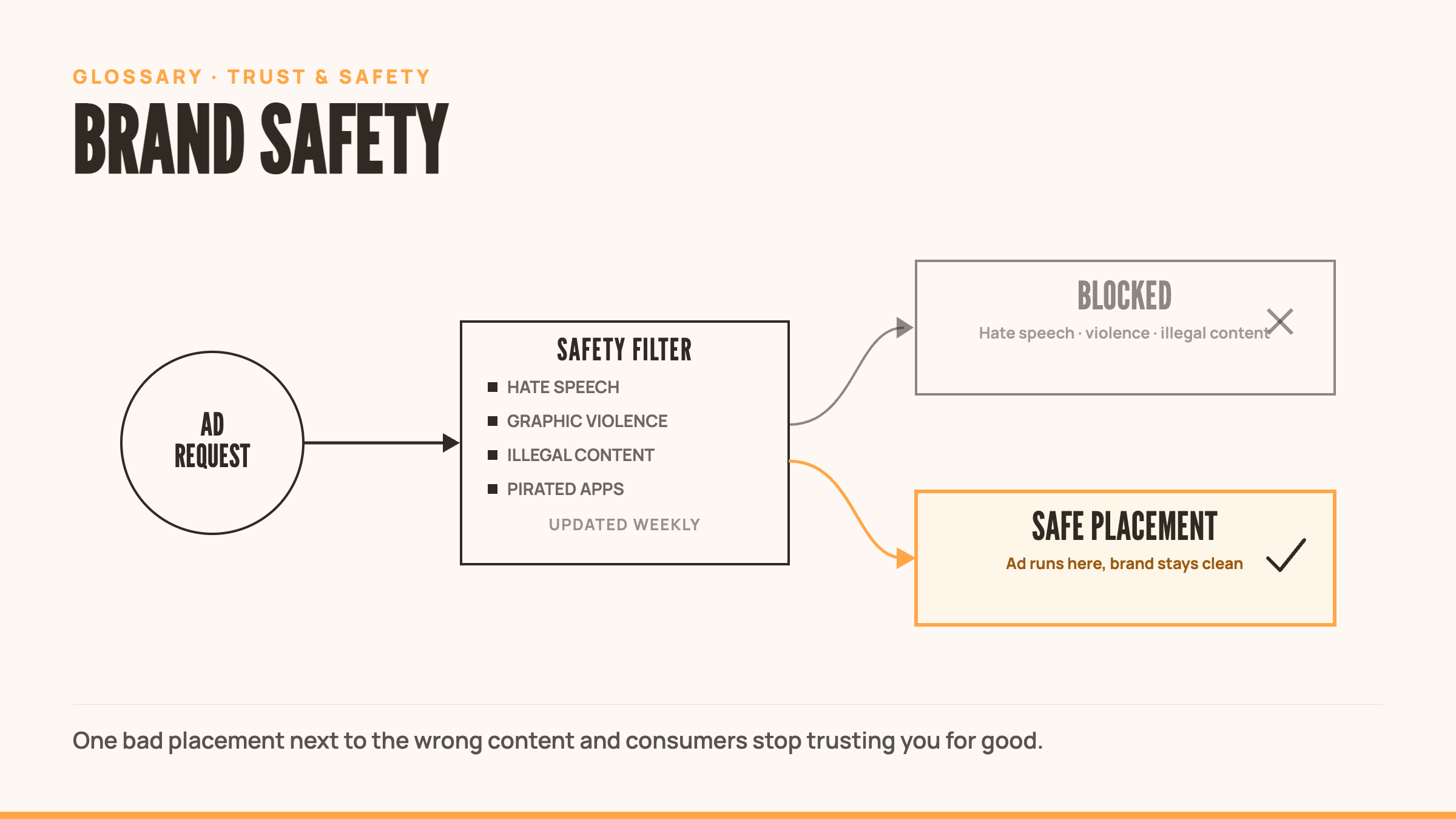
Quick Definition: Protecting your brand from appearing alongside harmful, offensive, or inappropriate content in the digital advertising ecosystem.
What is Brand Safety
Brand safety keeps your ads away from content that damages your reputation.
Your ad appears next to hate speech, graphic violence, or illegal content? That association sticks. Consumers remember where they saw your brand, even if placement was automated.
The IAB defines brand safety as the practices and technologies that prevent ads from running in contexts that could harm brand reputation. Think blocklists, content categories, keyword exclusions, and verification tools.
You control where your ads appear. Brand safety is the system that enforces those controls.
Brand Safety vs Brand Suitability
Brand Safety: Universal protection. Everyone blocks hate speech, violence, adult content, illegal activity. These are non-negotiables.
Brand Suitability: Nuanced and brand-specific. A gaming company might embrace action content that a financial services brand avoids. A wellness brand might steer clear of fast food contexts that don’t phase other advertisers.
Safety is the floor. Suitability is your brand’s ceiling.
Why It Matters
75% of consumers feel less favorable toward a brand whose ad runs next to misinformation or offensive content. 51% say they’d stop using that brand’s product or service entirely. These numbers come from US consumer research; exact figures shift by region, but the direction holds everywhere.
One bad placement tanks trust you spent years building. And trust doesn’t recover with an apology tweet.
Your ROAS might look great this month. But if your ads ran next to extremist content, you’re measuring the wrong thing.
Mobile-Specific Considerations
Mobile has unique risks desktop doesn’t face.
Pirate Mobile App List (PMAL): Apps removed from app stores for policy violations. They’re gone from the store but still active on millions of devices. Your ads can still serve there.
In-app environments: Less transparent than web. Harder to verify context. More reliance on network-level controls.
SDK-based inventory: Your ad might render inside an app you’ve never heard of, with content you can’t preview.
Mobile UA demands tighter controls, not looser ones.
Best Practices
Start with category exclusions. Block universally harmful content at the network level. Hate speech, graphic violence, adult content, illegal activity.
Use verification partners. IAS, DoubleVerify, Pixalate. They scan inventory before your ads serve. (Oracle shut down Moat along with its entire ad business in September 2024, so it’s no longer a live option.)
Audit your inventory regularly. What passed muster six months ago might not today. New apps, new publishers, new risks.
Set brand suitability guidelines beyond safety minimums. Define what aligns with your brand, not just what doesn’t violate it.
Monitor PMAL if you run mobile. Apps get removed constantly. Your blocklists need updates, not set-it-and-forget-it.
Test before scaling. New network? New placement? Small budget first, verify context, then scale.
Common Mistakes
Assuming networks handle it. They don’t. Default settings prioritize scale, not safety.
Setting controls once and never updating. The internet changes daily. Your blocklists can’t be static.
Ignoring in-app inventory. Mobile apps are harder to audit. That’s why they need more attention, not less.
Confusing safety with suitability. Blocking illegal content is brand safety. Blocking sports content because your brand targets wellness? That’s suitability. Know which you’re optimizing for.
Prioritizing scale over context. Cheap inventory is cheap for a reason. If the CPM looks too good, check where those impressions actually serve.
Related Terms
- Brand Suitability – Nuanced content alignment beyond safety minimums
- Viewability – Whether your ad was actually seen
- Ad Fraud – Fake impressions that waste budget
- Blocklists – Categories or sites you explicitly exclude
- Allowlists – Approved inventory you explicitly include
External Resources
- Amazon Advertising: Brand Safety Guide
- TAG (Trustworthy Accountability Group): Brand Safety
- Peer39: Brand Safety Guide for Advertisers
Frequently Asked Questions
What is an example of a brand safety issue?
Your ad renders next to hate speech, graphic violence, or illegal content. That association sticks with consumers even though the placement was automated.
What is brand safety in Meta ads?
Meta gives advertisers brand suitability controls on Facebook, Instagram, and Audience Network that filter out content unsuitable for a given brand, applied individually or in combination.
What is brand safety in DV360?
DV360 automatically filters content no advertiser wants to run next to (brand safety), and separately lets advertisers opt in or out of traffic that’s acceptable for some brands but not others (brand suitability).
How often should I update my blocklists?
Monthly at minimum. Weekly if you’re running significant spend. Daily if you’re in a high-risk category or managing a PR crisis.