

glossary
Viewability
Viewability measures whether ad impressions were actually seen by humans. An ad can serve, load, and get counted as an impression without anyone seeing it. Viewability tracks the difference between impressions served and impressions viewed.
Quick Definition
Viewability measures whether ad impressions were actually seen by humans. An ad can serve, load, and get counted as an impression without anyone seeing it. Viewability tracks the difference between impressions served and impressions viewed.
What is Viewability?
Viewability answers a simple question: Did anyone actually see your ad?
You pay for impressions. But an impression doesn’t mean someone saw it. The ad might load below the fold. The user might scroll past before it renders. The video ad might autoplay in a background tab. You still get charged.
Viewability measures what percentage of your paid impressions were actually visible to users.
Here’s the problem it solves: Before viewability became standard, advertisers paid for ads that never appeared on screen. A banner ad at the bottom of a webpage that no one scrolled to. A video ad that started playing in a tab the user switched away from. The impression counted. The invoice charged. But no human eyes saw it.
In 2014, Google analyzed billions of impressions and found that 56.1% weren’t viewable. More than half of ad spend was wasted on impressions no one saw. That got the industry’s attention.
Viewability doesn’t measure whether someone engaged with your ad. It doesn’t track clicks, installs, or conversions. It only measures whether the ad was on screen long enough to potentially be seen.
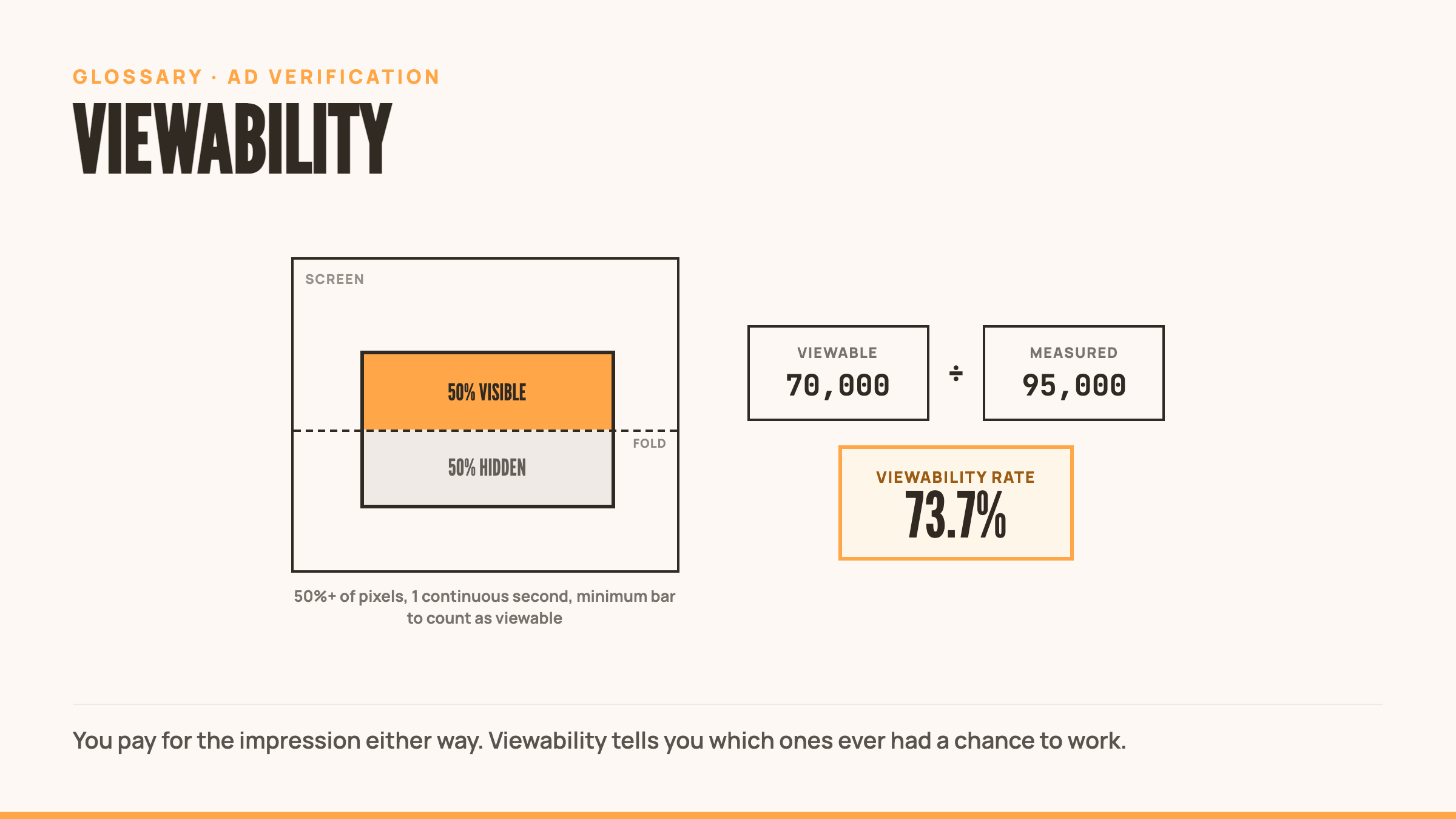
The threshold is low. An ad is viewable if at least 50% of its pixels appear on screen for at least one second. For video, it needs two seconds. That’s it.
This matters because you can optimize for impressions and still waste budget on ads no one sees. Viewability gives you a baseline: How many of the impressions you paid for actually had a chance to work?
IAB/MRC Standards
The industry needed a standard definition. In 2014, the Interactive Advertising Bureau (IAB) and Media Rating Council (MRC) published viewability standards that most platforms now follow.
Display Ads:
- At least 50% of the ad’s pixels must be visible on screen
- Must be visible for at least 1 continuous second
- Measured from when the ad enters the viewport
Video Ads:
- At least 50% of the video player’s pixels must be visible
- Must be visible for at least 2 continuous seconds
- Measured from when the video starts playing
Large Display Ads (242,500+ pixels):
- Only 30% of pixels need to be visible
- Must be visible for at least 1 continuous second
- Recognizes that large ads are harder to fully view
Mobile:
- Same standards apply as desktop
- 50% pixels visible for 1 second (display) or 2 seconds (video)
These standards are minimum thresholds. An ad that meets these criteria is considered “viewable” even if the user scrolled away immediately after.
Platforms like Meta, Google, TikTok, and AppLovin use these standards to report viewable impressions. When you see “viewable impressions” in campaign reporting, it’s based on these definitions.
How It’s Measured
Viewability tracking happens in real-time using JavaScript or SDK measurement.
Web: JavaScript tags track when an ad enters the viewport, how much of the ad is visible, and how long it stays visible. The tag compares the ad’s position to the browser window dimensions. If 50%+ of the ad is on screen for the required time, it’s counted as viewable.
Mobile Apps: SDKs track similar metrics within the app environment. The SDK checks the ad’s position relative to the device screen and measures visibility duration.
The Formula: Viewability Rate = (Viewable Impressions / Measured Impressions) × 100
Not all impressions can be measured. Some browsers block tracking scripts. Some environments don’t support measurement. The formula divides viewable impressions by measured impressions, not total impressions.
Example:
- 100,000 total impressions served
- 95,000 impressions measured
- 70,000 impressions viewable
- Viewability Rate = 70,000 / 95,000 = 73.7%
Ad networks report viewability rates in campaign dashboards. Meta calls it “on-screen rate.” Google uses “active view.” The metric names vary, but the underlying measurement follows IAB/MRC standards.
Why It Matters
Viewability is the floor. If your ad wasn’t viewable, nothing else matters.
Budget Efficiency: Paying for non-viewable impressions is wasted spend. You can’t get clicks, installs, or conversions from ads no one saw. Optimizing for viewability means more of your budget goes to impressions with potential, improving ROAS.
Performance Benchmarks: Low viewability skews your performance metrics. If 40% of your impressions weren’t viewable, your real CTR is higher than reported. Your real CPI is lower. Viewability gives you cleaner data.
Platform Optimization: Ad networks reward viewability. Higher viewability rates often correlate with better placements and lower costs. Platforms want ads that users engage with, and engagement requires visibility.
Creative Testing: Testing creative performance on non-viewable impressions is useless. If users didn’t see the ad, the creative didn’t fail. The placement did. Viewability separates creative performance from placement quality.
Mobile Gaming Context: Mobile game UA runs on volume. You’re buying millions of impressions across networks. Even a 10% improvement in viewability rate can mean thousands of additional installs without increasing spend.
Industry benchmarks sit around 60-70% viewability for display and 70-80% for video. If you’re below 50%, you’re bleeding budget.
Beyond Viewability (Attention Metrics)
Viewability was progress. The bar is low.
An ad can be viewable and still invisible. The user scrolled past in 1.1 seconds. The ad was technically on screen, but no one paid attention. Viewability measures opportunity. It doesn’t measure attention.
That’s the next frontier. The industry is moving toward attention metrics that go beyond basic visibility.
Attention Metrics Track:
- Time in view (not just 1-2 seconds, but total exposure time)
- Active attention (whether the user is actively engaging with the page)
- Gaze tracking (where the user is actually looking, using eye-tracking or predictive models)
- Interaction signals (mouse movement, scroll behavior, touch patterns)
Companies like Amplified Intelligence, Adelaide, and Lumen are building attention measurement platforms. They combine viewability data with engagement signals to estimate actual attention.
The argument: A 10-second viewable impression with active engagement is worth more than a 1.1-second viewable impression where the user was scrolling fast. Attention metrics try to capture that difference.
This matters for mobile gaming UA because attention correlates with conversion. Longer view time and active attention predict installs better than basic viewability. If you’re buying media on attention metrics, you’re buying higher-quality impressions.
The shift is happening slowly. Most platforms still price on impressions or viewability. But expect attention-based buying to become standard in the next few years.
Viewability was the floor. Attention is the ceiling.
Common Mistakes
Ignoring viewability entirely. Teams optimize for CTR and CPI without checking viewability. You might be running campaigns with 40% viewability and not know it. Check viewability first.
Assuming 100% viewability is possible. It’s not. Even well-optimized campaigns hit 70-80% max. Technical limitations, user behavior, and measurement gaps mean some impressions won’t be viewable. Aim for industry benchmarks, not perfection.
Blaming creatives for low performance when viewability is the issue. If your viewability rate is 50%, half your impressions weren’t seen. The creative didn’t fail. The placement did. Fix viewability before testing new creatives.
Not filtering out non-viewable impressions in reporting. If you’re calculating CTR or CVR based on total impressions including non-viewable ones, your metrics are wrong. Filter for viewable impressions to get accurate performance data.
Paying for non-viewable inventory. Some ad networks and placements have consistently low viewability. Below-the-fold banners, auto-play background videos, bottom-of-page slots. If a placement has sub-50% viewability, stop buying it.
Confusing viewability with engagement. Viewability means the ad was on screen. It doesn’t mean anyone cared. You can have 90% viewability and 0.1% CTR. Viewability is necessary, but it’s not sufficient.
Related Terms
- CTR (Click-Through Rate) – Measures clicks, but requires viewability first
- CPM (Cost Per Mille) – Pricing model based on impressions, not viewable impressions
- Video Ads – Higher viewability standards (2 seconds vs 1 second)
- Creative Testing – Requires viewable impressions for accurate results
External Resources
- Amazon Ads: Viewability Guide
- Publift: MRC Viewability Standards
- Mobile Ads: Why Viewability Matters
Frequently Asked Questions
What is the difference between visibility and viewability?
Viewability is the industry-standard, measurable version of visibility. It follows a specific IAB/MRC definition: at least 50% of an ad’s pixels on screen for at least 1 second, 2 seconds for video. “Visibility” is the general concept; viewability is how the industry actually measures and reports it.
Is viewability the same as impressions?
No. An impression means the ad was served and counted, whether or not anyone saw it. Viewability measures what percentage of those served impressions were actually on screen long enough to potentially be seen. You pay for impressions; you want viewable ones.
What is a synonym for viewability?
Platforms use different names for the same concept. Meta calls it “on-screen rate,” Google calls it “active view.” All of them measure viewability against the same underlying IAB/MRC standards.
Is viewability a KPI?
Yes, treat it as a diagnostic KPI rather than a goal in itself. It’s the floor: if impressions weren’t viewable, nothing downstream, CTR, installs, ROAS, can be trusted. Optimize for conversions, but check viewability first when performance looks off.