

glossary
End Card
Quick Definition: The final screen shown after a video ad finishes playing, designed to capture user intent and drive installs. Interactive end cards convert 7x better than static ones. — 01. What is an End Card? An end card appears when your video ad finishes. It’s the last chance to convert viewers into users. Most […]
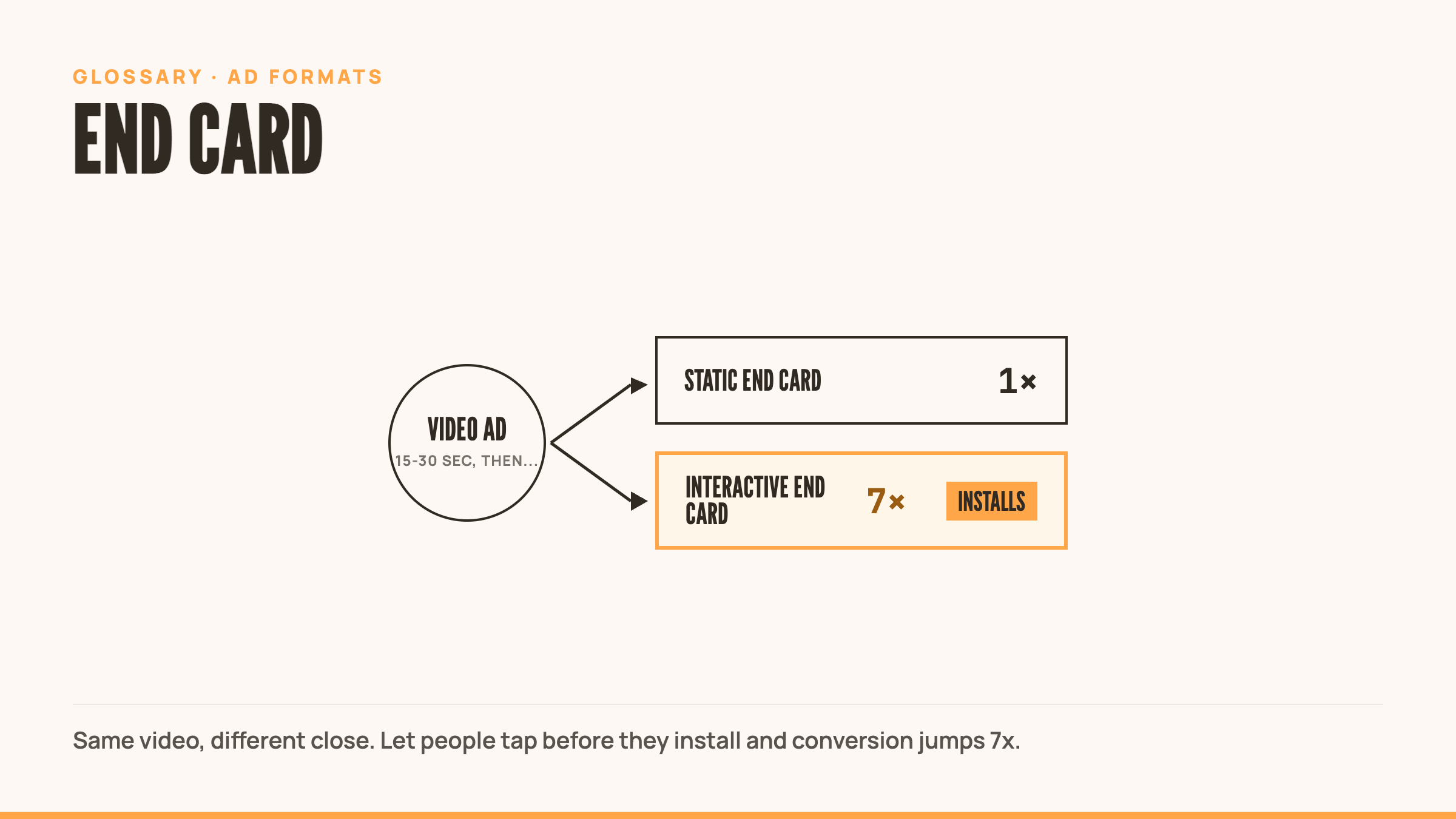
Quick Definition: The final screen shown after a video ad finishes playing, designed to capture user intent and drive installs. Interactive end cards convert 7x better than static ones.
What is an End Card?
An end card appears when your video ad finishes. It’s the last chance to convert viewers into users.
Most UA managers treat end cards as an afterthought. That’s a mistake. End cards are standalone creative units requiring their own implementation, testing, and optimization.
Think of playable ads in three parts: tutorial prompt, interactive experience, end card. The end card closes the loop. It captures the player when intent peaks.
Video ads use end cards differently. The video tells the story. The end card drives the action. Together, they form a conversion system.
Types of End Cards
Static End Cards
A single image with your app icon, CTA button, and maybe a rating or testimonial.
Simple to build. Easy to deploy. Decent baseline performance.
The problem? They leave conversion on the table.
Interactive End Cards
Mini-experiences that let users engage before installing. Tap to play a moment from your game. Swipe to explore features. Interact with your brand.
Interactive end cards require HTML builds (5MB max file size). More complex to produce. Worth every hour of dev time.
Performance Impact
The data tells the story:
Install Rates: Interactive end cards deliver 7x better IPM (installs per mille) than static versions, per AppTweak’s analysis of Smadex campaign data.
Click-Through Rate: 47% higher CTR when users can interact before committing, same source.
Conversion Lift: The right end card combination drives 30% higher conversion rates.
Market Adoption: 70-80% of video ad spend now pairs with interactive end cards (Moloco data). That’s not trend chasing. That’s proven performance.
One end card change can flip a losing campaign. Or double your winner’s efficiency.
Best Practices for Optimization
Test With Intent
Budget split matters. Allocate 30% to testing new end cards, 70% to proven winners. Testing finds the outliers. Proven winners fund the exploration.
Keep It Focused
One clear CTA. One compelling reason to install. Too many options kill conversion.
Match the Experience
If your video shows gameplay, your end card should feel like the next step. Continuity converts better than contrast.
Design for Thumbs
Mobile first. Always. Buttons should be thumb-sized. Interactions should feel natural. Test on actual devices before shipping.
Optimize Load Time
5MB is the limit. Use it wisely. Compress assets. Lazy load when possible. A slow end card is a useless end card.
Version Control
Track which end card runs with which video. Performance data means nothing if you can’t reproduce the combo.
Common Mistakes
Treating End Cards as Templates Every game has different conversion triggers. Copy-paste end cards leave performance on the table.
Ignoring Load Performance Your end card can’t convert if it doesn’t load. File size and optimization matter more than fancy animations.
Static When You Should Be Interactive If 70-80% of the market uses interactive end cards, you’re competing with that standard. Static is the baseline, not the target.
Testing Too Many Variables at Once Change the CTA copy or the background, not both. Multivariate testing sounds smart until you can’t tell what worked.
No Documentation “Which end card was that?” becomes the most expensive question in your retro. Document everything.
Related Terms
- Creative Fatigue – Why even winning end cards need rotation
- Playable Ads – Where end cards often appear
- CTA (Call to Action) – The button that drives the install
- Video Ads – The creative format that precedes end cards
- Interactive Ads – The category that includes interactive end cards
External Resources
- Tips to Make Amazing End Cards for Mobile Video Ads – App Samurai
- End Cards: The Secret to Better Mobile Ad Performance – Singular
- Interactive End Card Implementation Guide – ironSource Developers
- Improve Creatives’ Performance for Mobile Gaming Ad Campaigns – AppTweak (source of the 7x IPM / 47% CTR stats above)
Frequently Asked Questions
Should every video ad have an interactive end card?
The data says yes. Interactive end cards show 7x better install rates than static ones. Budget and production capacity are real constraints, but static end cards should be the fallback, not the default.
How do I know if my end card is too complex?
If it takes more than 3 seconds to load or requires explanation to use, simplify it. Conversion happens in moments, and a complex end card kills momentum.
Can I reuse end cards across different video ads?
You can, but match matters. If your video shows puzzle gameplay and your end card shows racing, conversion drops. The end card should feel like the natural next step from the video.
What’s the ideal file size for interactive end cards?
Aim for 2-3MB even though the platform limit is typically 5MB. Faster load times mean higher completion rates, so compression is your friend.
How often should I refresh my end cards?
When performance degrades or creative fatigue sets in. Track CTR and install rate by end card variant, and when either drops 20% from peak, test new versions.
Last updated: 2025-12-22