

glossary
Interactive Ads
Interactive ads are ad units that require user participation—tap, swipe, play, choose. They turn passive viewers into active players, delivering stronger engagement and behavioral data than static or video formats.
Quick Definition
Interactive ads are ad units that require user participation: tap, swipe, play, choose. They turn passive viewers into active players, delivering stronger engagement and behavioral data than static or video formats.
What Are Interactive Ads?
Interactive ads demand action. Unlike static banners or video ads that play whether you care or not, interactive formats require the user to do something. Tap a button. Swipe through options. Play a mini-game. Answer a question.
This matters because over 90% of mobile device time happens inside apps, where users expect interaction. Static ads feel like interruptions. Interactive ads feel like invitations.
The payoff is measurable. Users who interact with an ad spend more time with your brand. They remember it better. You get real-time behavioral data showing exactly how they engaged: what they tapped, where they dropped off, which choices they made.
For mobile game marketers, interactive ads solve a core problem: showing someone your game without forcing them to install it first. A 30-second playable ad lets users experience your gameplay mechanics, art style, and core loop before deciding to download. That’s not a promise. That’s proof. See it in real playable examples.
The format forces creative teams to think differently. You can’t just produce a flashy video and hope it converts. You need to design an experience that teaches, entertains, and convinces in seconds.
Types of Interactive Ads
Playable Ads
Mini-games that simulate your actual game experience. Players tap, swipe, and solve puzzles to experience core gameplay before installing. Playables are the premium interactive format for mobile game UA: they filter for quality installs by showing real mechanics upfront.
Quizzes and Polls
Simple interactive formats where users answer questions or vote on options. Common in casual games and brand campaigns. Lower production cost than playables but less immersive.
Augmented Reality (AR) Ads
Users point their camera to see virtual objects in real space. High novelty factor, but limited scale due to device requirements and production complexity.
Swipeable Carousels
Multiple images or offers users swipe through. Basic interactivity, but effective for showcasing features or characters.
Video Ads with Interactive End Cards
Standard video that ends with a playable moment or choice. Combines passive viewing with active engagement.
Benefits for Mobile Game Marketing
Stronger Brand Recall
Users remember what they did, not just what they saw. Playing your game, even for 15 seconds, creates memory anchors that passive video can’t match.
Longer Attention Spans
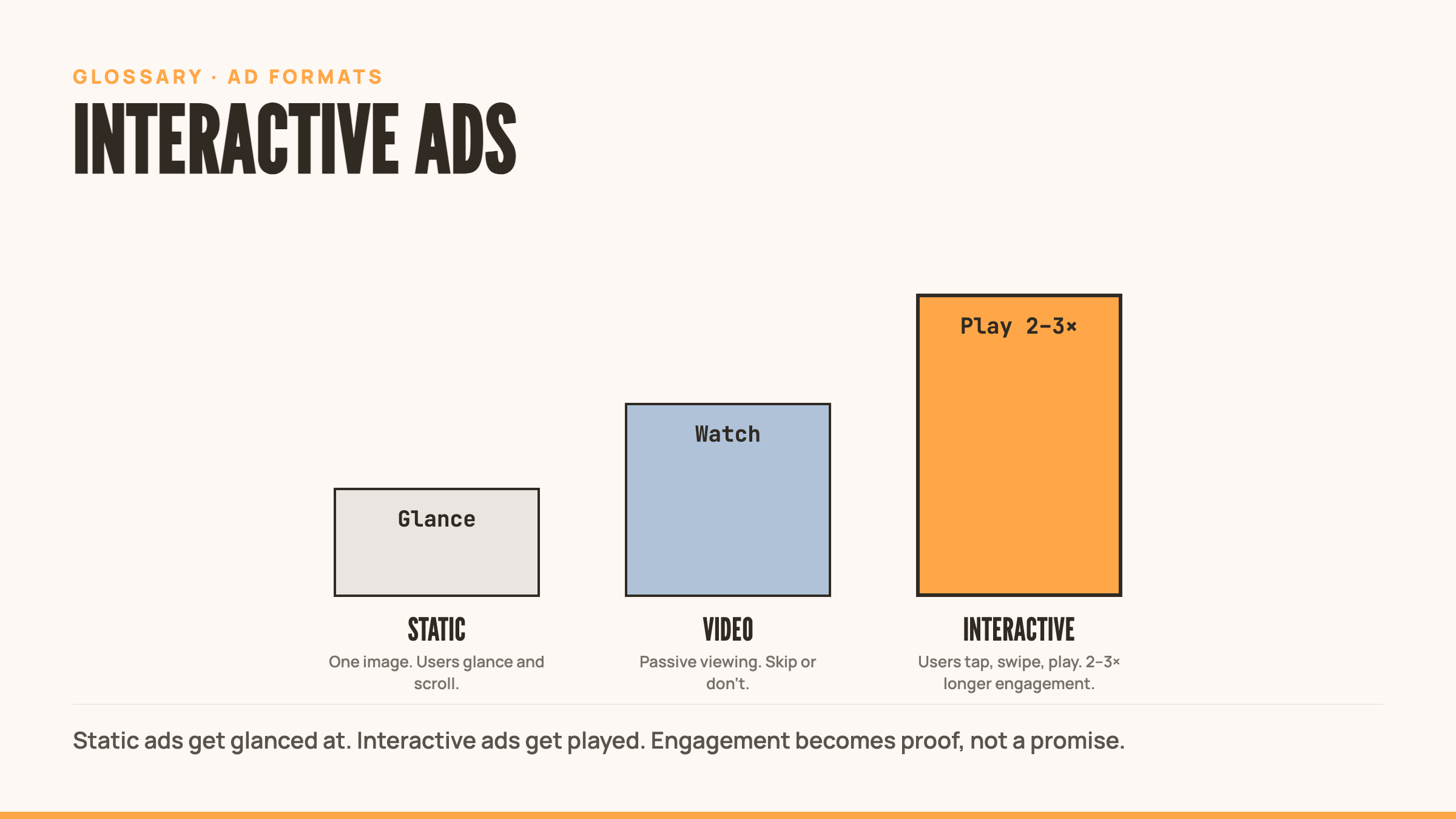
Interactive ads keep users engaged 2-3x longer than video. That’s more time to communicate your game’s value and convert interest into installs.
Real Behavioral Data
Every tap, swipe, and choice generates data. You learn which mechanics resonate, where users get confused, and what drives conversion. That insight feeds back into creative strategy.
Quality Install Filtering
Users who complete a playable ad understand your game before installing. They convert at higher rates and retain better because they chose based on real experience.
Creative Differentiation
In a feed full of static banners and skippable video, interactive ads stand out. They break the scroll and demand attention.
Interactive Ads vs Traditional Formats
Static Ads: One image. No movement. Limited messaging. Users glance and scroll.
Video Ads: Passive viewing. Users watch (or skip). No participation required. You control the message, but not the engagement.
Interactive Ads: Users participate. They make choices, solve problems, play. Engagement is active, not passive. You create an experience, not just a message.
The tradeoff is production complexity. Static ads are fast and cheap. Video requires more work. Interactive formats, especially playables, demand design, development, and testing. But the data advantage and conversion quality justify the investment.
Best Practices
Design for Seconds, Not Minutes
Users decide in 5-10 seconds. Make the first interaction obvious and rewarding. If they don’t understand what to do immediately, you’ve lost them.
Show Core Gameplay
Don’t bait-and-switch. If your playable shows puzzle mechanics but your game is a shooter, installs will churn. Show what players actually get.
Test Interaction Patterns
Some mechanics feel natural on mobile. Others frustrate. Test tap vs. swipe, single action vs. multi-step, simple vs. complex. Let data guide design.
Optimize for Completion
Track where users drop off. If 80% quit at step three, step three is the problem. Simplify, clarify, or cut it entirely.
Measure Beyond CTR
Click-through rate matters less for interactive ads. Track completion rate, interaction time, and post-install retention. Those metrics reveal quality.
Create Volume
Interactive ads fatigue fast. Plan to produce dozens, not one or two. The format demands creative production at scale.
Common Mistakes
Overcomplicating the Interaction Users won’t read instructions or watch tutorials. If the ad requires more than one obvious gesture, it’s too complex.
Ignoring Load Time A playable that takes 10 seconds to load is a playable that never gets played. Optimize file size ruthlessly.
Designing for Desktop Interactive ads run on phones. Small screens. Touch input. If it feels cramped or fiddly on a 6-inch display, redesign it.
Forgetting the End Card Users finish your interactive ad. Now what? If the call-to-action isn’t immediate and obvious, you wasted their engagement.
Treating Playables Like Video Playables are not animated videos. They’re functional prototypes. Design for interaction, not just visual polish.
Skipping Creative Testing One playable won’t work for every audience. Test different mechanics, art styles, and hooks. Volume and exploration win.
Related Terms
External Resources
- Unity: Interactive Ads Glossary
- Chartboost: Interactive Advertising Definition
- Amazon Ads: Interactive Ads Guide
Frequently Asked Questions
What is an interactive ad?
An ad unit that requires user participation rather than passive viewing: tap a button, swipe through options, play a mini-game, answer a question. Interactive ads turn viewers into active players and generate behavioral data static or video formats can’t capture.
What are the different types of interactive advertising?
For mobile game UA, the main formats are playable ads (mini-games simulating real gameplay), quizzes and polls, augmented reality experiences, swipeable carousels, and video ads with interactive end cards. Playables are the premium format because they filter for quality installs.
What’s the difference between a playable ad and an interactive ad?
Playable ads are a specific type of interactive ad focused on simulating your actual game. Interactive ads is the broader category, which also includes quizzes, AR experiences, and other formats that require user action.
How long should an interactive ad experience last?
Target 10-30 seconds. Users decide fast whether to engage, and longer experiences risk drop-off before you get to the conversion moment.
How do I measure success for interactive ads?
Track completion rate, interaction time, install rate, and post-install retention. Click-through rate matters less here than for static or video ads. Those deeper metrics reveal install quality, not just attention.