

glossary
Incrementality
Quick Definition: Measurement methodology that isolates the true impact of your marketing spend by comparing outcomes with and without your ads running. — 01. What is Incrementality Incrementality answers the question every CFO eventually asks: “Would we have gotten those sales anyway?” Most attribution systems track correlation. User saw ad, user installed, attribution platform claims […]
Quick Definition: Measurement methodology that isolates the true impact of your marketing spend by comparing outcomes with and without your ads running.
What is Incrementality
Incrementality answers the question every CFO eventually asks: “Would we have gotten those sales anyway?”
Most attribution systems track correlation. User saw ad, user installed, attribution platform claims credit. But correlation isn’t causation. That user might have installed without ever seeing your ad.
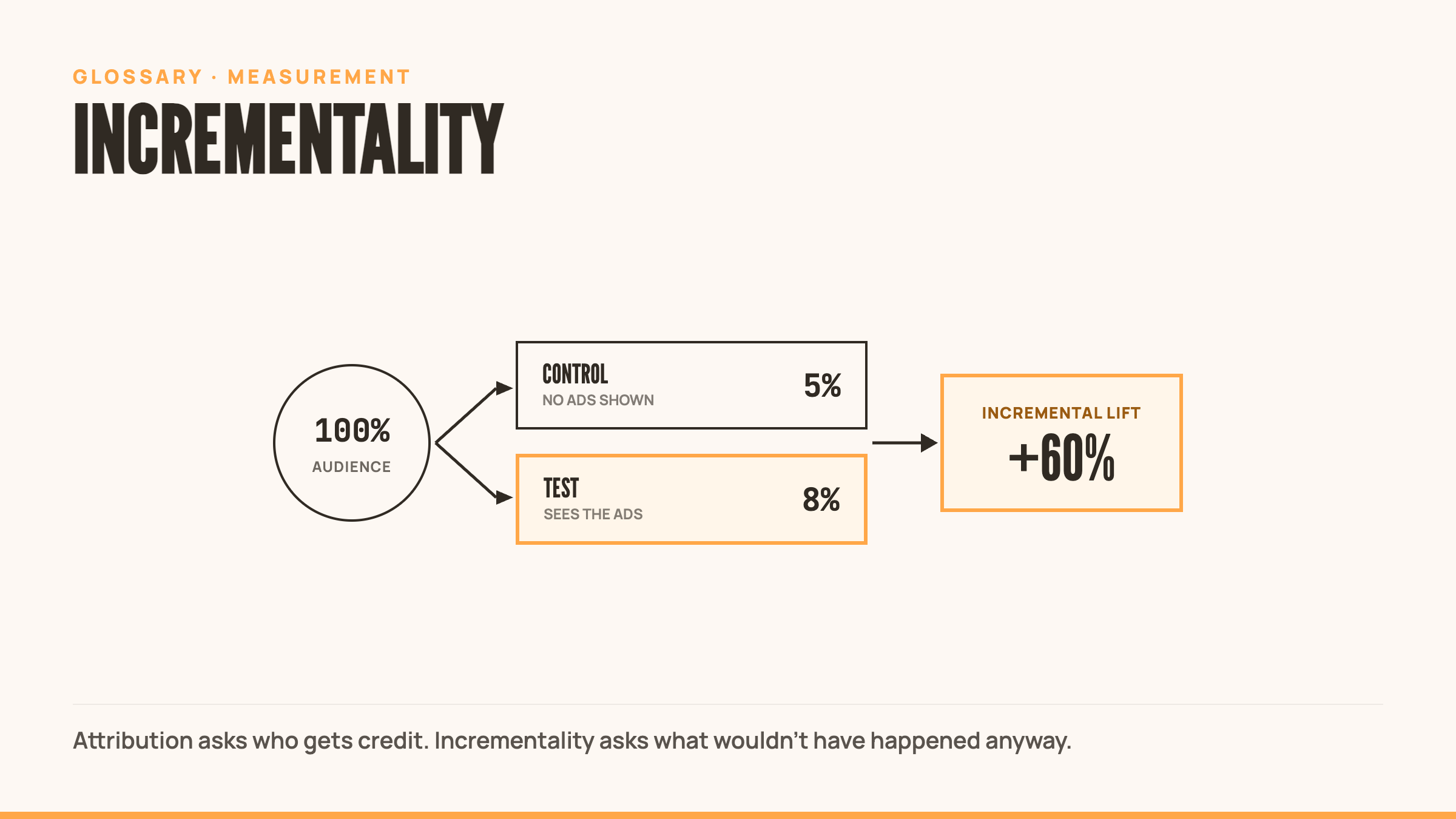
Incrementality testing measures actual lift. You split your audience into test and control groups. Test group sees your ads. Control group doesn’t. The difference in conversion rates between groups is your incremental lift.
That’s your real impact.
Why It Matters (Especially in 2025)
Privacy changes killed the old playbook. IDFA is dead. Multi-touch attribution is practically impossible. The user-level tracking that powered UA for a decade is gone.
Incrementality doesn’t need user-level tracking. You measure at the group level. Geo-based tests. Holdout groups. Statistical modeling that works without personally identifiable data.
Privacy-first measurement isn’t a nice-to-have anymore. It’s the only measurement you can trust.
Plus, incrementality catches something attribution never could: organic cannibalization. How much of your paid spend is just stealing installs you would’ve gotten for free? Attribution platforms will never tell you that. They get paid when they claim credit.
How to Measure
Geo-Based Testing
Split test by geographic region. Run ads in some geos, not others. Compare install rates between test and control regions.
Works best for: Brand campaigns, broad awareness plays, testing new channels.
User-Level Testing
Randomly assign users to test or control groups. Serve ads to test group only. Measure conversion rate difference.
Works best for: Retargeting, lookalike audiences, performance campaigns.
A/B Testing
Classic randomized controlled trial. Split traffic, expose one group to your marketing, hold out the other.
Works best for: Channel testing, budget allocation, proving incrementality to skeptical stakeholders.
Time-Based Testing
Run campaigns on/off in intervals. Measure baseline conversion rates during off periods, compare to on periods.
Works best for: Always-on channels, platforms where geo-splits aren’t possible.
Key Metrics
Incremental Lift Percentage increase in conversions caused by your ads. Formula: (Test Group CVR – Control Group CVR) / Control Group CVR
Incremental Installs Absolute number of installs directly caused by your marketing. Formula: Test Group Actual Installs – (Control Group Install Rate × Test Group Size)
Incremental ROAS Revenue generated per dollar of ad spend, accounting only for truly incremental conversions. Formula: Incremental Revenue / Ad Spend
Organic Cannibalization Rate Percentage of paid installs that would have happened organically. Formula: 1 – (Incremental Installs / Attributed Installs)
Statistical Significance Confidence level that your results aren’t random noise. Aim for 95% or higher.
Common Mistakes
Running tests too short: Need enough time to reach statistical significance. Ending early gives false results.
Sample sizes too small: Tiny control groups create noisy data. Need volume for clean reads.
Ignoring seasonality: Black Friday test vs. January baseline isn’t measuring incrementality. It’s measuring calendar effects.
Not accounting for spillover: Users in control group might still see your ads through other devices, shared screens, word of mouth. Spillover inflates control group performance, understates true lift.
Trusting attribution platforms for incrementality: Platforms that make money from attribution have zero incentive to tell you half your spend is wasted.
One-and-done testing: Market conditions shift. Creative fatigues. Test incrementality regularly, not once a year.
Related Terms
- Attribution: Tracking which touchpoints get credit for conversions (correlation-based)
- MMP: Mobile Measurement Partner – platforms that track attribution
- ROAS: Return on Ad Spend – revenue per dollar spent on ads
- A/B Testing: Controlled experiments comparing two variants
- ATT: Apple’s App Tracking Transparency – privacy framework that killed IDFA
- SKAdNetwork: Apple’s privacy-safe attribution framework
External Resources
- Adjust: Incrementality Glossary
- Google: Incrementality Testing Guide
- Measured: What is Incrementality Testing?
Frequently Asked Questions
What is the meaning of incrementality?
Incrementality is a measurement methodology that isolates the true impact of your marketing spend by comparing outcomes with and without your ads running, instead of just crediting whoever touched the user last.
How do you measure incrementality?
Four common methods: geo-based testing (ads on in some regions, off in others), user-level testing (random test/control groups), A/B testing, and time-based testing (campaigns on/off in intervals).
What is the formula for incrementality?
Incremental lift = (Test Group CVR – Control Group CVR) / Control Group CVR. That percentage tells you how much of your conversion rate is actually caused by your ads.
How is incrementality different from attribution?
Attribution tracks correlation: user saw ad, user converted, platform claims credit. Incrementality measures causation: whether the ad actually caused the conversion.