

glossary
Media Mix
Media Mix is how you split your ad budget across channels to reach your audience. Social, video, in-app, CTV, search. The combination determines who sees your ads, when, and how often.
Quick Definition
Media Mix is how you split your ad budget across channels to reach your audience. Social, video, in-app, CTV, search. The combination determines who sees your ads, when, and how often.
What is Media Mix
Media mix is the allocation of marketing spend across communication channels. You have a budget. You have channels. Media mix is the decision of which channels get what percentage.
The goal: maximize reach and impact per dollar spent.
Nearly 4.9 billion people use smartphones globally as of 2024 (active smartphone subscriptions run higher, around 7.2 billion, since many people carry multiple devices). Global app-install ad spend hit $68 billion for full-year 2023. 110 million social buyers in the US represent 38.8% of the population. Your media mix decides how much of that audience you capture. The IAB tracks digital advertising spend across channels annually.
This isn’t a “set it and forget it” decision. Channel performance shifts. Audience behavior changes. Your media mix needs to evolve with the data.
Key Channels for Mobile
In-App Advertising The largest channel for mobile UA. Ads served inside other apps. Includes banner ads, interstitials, rewarded video, and playable ads. Dominant networks: Meta, AppLovin, Unity, Google.
Social Media Organic and paid reach across platforms. Facebook, Instagram, TikTok, Snapchat, Twitter. 110M+ social buyers in the US alone. Strong for brand awareness and retargeting.
Connected TV (CTV) Growing fast. In a 2022 AppsFlyer survey, 98% of brands said they believe CTV will surpass mobile advertising. Delivers video ads on streaming platforms. Premium inventory, higher CPMs, but strong engagement.
Mobile Web Banner ads, native ads, and video across mobile browsers. Lower CPMs than in-app, but broader reach outside app ecosystems.
Search Google Search Ads, Apple Search Ads. High intent traffic. Users already looking for solutions. Expensive but converts well.
Media Mix Modeling (MMM)
Media Mix Modeling measures how each channel contributes to business outcomes. Instead of guessing which channels work, MMM uses statistical analysis to identify drivers of performance.
27.6% of US marketers rate MMM as the most reliable measurement method they use, more than any other method, per a 2025 EMARKETER/TransUnion survey. Digiday covers how attribution models are shifting toward MMM in the privacy-first era.
How MMM Works:
- Collects historical data across all channels
- Analyzes contribution of each channel to conversions, revenue, or installs
- Accounts for external factors (seasonality, competition, market shifts)
- Outputs recommended spend allocation per channel
Why MMM Matters: Attribution is broken. Last-click attribution overweights bottom-funnel channels. MMM captures the full picture, including upper-funnel impact that attribution models miss.
Optimization Strategies
Start with benchmarks, not guesses. Industry benchmarks exist for mobile UA spend allocation. Use them as a starting point, then adjust based on your data.
Test incrementally. Shift 10-15% of budget between channels. Measure impact. Iterate. Big swings create noise. Small shifts reveal signal.
Track leading indicators. Don’t wait for ROAS to adjust. Monitor CPI, CTR, engagement rate, and creative fatigue. These signals tell you when to reallocate before performance drops.
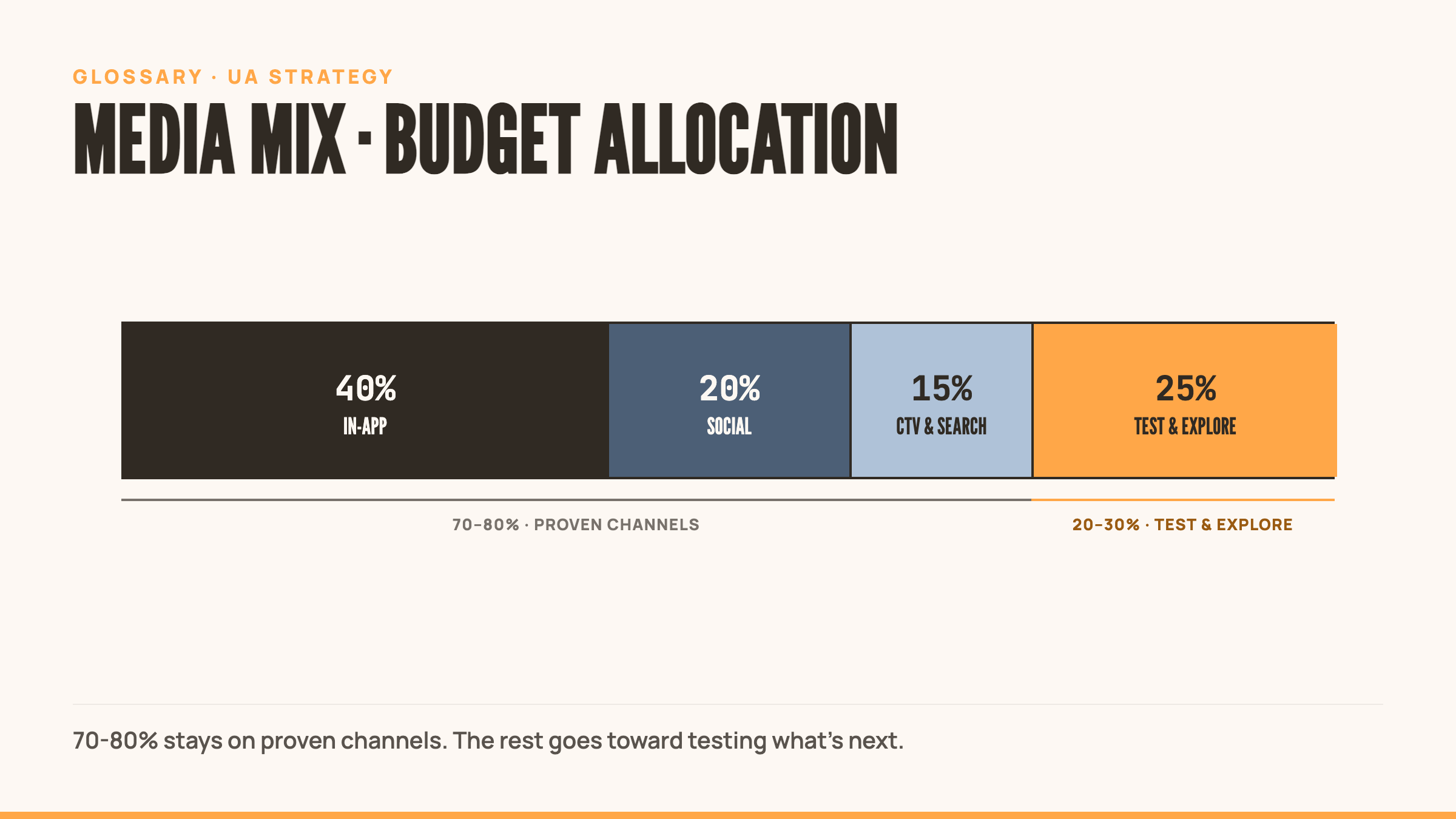
Balance exploration and exploitation. Spend 70-80% on proven channels. Allocate 20-30% to test new channels or creative formats. Apply exploit vs explore principles. New channels can unlock untapped audiences.
Refresh creative per channel. Creative fatigue hits different channels at different speeds. Social burns fast. CTV lasts longer. Match creative refresh cadence to channel dynamics, which is easier with a creative generation pipeline built for that pace. AdExchanger analyzes cross-channel performance trends in mobile advertising.
Common Mistakes
Ignoring upper-funnel impact. Cutting brand awareness spend because it doesn’t show immediate ROAS. Then wondering why acquisition costs climb three months later.
Over-indexing on one channel. Pouring 80% of budget into Facebook because it worked last year. When iOS 14.5 hit, those teams had no diversification.
Using last-click attribution for allocation. Last-click gives all credit to the final touchpoint. Your media mix decision ends up starving channels that drive consideration.
Not accounting for saturation. Every channel has a saturation point. Doubling spend doesn’t double results. Track diminishing returns and reallocate.
Setting media mix annually. The market changes faster than your annual plan. Revisit media mix quarterly at minimum, monthly if you’re scaling fast.
Related Terms
- Attribution Models – How you assign credit for conversions across touchpoints
- ROAS – Return on Ad Spend, the metric most teams use to evaluate channel performance
- Creative Fatigue – When ad performance declines due to audience overexposure
- CPI – Cost Per Install, key metric for mobile UA channel efficiency
- Incrementality Testing – Method to measure true lift from marketing spend
External Resources
- Amazon Advertising: Media Mix Strategy
- Maximize Your Mobile Media Mix in 2024
- Media Mix Optimization Guide
Frequently Asked Questions
What does the term media mix refer to?
The combination of marketing and advertising channels a brand uses to reach its audience, spanning paid, owned, and earned media like in-app, social, search, and CTV.
How often should I adjust my media mix?
Quarterly at minimum. Monthly if you’re running significant spend or scaling fast. Weekly for high-volume campaigns testing new channels.
What percentage of budget should go to testing new channels?
20-30% for exploration, 70-80% on proven channels. If you’re not testing, you’re missing opportunities. If you’re testing everything, you’re burning budget.
How do I know when a channel is saturated?
Watch for diminishing returns. If increasing spend 20% only lifts results 5%, you’ve hit saturation. Time to diversify or refresh creative.