
glossary
Winning Creative
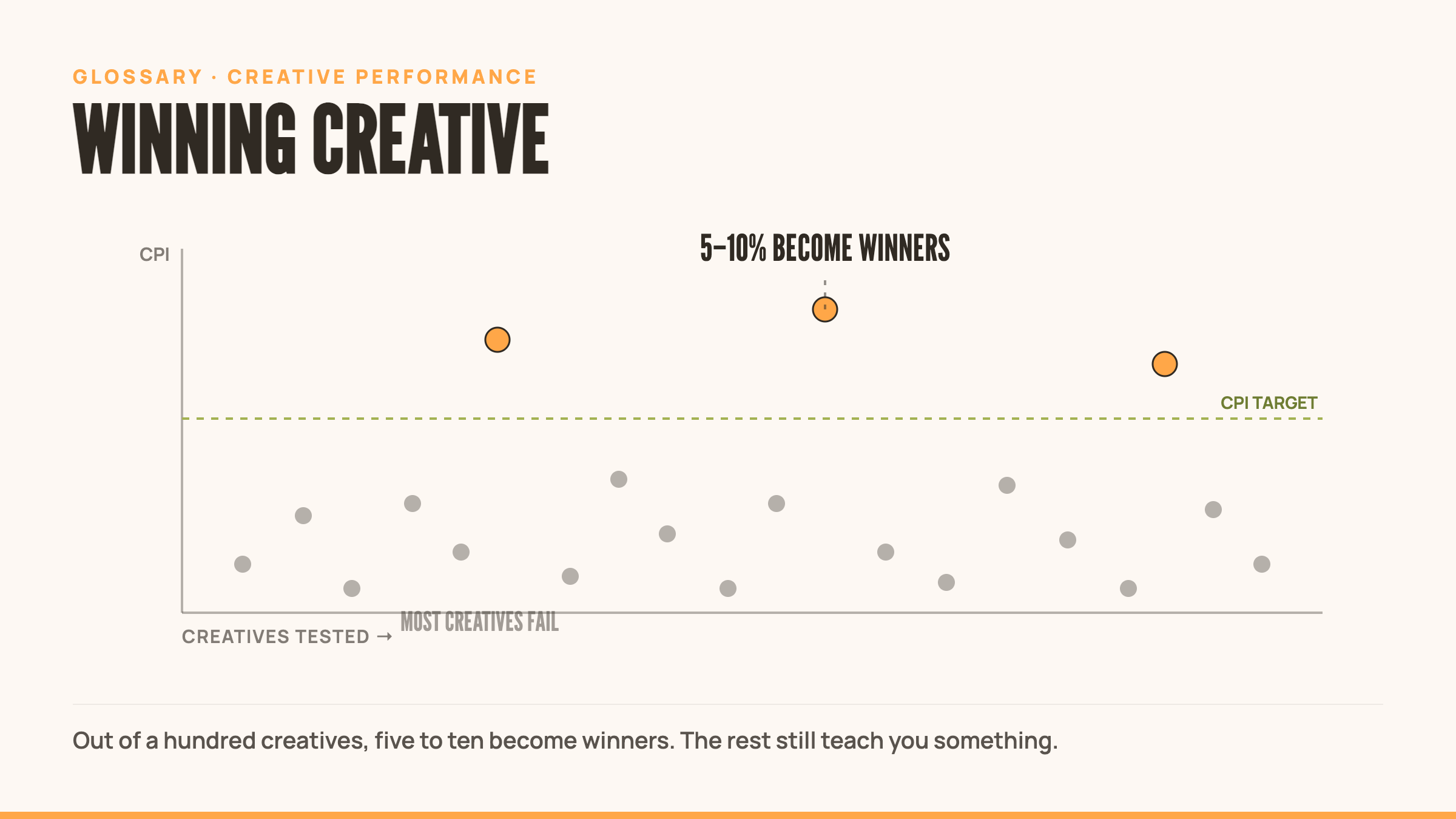
A winning creative is any ad that meets or exceeds your target performance KPIs. Winning creatives hit CPI targets, deliver positive ROAS, and scale without burning budget. The reality: only 5-10% of tested creatives become winners.
Quick Definition
A winning creative is any ad that meets or exceeds your target performance KPIs. Winning creatives hit CPI targets, deliver positive ROAS, and scale without burning budget. The reality: only around 5% of tested creatives become winners, per Motion’s 2026 creative benchmark research, ranging from roughly 4% at smaller spend tiers to 8% at enterprise scale.
What is a Winning Creative
A winning creative performs. That means it beats your CPI benchmark, drives positive ROAS, and scales with sustainable economics.
Winning creatives vary by context. What wins for a casual puzzle game on Unity Ads differs from what wins for a mid-core strategy game on Meta. Genre, ad network, geo, and campaign goals all define what “winning” means.
The key: winning creatives meet thresholds. They clear the bar. They justify continued spend. They don’t need to be exceptional outliers to be valuable.
Winning vs Hit Creatives
Winning creatives perform well. Hits are outliers.
A winning creative might beat your $2.50 CPI target with a $2.10 install cost and deliver 3x ROAS. That’s solid. That’s repeatable. That scales.
A hit creative blows past expectations. It delivers $1.20 CPI when the target is $2.50. It generates 8x ROAS. It drives 10x the volume you projected. Hits are rare, unpredictable, and game-changing.
You need multiple winning creatives to build a sustainable UA program. You can’t predict or rely on hits. But when you create enough volume and test systematically, hits emerge from your portfolio of winners.
Defining Winning Criteria
Winning criteria must be specific and measurable.
Start with CPI. If your target is $3.00 and the creative delivers $2.80, it’s a winner. If it delivers $3.50, it’s not.
Add ROAS thresholds. D7 ROAS above 2-3x for casual games. D30 ROAS above 100% for mid-core titles with IAP models. These benchmarks vary by monetization model and genre.
Consider secondary metrics. Install rate, retention rate, engagement depth. A creative that drives cheap installs but terrible retention isn’t a winner. It’s a volume trap.
Set refresh triggers. When CPI climbs 25% or install rate drops 30%, the creative fatigues. Winning status expires. Replace it.
Building a Portfolio of Winners
Sustainable UA requires multiple winning creatives running simultaneously.
Single-creative dependence kills campaigns. One winner fatigues. Performance drops. You scramble for replacements. Budget stalls.
Portfolio approach: test at volume, identify 8-12 winners, rotate them across networks and geos. When one fatigues, you have backups ready.
Launch new creatives weekly. Test at real volume instead of a handful of concepts. Motion’s 2026 benchmark research (cited above) found a team testing 4 concepts a week surfaces roughly 0.2 winners a week on average, while a team testing 18 a week surfaces roughly 0.9. Volume compounds. Test more, find more winners.
Iteration extends lifespan. When a winner starts fatiguing, create variations. Swap hooks, adjust pacing, test new CTAs. The hook fatigues first and carries the most weight, so a fresh opener on a proven body often restores performance without starting from scratch. This is creative exploitation in action.
Common Mistakes
Confusing volume with quality. Testing 100 similar concepts doesn’t find winners. Test diverse ideas.
Chasing hits instead of building a winner portfolio. Hits are outliers. You can’t predict them. Focus on systematic creative discovery of consistent winners.
Killing creatives too early. Give concepts real budget. $500 tests don’t generate statistical significance. Allocate $2,000-$5,000 per concept for valid results.
Ignoring creative fatigue. Winners don’t win forever. Monitor performance weekly. When metrics decline 25%+, refresh or replace.
Not testing actual gameplay. Misleading hooks drive installs but terrible retention. Authentic gameplay creatives generate higher-quality users, even if IPM is lower.
Related Terms
- Hit Creative: Exceptional outlier that dramatically exceeds performance expectations
- Creative Discovery: Systematic process of testing concepts to identify winners
- A/B Testing: Controlled comparison of creative variants to isolate performance drivers
- CPI (Cost Per Install): Primary metric for evaluating creative performance in UA campaigns
External Resources
- Ultimate Guide to Creative Testing for Mobile Game User Acquisition – Framework for structured testing and metrics
- 5 Winning Mobile Game Ads and What Makes Them Great – Analysis of what drives creative performance
- We Analyzed 1,000+ Game Ads. The Top 5% Share This – Patterns from top-performing creatives
Frequently Asked Questions
How long does a winning creative stay effective?
Depends on spend velocity and audience saturation. High-spend campaigns ($50K+/month) see fatigue in 2-4 weeks. Lower-spend campaigns can run winners for 6-8 weeks. Monitor CPI and install rate weekly, and refresh once either declines 25%+.
Should I optimize existing winners or create new concepts?
Both. Iterate on proven winners with new hooks, pacing, or CTAs to extend their lifespan, while simultaneously testing entirely new concepts so a portfolio doesn’t collapse when several winners fatigue at once.
What budget do I need to validate a winning creative?
Minimum $2,000-$5,000 per concept for statistical significance. $500 tests generate noise, not signal. You need enough spend to get 200+ installs per creative to separate real performance from variance.