

glossary
Creative Discovery
Quick Definition: The systematic process of finding winning ad creatives through volume-based exploration. You can’t predict what will hit. You discover it by creating fast, testing wide, and letting performance reveal the winners. — 01. What is Creative Discovery Creative discovery treats UA creative testing as an exploration problem, not a prediction problem. Most teams […]
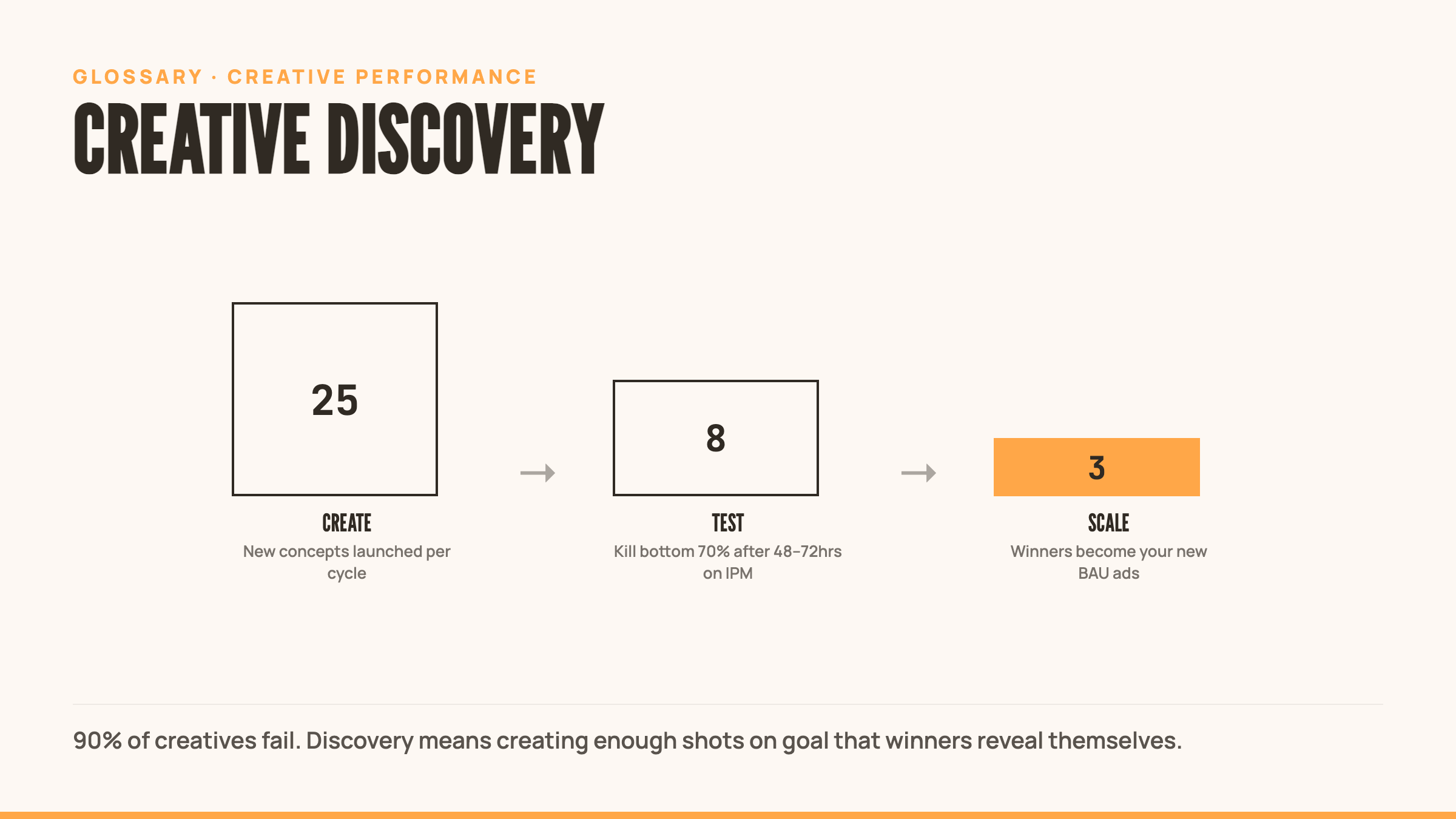
Quick Definition: Creative discovery is the ad creative testing process for finding winning ad creatives through volume-based exploration. You can’t predict what will hit. You discover it by creating fast, testing wide, and letting performance reveal the winners.
What is Creative Discovery
Creative discovery treats UA creative testing as an exploration problem, not a prediction problem.
Most teams try to guess what will work. They brainstorm the “perfect” concept, spend weeks building it, launch cautiously, and hope. This approach assumes you can predict hits.
Discovery starts from a different truth: 90% of creatives fail. One winning ad can drive more revenue than ten mediocre ones combined. The goal isn’t to predict winners. The goal is to create enough shots on goal that winners emerge from real performance data.
Discovery means:
- Creating volume
- Testing systematically
- Letting data decide
- Moving fast (because every day without a winner costs you)
The Discovery Challenge
Traditional creative production makes discovery impossible.
Manual production limits you to 5-10 new creatives per month. With 90%+ failure rates, that’s maybe one winner per month if you’re lucky. And by the time it’s live, creative fatigue is already starting.
The math doesn’t work:
- Production takes 2-3 weeks per creative
- Testing takes another 2-4 weeks to reach significance
- Results come back 4-6 weeks after you had the idea
- By then, you need to start over
Meanwhile, your competitor with faster discovery is already on their third iteration. They found the winning angle while you’re still waiting for test results on concept one.
Speed to discovery determines who wins. Faster discovery means more winners per quarter, fresher angles, and less reliance on any single ad doing all the heavy lifting.
Discovery Process in Mobile UA
Discovery follows a funnel: create many, test many, scale few.
Phase 1: Volume Creation Launch 20-30 new creatives per test cycle. Mix formats (video ads, playable ads, static), angles (gameplay, meta-humor, social proof), and hooks. Don’t overthink it. Get concepts into market.
Phase 2: Initial Testing Run all creatives through equal exposure. Measure IPM (installs per mille) first. Kill bottom 70% after 48-72 hours. No second chances for poor performers.
Phase 3: Advanced KPIs Push survivors to CPA and ROAS testing. Increase budget, measure retention rate and LTV signals. Another 20% get cut here.
Phase 4: Scale Winners The 2-3 creatives still standing become your new BAU ads. Scale budget, run across networks, and squeeze every dollar of performance before fatigue sets in.
Phase 5: Repeat By the time you scale winners, the next batch is already in testing. Discovery never stops.
Optimizing for Discovery
Fast discovery requires three things: speed, volume, and data.
Speed: Cut production time from weeks to days. Use templates, modular systems, or AI-assisted tools. Every day saved in production is another day your winner could be running.
Volume: You need 15-20 new concepts per month minimum to sustain discovery. Fewer shots means fewer winners. More means faster learning and better odds.
Data: Define kill metrics early (IPM thresholds, CPI targets, minimum ROAS). Use statistical significance, not gut feel. Make decisions in 72 hours, not 2 weeks.
Don’t confuse discovery with chaos. Discovery is disciplined. You create fast, but you test systematically. You explore wide, but you measure everything.
Common Mistakes
Mistake 1: Testing Too Few Creatives Launching 3-5 ads per month and hoping one hits. With 90% failure rates, you need 10x that volume.
Mistake 2: Waiting for “The Perfect Concept” Spending weeks debating ideas instead of getting them into market. The market decides what’s perfect, not your creative team.
Mistake 3: Keeping Losers Alive Too Long Running underperformers for weeks “to give them a chance.” Kill fast. Redeploy budget to winners or new tests.
Mistake 4: No Kill Criteria Testing without pre-defined thresholds. Every creative needs a number it has to hit within 48-72 hours or it dies.
Mistake 5: Treating Discovery Like a One-Time Project Finding one winner and calling it done. Discovery is continuous. The moment you stop exploring, your competitors pass you. Creative fatigue never stops.
Mistake 6: Testing New vs. Old Creatives Comparing fresh ads against battle-tested ones with weeks of pixel optimization. Test new against new. Let them earn their way to the big leagues.
Related Terms
- Creative Exploration – The testing methodology that powers discovery
- Hit Creative – The rare ad that significantly outperforms average
- Winning Creative – An ad that meets or exceeds target KPIs
- Creative Velocity – The speed at which you produce and test new creatives
External Resources
- The Ultimate Guide to Facebook Ad Creative Testing in 2025 – Comprehensive framework for testing methodology and best practices
- Creative Testing: 3 Key Steps for High-Performing Ads – Phased testing approach for mobile UA
- 2025 Mobile Ad Creative Index – Industry benchmarks and performance data across formats
Frequently Asked Questions
How many creatives do I need to test per month to make discovery work?
Minimum 15-20 new concepts per month. With 90% failure rates, fewer tests means you might not find a winner that month. Top performers test 30-50 per month.
How long should I run a creative before killing it?
48-72 hours with enough spend to reach statistical significance on your primary metric, usually IPM for installs. If it’s not beating your kill threshold by then, cut it and move budget to the next test.
Can you use discovery for brand campaigns or only performance?
Discovery works best for performance campaigns with clear KPIs like CPA, ROAS, and IPM. Brand campaigns need different measurement frameworks, but the same principle holds: test volume, move fast, let data decide what winning means.