

glossary
Hit Creative
Quick Definition: A hit creative is an ad that dramatically outperforms your baseline, often by 2-3x or more. In mobile UA, 90% of creatives underperform. The 1-3% that become hits carry your entire performance. A single hit can deliver the majority of your installs for weeks or months. — 01. What is a Hit Creative […]
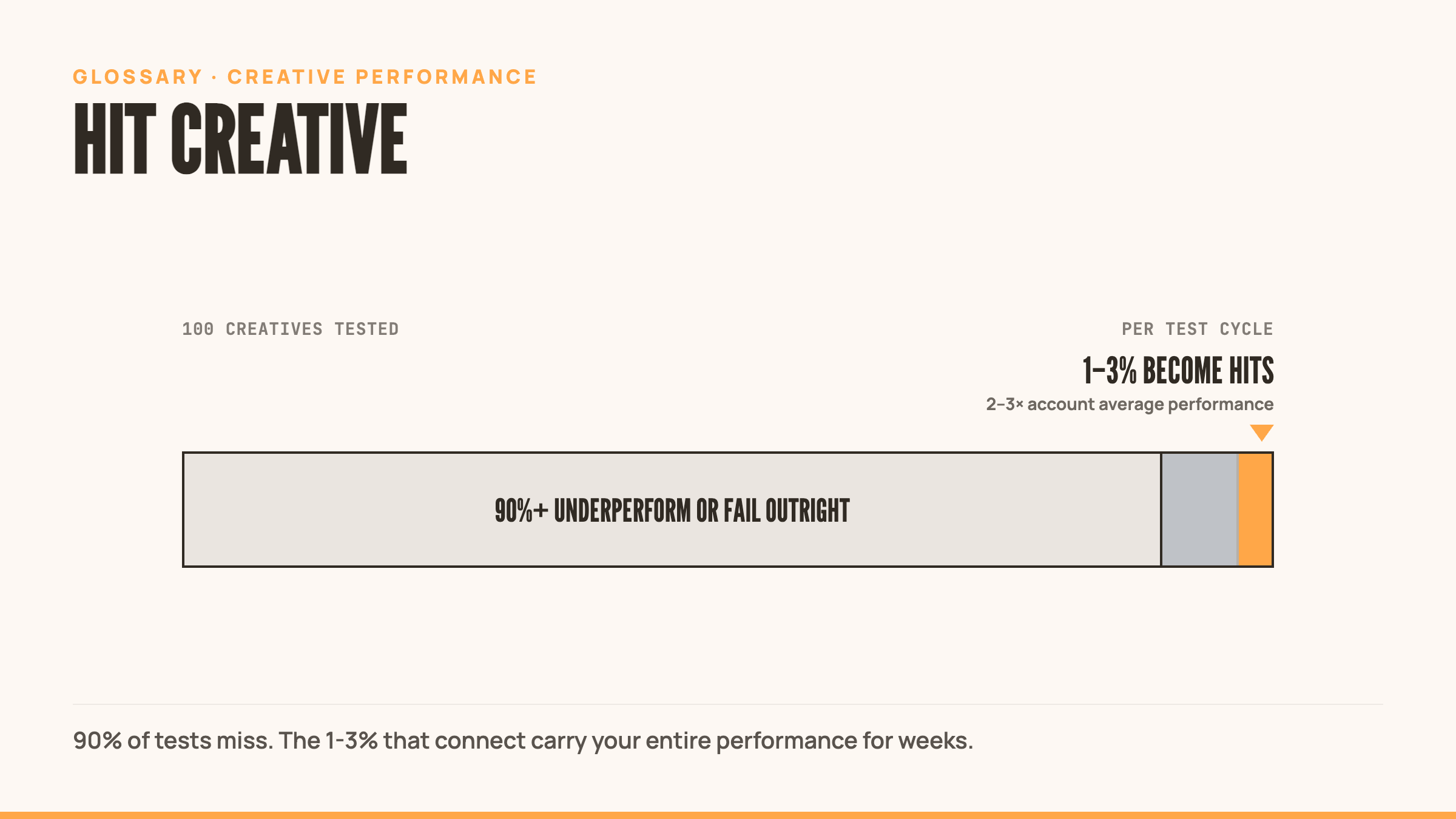
Quick Definition: A hit creative is an ad that dramatically outperforms your baseline, often by 2-3x or more. In mobile UA, 90% of creatives underperform. The 1-3% that become hits carry your entire performance. A single hit can deliver the majority of your installs for weeks or months.
What is a Hit Creative
A hit creative is the rare winning ad creative that breaks through the noise and drives outsized results.
Most creatives fail. This is normal. You’re not running tests to prove your ideas work. You’re running tests to find the few that actually do.
A hit doesn’t just beat the average. It changes the game. Higher CTR, stronger CVR, lower CPI. The metrics tell the story: this one connects.
Hits are unpredictable. You can’t design them into existence. But you can create the conditions to find them. Volume. Speed. Exploration.
The math is brutal but clear. Test 100 ideas, find 1-3 winners, scale them hard.
Hit Creative Characteristics
Performance Metrics
A hit creative delivers measurable impact:
- 2-3x above account average on key metrics (CTR, CVR, ROAS)
- Significantly lower CPI compared to baseline campaigns
- Strong retention signals (D1, D7, D30 retention) indicating quality traffic
- Sustained performance over multiple days or weeks before creative fatigue
Behavioral Signals
You know it when you see it:
- Stops the scroll. High hook rate in the first 3 seconds.
- Feels native. Blends into the platform, then breaks out.
- Drives installs at scale. Not just engagement, but conversions.
- Generates momentum. Performance compounds as the algorithm favors it.
Quality Indicators
Hits don’t just drive volume. They drive the right volume:
- Higher Day 1 retention (above ~27%, roughly the top-quartile bar, not just “average”)
- Better LTV:CAC ratios (3:1 or higher)
- Strong in-app engagement and monetization signals
Finding Your Next Hit
You can’t predict a hit. But you can explore smarter.
1. Volume is Non-Negotiable
Test 5-10 new creatives weekly minimum. The top performers test 15-30 variations per month. Every test is a lottery ticket. You need enough tickets to win.
2. Fail Fast, Scale Faster
Give each creative enough budget to prove itself (aim for 1,000+ impressions, 100+ conversions). Kill underperformers within 24-48 hours. When you find a winner, scale aggressively.
3. Test Multiple Angles Simultaneously
Don’t test one idea at a time. Run multiple concepts in parallel. Gameplay-focused, story-driven, fail state, emotional hook, puzzle mechanics. Different angles resonate with different audiences.
4. Platform Matters
What works on Meta might fail on TikTok. Test platform-specific formats. TikTok needs lo-fi, native UGC-style content. Meta rewards polished video with strong hooks. AppLovin and Unity have their own patterns.
5. Learn From Losses
Document what fails and why. Weak hooks? Poor gameplay representation? Misaligned messaging? The learnings from 97 failures inform the 3 hits.
Managing Hit Creative Lifecycle
Every hit creative follows a lifecycle. Manage it deliberately.
Launch Phase (Days 1-7)
Monitor early signals. CTR, CVR, CPI. If it’s a hit, you’ll see it within the first few days. Strong performance out of the gate is the best predictor of long-term success.
Scale Phase (Weeks 2-4)
Push budget into winning creatives. Increase spend while maintaining target CPI. Duplicate campaigns with slight variations. Test different audiences and placements to maximize reach.
Fatigue Phase (Weeks 3-6)
Performance degrades. Frequency climbs. CTR drops 20-30% week over week. Watch for the signals:
- CTR decline of 15%+ from peak
- Frequency above 3-4 impressions per user
- Rising CPI despite stable bids
Creative fatigue timelines vary by platform. TikTok: 5-7 days. Meta: 2-4 weeks. Adjust refresh cadence accordingly.
Retire Phase
Don’t ride hits into the ground. Pause creatives when CPI exceeds target by 20%+. Archive the creative and document what made it work. Use those insights for the next production cycle.
Common Mistakes
Mistake 1: Betting on Opinions
Your creative team’s favorite concept is not the market’s favorite concept. Test it. Let performance decide.
Mistake 2: Testing Too Slowly
Monthly creative refreshes won’t cut it. The market moves too fast. Weekly iteration is the baseline. Daily is better.
Mistake 3: Killing Winners Too Early
Don’t pause a hit creative just because CTR dipped 10%. Monitor the full funnel. If CPI stays on target and conversions are strong, keep running.
Mistake 4: Scaling Too Conservatively
When you find a hit, scale it. Double the budget. Triple it. Hits are rare. Extract maximum value before fatigue sets in.
Mistake 5: Not Documenting Learnings
Every hit tells you something about what works. Hook type, visual style, messaging angle, pacing. Capture those insights. They inform the next round of exploration.
Related Terms
- Winning Creative – A creative that meets or exceeds performance targets, but may not reach “hit” status
- Creative Discovery – The systematic process of exploring creative concepts to identify hits
- Creative Fatigue – The performance decline that occurs when audiences become overexposed to an ad
- Creative Exploration – The strategic framework for testing high volumes of creative variations to find outliers
External Resources
- AppAgent: Scaling Mobile User Acquisition with Ad Creatives Testing – Comprehensive guide to creative testing methodology and performance metrics
- AppsFlyer: What is Creative Fatigue and How Do You Combat It? – Deep dive into creative lifecycle management and fatigue detection
- Segwise: Creative Testing Strategies for Mobile UA Campaigns in 2025 – Current best practices for identifying and scaling high-performing creatives
Frequently Asked Questions
How long does a hit creative typically last?
Platform-dependent. On TikTok, 5-7 days before fatigue sets in. On Meta, 2-4 weeks. Monitor frequency and CTR decline, and refresh once performance drops 20-30% from peak.
What percentage of creatives become hits?
Industry reality is 1-3% of all creatives tested become true hits, while 90%+ underperform or fail outright. That’s why volume matters more than any single bet.
Should I duplicate a hit creative across all platforms?
Test it, don’t assume it. What crushes on Meta might flop on TikTok. Adapt the concept to fit each platform’s format and audience expectations.