

glossary
Multi-Touch Attribution (MTA)
Multi-Touch Attribution assigns weighted credit to multiple marketing touchpoints across the customer journey. Instead of crediting one source, MTA tracks every interaction and determines how much each contributed to conversion.
Category: Analytics & Measurement Related Terms: Attribution Modeling, Marketing Mix Modeling (MMM), Customer Journey, Conversion Tracking
Quick Definition
Multi-Touch Attribution assigns weighted credit to multiple marketing touchpoints across the customer journey. Instead of crediting one source, MTA tracks every interaction and determines how much each contributed to conversion.
What is Multi-Touch Attribution?
A user sees your ad on Facebook. Clicks. Bounces. Three days later, searches your brand name. Clicks a retargeting ad. Installs.
Which channel gets credit?
Single-touch attribution picks one (first or last-click). Multi-touch attribution splits the credit across all of them, weighted by importance.
MTA tracks every touchpoint in the user journey and assigns fractional credit based on the attribution model you choose. The goal is better visibility into which channels and tactics actually drive conversions.
For mobile User Acquisition, MTA helps answer the hard questions. Is that influencer campaign worth it? Should you cut YouTube spend? Which creative channels assist conversions even if they don’t get last-click credit?
Attribution Models
Linear Attribution
Every touchpoint gets equal credit.
Example: User sees 5 ads before installing. Each gets 20% credit.
Best for: Understanding overall channel mix when you believe all touches matter equally.
Time Decay Attribution
Recent touchpoints get more credit. Older interactions get less.
Example: Ad from yesterday gets 40% credit. Ad from last week gets 10%.
Best for: Performance campaigns where recency matters more than early awareness.
U-Shaped (Position-Based) Attribution
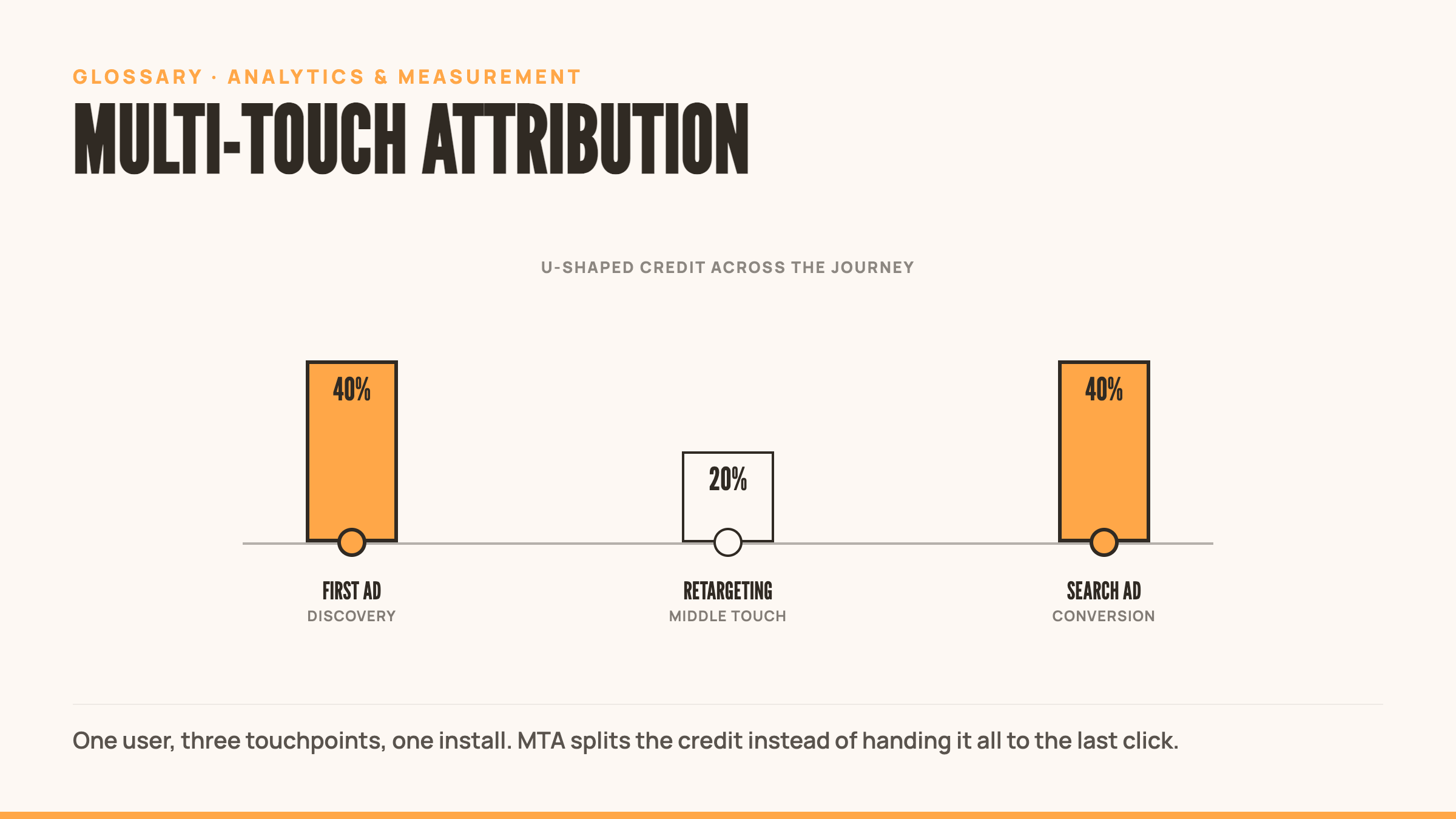
First and last touchpoints get 40% each. Middle touches split the remaining 20%.
Example: First ad (40%) + middle retargeting (20%) + last search ad (40%).
Best for: Valuing both discovery and conversion moments.
W-Shaped Attribution
First touch, lead creation, and opportunity creation each get 30%. Remaining 10% split across other touches.
Best for: B2B or longer funnels where lead quality matters as much as discovery and close.
Data-Driven (Algorithmic) Attribution
Machine learning analyzes actual conversion patterns and assigns credit based on statistical impact.
Example: ML determines YouTube ads increase conversion likelihood by 18%, assigns credit accordingly.
Best for: High-volume campaigns with enough data to train models. Most accurate when you have scale.
Benefits of Multi-Touch Attribution
Granular Channel Insights
See which channels assist conversions even if they don’t get last-click credit. YouTube might not convert directly but could drive 30% of conversions when combined with retargeting.
Smarter Budget Allocation
Stop killing channels that look weak on last-click but drive crucial early awareness. Reallocate spend to what actually works across the full journey.
Better ROAS Understanding
Know the real return on each channel, not just the last one users touched. Prevents over-investing in bottom-funnel tactics while starving top-of-funnel growth. ROAS visibility improves dramatically.
Cross-Channel Optimization
Understand how channels work together. Maybe TikTok + Google Search is your winning combo, but you’d never know with single-touch attribution.
Privacy Era Challenges (Privacy Era)
Apple’s ATT (App Tracking Transparency)
Users opt out of tracking. Attribution breaks when you can’t follow users across apps and the web.
Impact: MTA accuracy dropped significantly for iOS traffic. Many advertisers moved to probabilistic matching or aggregated data.
Google’s Privacy Sandbox Reversal
Google backed off its plan to kill third-party cookies in Chrome (April 2025), then shut down the entire Privacy Sandbox initiative in October 2025, retiring Topics, Protected Audience, and Attribution Reporting after low industry adoption. Third-party cookies stay in Chrome indefinitely.
Impact: The Chrome cookie sunset advertisers spent years preparing for isn’t happening. But cookies remain unreliable for cross-site MTA regardless. Safari and Firefox still block third-party cookies by default, regulation keeps tightening, and users keep opting out. Advertisers should still shift toward first-party data strategies rather than bet on a stable cookie ecosystem.
Cross-Device Tracking
Users start on mobile, convert on desktop. Or browse on tablet, buy on phone.
Reality: Without persistent identifiers, linking these journeys is guesswork. MTA models degrade to probabilistic matching.
GDPR and ITP (Intelligent Tracking Prevention)
Privacy regulations and browser restrictions limit how long you can track users and what data you can collect.
Impact: Attribution windows shrink. MTA becomes less complete. You’re optimizing on partial data.
The Shift to CDPs and Server-Side Tagging
Advertisers invest in Customer Data Platforms and move tracking server-side to maintain visibility within privacy rules.
Result: MTA still works, but requires more sophisticated infrastructure and first-party data strategies.
Common Mistakes
Trusting the Model Without Testing
Attribution models are assumptions, not truth. Always validate with incrementality tests or holdout experiments.
Ignoring View-Through Attribution
Focusing only on clicks misses users who saw ads but didn’t click. View-through attribution matters for awareness channels like YouTube and display.
Over-Crediting Retargeting
Last-touch models make retargeting look amazing because it catches users right before conversion. MTA reveals retargeting often just harvests demand other channels created.
Not Accounting for Organic Conversions
Users who would’ve converted anyway get attributed to paid channels. MTA doesn’t solve the counterfactual problem on its own.
Choosing the Wrong Model for Your Funnel
Linear attribution for a direct-response campaign overstates awareness channels. Time decay for a long B2B cycle understates early research touches. Match the model to your reality.
Related Terms
- Attribution Modeling – Framework for assigning credit across touchpoints
- Marketing Mix Modeling (MMM) – Statistical approach using aggregate data instead of user-level tracking
- Customer Journey – Full path users take from awareness to conversion
- Conversion Tracking – Measuring when users complete desired actions
- Incrementality Testing – Measuring lift from marketing vs. baseline conversions
External Resources
Frequently Asked Questions
What does multi-touch attribution mean?
Multi-touch attribution, or MTA, assigns weighted credit to multiple marketing touchpoints across a user’s journey instead of crediting a single source. It tracks every interaction, from the first ad seen to the final click, and splits credit based on the model you choose.
What’s the difference between last-touch and multi-touch attribution?
Last-touch attribution gives all the credit to the final touchpoint before conversion. Multi-touch attribution distributes credit across every touchpoint in the journey, so channels that assist early on still get recognized.
How do I implement multi-touch attribution?
Start with accurate, comprehensive data collection across every touchpoint. Choose an attribution model that fits your funnel complexity, then assign attribution weights to each touchpoint based on that model. Validate the results with incrementality testing.
What’s the difference between single-touch and multi-touch attribution models?
Single-touch models, like first-touch or last-touch, give all conversion credit to one touchpoint. Multi-touch models recognize that users typically interact with multiple touchpoints before converting and spread credit across all of them.
Does MTA still work after iOS 14?
Yes, but with less precision. Probabilistic models, aggregated conversion signals like SKAdNetwork, and blended MMM/MTA approaches fill the gaps left by ATT. Expect less granularity, especially on iOS traffic.