

glossary
A/B Testing
Amazon Web Services (AWS) Certificate Manager (ACM) is a service that lets you easily provision, manage, and deploy Secure Sockets Layer/Transport Layer Security (SSL/TLS) certificates.
Quick Definition
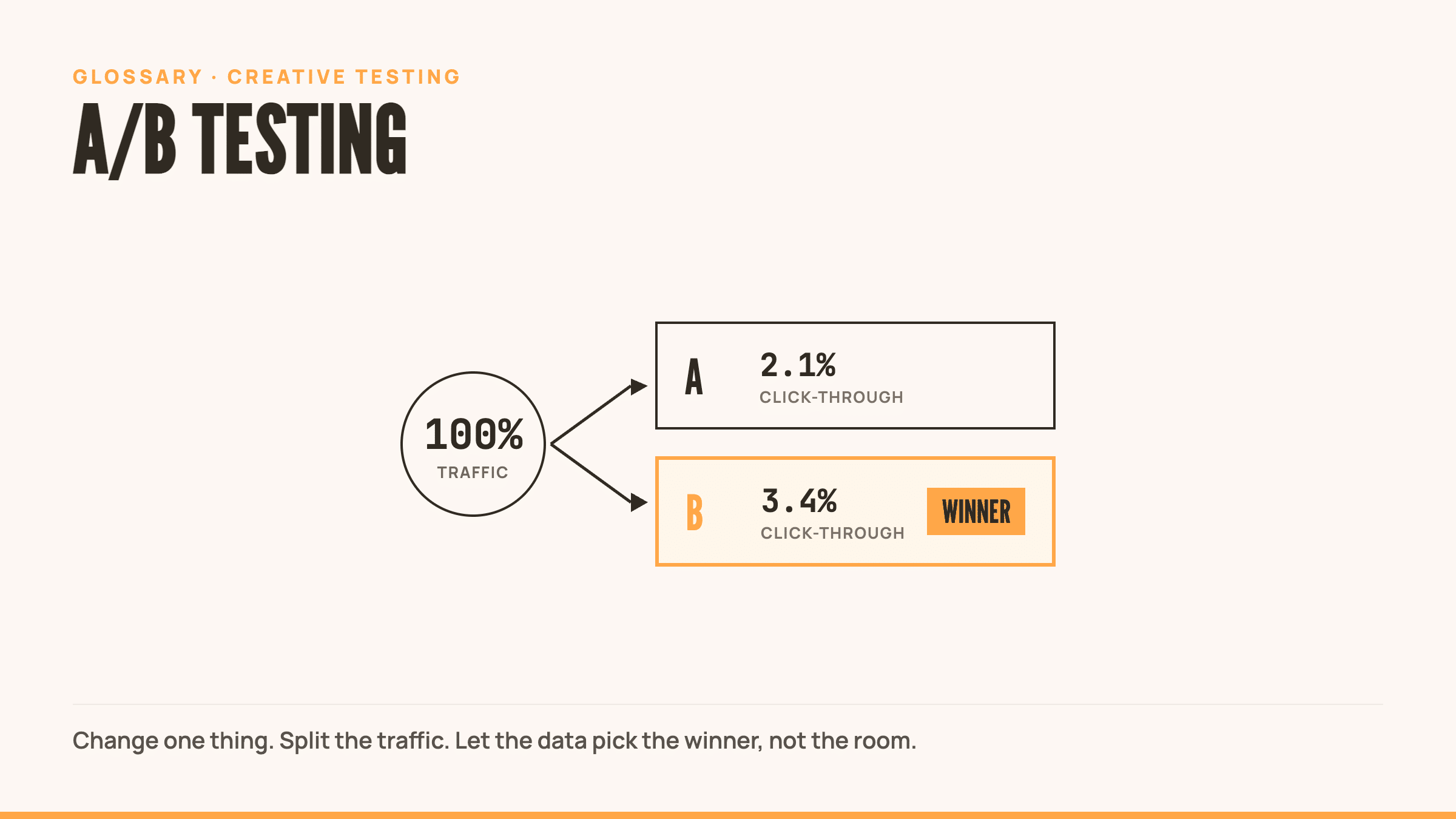
Running two or more versions of an ad simultaneously to see which performs better. You change one thing, measure the results, and let the data decide.
What is A/B Testing?
A/B testing compares different versions of your ad creative to determine what drives better performance. You run variant A against variant B (or C, D, E) with real traffic, real budgets, and real results.
The goal is simple: find what works. Kill what doesn’t.
In mobile UA, where 90% of creative ideas fail, A/B testing turns expensive guesses into systematic discovery. You’re not betting on opinions. You’re building evidence.
What to Test
You can test almost anything:
Creative elements:
- Ad copy and messaging
- Visuals and video concepts
- CTAs and end cards
- Playable mechanics
- Character designs
Technical parameters:
- Targeting criteria
- Ad placements
- Campaign objectives
- Bid strategies
- Audience segments
The key is isolating variables. Change one thing at a time, or you won’t know what caused the lift.
Best Practices
Define clear objectives Know what you’re measuring before you start. CPI? Install volume? Day 7 ROAS? Pick one North Star metric.
Test one variable at a time Change the headline or the visual. Not both. Multiple changes hide the truth.
Run for at least two weeks Statistical significance takes time. Most tests need 14+ days to account for day-of-week patterns and user behavior cycles.
Ensure sufficient traffic Small sample sizes produce noise, not insight. You need volume to trust the data.
Set a winner threshold Decide upfront what “better” means. 10% CPI improvement? 20% better ROAS? Define success before the test runs.
2025 Trends
Real-time testing Platforms now optimize while campaigns run, and modern creative analysis tools mean you’re not waiting weeks for results. You’re seeing performance shift in hours.
AI integration Automated testing systems analyze performance faster than humans can. They kill losers early, scale winners aggressively, and run multivariate tests at speeds manual testing can’t match.
Dynamic creative optimization AI assembles ad variations on the fly, testing hundreds of combinations you’d never build manually. The machine explores using creative exploration at scale. You focus on the concepts worth exploring.
Common Mistakes
Testing too many variables at once You changed the video, the CTA, the audience, and the bid strategy. Now which one drove the improvement? You’ll never know.
Stopping tests too early You saw a winner on day three and declared victory. Then week two data reversed everything. Patience beats impulse.
Ignoring statistical significance Small lifts on small samples mean nothing. Make sure your results are real before you scale.
Testing without hypotheses Random testing wastes budget. Have a reason for every variant. What are you trying to learn?
Not documenting results You ran 50 tests and remember none of them. Document what worked, what failed, and why. Build institutional knowledge.
Related Terms
- Creative Fatigue: When ad performance declines as audiences see the same creative too many times
- Multivariate Testing: Testing multiple variables simultaneously to find optimal combinations
- Statistical Significance: Confidence that performance differences are real, not random noise
- Exploration vs. Exploitation: Balancing testing new ideas against scaling proven winners
- Holdout Groups: Control audiences that don’t see certain variants, used to measure incremental impact
External Resources
- Adjust: A/B Testing for Mobile Apps
- Udonis: A/B Testing Ads Guide
- BigAbid: Best Practices for Mobile App A/B Testing
Frequently Asked Questions
What is the meaning of A/B testing?
A/B testing runs two or more versions of an ad against real traffic to see which one performs better. You change one variable, measure results, and let the data pick the winner instead of guessing.
What are examples of A/B testing?
In mobile UA you can test almost anything: ad copy, video concepts, CTAs, end cards, playable mechanics, even targeting and bid strategy. The rule is to isolate one variable per test so you know what actually drove the result.
Is A/B testing dead?
No. A/B testing still isolates cause and effect, which no shortcut replaces. What’s changed is speed: real-time optimization and AI-assisted dynamic creative now let you run more tests, faster, and kill losers before they burn budget.
How long should I run an A/B test?
Minimum two weeks. Most mobile UA tests need 14+ days to account for day-of-week patterns and enough traffic to reach statistical significance.