
glossary
Creative Exploration
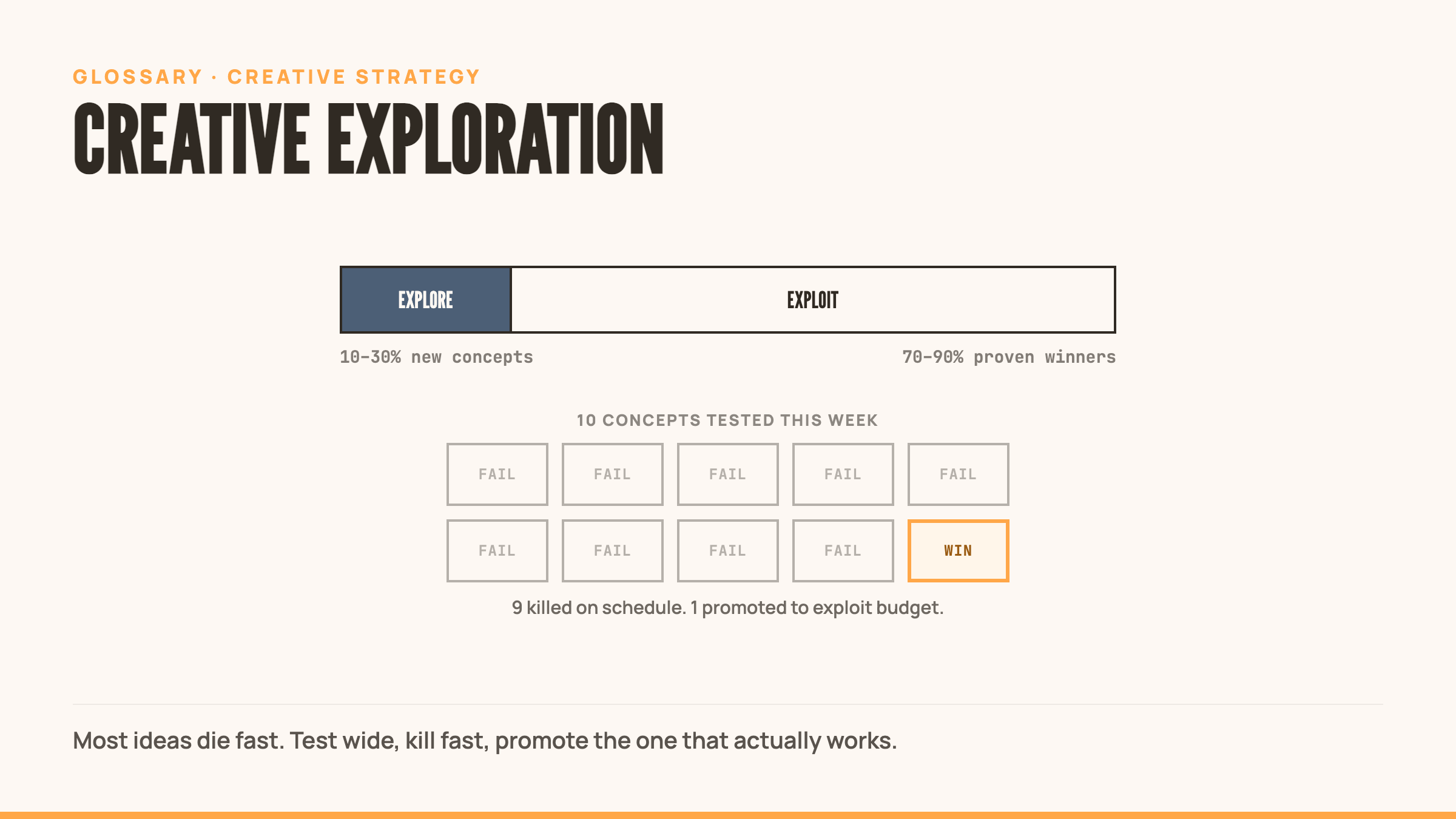
Quick Definition Creative exploration is the deliberate testing phase where you cast a wide net across new concepts, formats, and approaches to find your next winning ad. You can’t predict a hit. But you can explore smarter through systematic testing that accepts the brutal reality: 90%+ of creatives fail. — 01. What is Creative Exploration […]
Quick Definition
Creative exploration is the deliberate testing phase where you cast a wide net across new concepts, formats, and approaches to find your next winning ad. You can’t predict a hit. But you can explore smarter through systematic testing that accepts the brutal reality: most creatives fail before they ever prove themselves.
What is Creative Exploration
Creative exploration is one half of the exploration vs exploitation framework in ad creative strategy: the phase focused on discovering what works by testing diverse creative ideas at scale. You deliberately try concepts outside your current winners to find the next breakthrough that moves the needle on ROAS.
The goal is discovery. You’re not optimizing existing winners. You’re searching for new ones.
In mobile UA, exploration means shipping multiple creative concepts weekly, measuring performance fast, and killing losers before they burn budget. The faster you explore, the faster you discover what actually converts.
Most studios treat exploration like a luxury. Sett treats it like infrastructure.
Explore vs Exploit Framework
The explore/exploit framework balances two competing goals in UA creative strategy:
Exploration = Testing new creative concepts to find future winners. You’re gathering information about what might work. Performance looks weaker because you’re building knowledge.
Exploitation = Maximizing returns from proven winners. You’re harvesting value from what you already know works. Performance looks stronger because you’re optimizing known quantities.
Both are required. Too much exploration wastes budget on dead ends. Too much exploitation leaves you vulnerable when winners fatigue.
Common range: allocate 10-30% of budget to exploration, 70-90% to exploitation. High-growth teams skew higher on exploration. Mature campaigns skew toward exploitation. Exact splits vary by market, since CPI and traffic volume differ substantially between Tier-1 and Tier-2/3 regions.
Sett’s technology makes exploration faster and cheaper so you can afford to do more of it without killing efficiency.
Why Exploration Matters in UA
Creative fatigue is the silent killer of UA performance. The average creative lifespan in mature markets is under five days. That winning ad driving 70% of your installs today will be dead by next week.
You need a pipeline of new winners constantly flowing into exploitation. Systematic creative research & ideation builds that pipeline.
The math is brutal. Most creatives fail, so you need to test many concepts to find one winner. If winners fatigue every 5-10 days, you need multiple new winners monthly just to maintain performance.
Without systematic exploration, you’re playing defense. When your current winners fatigue, ROAS drops and you scramble. With exploration baked into your process, you have candidates ready to promote.
The best UA teams treat exploration like R&D. It’s not overhead. It’s how you stay ahead.
Exploration Best Practices
1. Test at Volume Launch 3-5 new creative concepts weekly minimum. Higher volume = more shots on goal.
2. Set Clear Kill Criteria Define failure upfront. Example: If creative doesn’t hit 50% of target CPI after 300 installs, kill it. Calibrate the exact thresholds to your own CPI and traffic volume. A $300 spend threshold means something different in a $2 CPI market than a $0.20 CPI market. Don’t let losers linger.
3. Budget Ring-Fencing Protect exploration budget from exploitation pressure. If all budget flows to proven winners, you never discover new ones.
4. Diverse Concepts Test different hooks, formats, and creative angles. Don’t just iterate on winners. Explore adjacencies.
5. Fast Read Windows Measure performance in days, not weeks. Speed to decision = more exploration cycles per month.
6. Promote Winners Fast When exploration finds a winner, move it to exploitation immediately. Don’t leave it under-budgeted.
Common Mistakes
Treating exploration as optional. Exploration is infrastructure, not a nice-to-have. When you skip it, creative fatigue kills you.
Testing one creative at a time. Sequential testing is too slow. Test multiple concepts in parallel to accelerate discovery.
No kill criteria. Without clear failure thresholds, bad creatives burn budget forever. Define when to stop.
Only iterating on winners. Small tweaks to existing ads rarely produce breakthroughs. Explore bold new concepts.
Pulling budget too early. Don’t judge performance after 20 installs. Give creatives enough volume to show signal.
Analysis paralysis. Perfect creative briefs don’t exist. Ship fast, measure, learn. Exploration is empirical.
Related Terms
- Creative Exploitation – Maximizing ROAS from proven winning ads
- A/B Testing – Controlled experiments comparing creative variants
- Creative Strategy – Overall framework for creative production and testing
- Hit Creative – High-performing ad that significantly outperforms average
- Creative Fatigue – Performance decline as audiences see the same ad repeatedly
- ROAS – Return on Ad Spend, primary metric for UA efficiency
External Resources
- Ultimate Guide to Creative Testing for Mobile Game User Acquisition – Segwise’s framework for structured creative testing from concept validation through scaling
- A Framework for Testing Acquisition Campaign Creatives – Phiture’s systematic approach to creative testing with decision flowcharts
- Exploration vs Exploitation in A/B Testing – Deep dive on balancing discovery and optimization in testing strategies
Frequently Asked Questions
What is creative exploration?
Creative exploration is the phase of ad creative strategy focused on discovering what works by testing diverse concepts at scale, rather than optimizing the winners you already have. The goal is discovery, not exploitation.
How much budget should go to exploration vs exploitation?
Industry standard is 10-30% of budget to exploration and 70-90% to exploitation. High-growth teams and new products skew higher on exploration; mature campaigns with stable winners skew toward exploitation.
What’s the difference between exploration and A/B testing?
A/B testing compares small variations to optimize a known winner, like a CTA or thumbnail. Exploration tests fundamentally different creative concepts, entirely new hooks and formats, to discover new winners. Exploration finds new territory. A/B testing optimizes what you found.
How long should I test a creative before killing it?
Industry standard is roughly 50 install events, $300 in spend, or 5-10K impressions as a minimum read. If a creative hasn’t shown promise by then, kill it and move budget to the next concept.