

glossary
IPM (Installs Per Mille)
Quick Definition: IPM measures how many app installs you get per 1,000 ad impressions. It’s the conversion metric that lets UA managers compare creative performance apples-to-apples across campaigns. — 01. What is IPM? IPM stands for Installs Per Mille. “Mille” is Latin for thousand, so IPM counts installs per thousand impressions. When you run UA […]
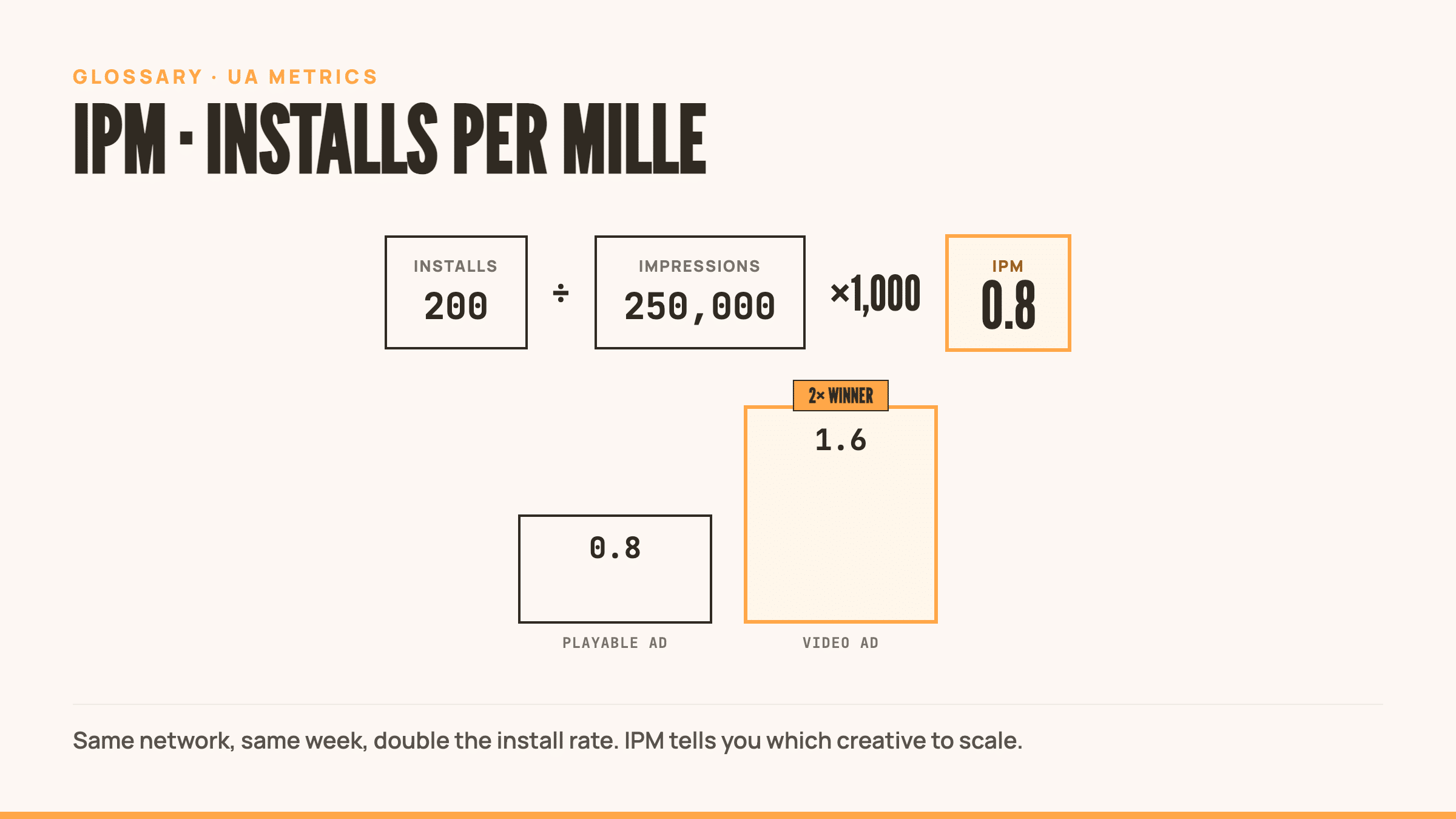
Quick Definition: IPM measures how many app installs you get per 1,000 ad impressions. It’s the conversion metric that lets UA managers compare creative performance apples-to-apples across campaigns.
What is IPM?
IPM stands for Installs Per Mille. “Mille” is Latin for thousand, so IPM counts installs per thousand impressions.
When you run UA campaigns, impressions pile up fast. Your ad shows 500,000 times. You get 300 installs. Is that good? Hard to tell when you’re staring at raw numbers.
IPM standardizes it. Take those 300 installs, divide by 500,000 impressions, multiply by 1,000. You get 0.6 IPM. Now you can compare that creative against everything else you’ve run.
This matters because UA managers test dozens of creatives simultaneously. Different campaigns, different networks, different budgets. IPM gives you a single number to rank them all.
Strong IPM means your creative converts. Players see it, they want it, they download. Weak IPM means something’s broken. Maybe the creative doesn’t hook. Maybe the targeting is off. Maybe your app store page kills the conversion.
IPM sits between CTR and CPI in your funnel. CTR tells you if people click. CPI tells you what you paid. IPM tells you if the creative actually drives installs at scale.
Mobile game UA lives and dies on this number. You’re buying impressions. You need installs. IPM is the bridge.
And here’s the kicker: strong IPM doesn’t just get you more installs. It improves your position in waterfall bidding. Ad networks see your creative converting, they show it more. You win more auctions, get more traffic, compound your advantage.
Weak IPM? You get buried.
How to Calculate IPM
The formula is simple:
IPM = (Installs / Impressions) × 1,000
Example:
Your playable ad runs on Unity Ads for a week.
- Impressions: 250,000
- Installs: 5,000
IPM = (5,000 / 250,000) × 1,000 = 20
Your creative drives 20 installs per thousand impressions.
Compare that to your video ad on the same network:
- Impressions: 250,000
- Installs: 10,000
IPM = (10,000 / 250,000) × 1,000 = 40
The video ad has 2x the IPM. That’s your winner.
Why IPM Matters for Mobile Game UA
IPM is one of the core KPIs UA managers track during creative testing. Here’s why it matters:
1. Creative Performance Ranking
You’re running 20 playables across Meta, AppLovin, and Unity. Each has different impression volumes. IPM lets you rank them all on a level playing field — the same creative performance analysis that tells you which concepts to scale and which to kill.
2. Waterfall Optimization
Ad networks prioritize creatives that convert. Strong IPM gets your ad shown more often, winning more auctions, compounding traffic. Weak IPM gets you buried at the bottom of the waterfall.
3. Budget Allocation
You know which creatives drive installs efficiently. Pour budget into high-IPM creatives, kill the low performers fast.
4. Creative Fatigue Detection
Watch IPM over time. When it drops, your creative is burning out. Time to rotate in fresh concepts.
5. Network Performance Comparison
Same creative, different networks. IPM shows you which platforms convert best for your game.
Factors That Influence IPM
IPM isn’t random. Specific factors drive it up or down:
Creative Quality
Your ad has to hook players fast. Boring creative = low IPM. Sharp gameplay moments, clear value prop, strong hook = high IPM.
Audience Targeting
Show your puzzle game to match-3 fans? Strong IPM. Show it to FPS players? Dead creative. Targeting precision matters.
App Store Optimization (ASO)
Players click your ad, land on your store page, bounce. Weak ASO kills IPM even when your creative works. Icon, screenshots, description all matter.
Ad Format
Playables typically drive higher IPM than static ads. Video ads with strong CTAs outperform generic gameplay clips. Format influences conversion.
Network Quality
Some networks have better user intent. Players on those platforms convert faster. Your IPM shifts network-to-network even with identical creative.
Seasonality
Holiday spikes, back-to-school lulls, summer drops. User behavior changes, IPM follows.
How to Improve IPM
Improving IPM requires testing creative, targeting, and ASO together.
Test More Creatives
Volume matters. You can’t predict what converts. Test 10 playables, not 2 — agentic creative generation makes that volume achievable without blowing up your production budget. Find the outliers.
Hook Faster
Players scroll fast. Your creative has 3 seconds to hook or you’re dead. Lead with your strongest moment.
Tighten Targeting
Broad audiences tank IPM. Go narrow. Test lookalikes, interest-based segments, competitor targeting.
Optimize Your Store Page
Your ad is working if CTR is strong but IPM is weak. The problem is your app store page. Fix your icon, rewrite your description, test new screenshots.
Rotate Creative Frequently
Creative fatigue kills IPM. Rotate fresh concepts before performance drops.
Match Creative to Audience
Casual players want different hooks than midcore players. Tailor your creative to the segment.
IPM vs Other Metrics
IPM works alongside other UA metrics. Here’s how they compare:
IPM vs CTR (Click-Through Rate)
CTR measures clicks per impression. IPM measures installs per impression. You can have strong CTR but weak IPM if players click but don’t convert on the store page.
IPM vs CVR (Conversion Rate)
CVR measures installs per click. IPM measures installs per impression. CVR isolates store page performance. IPM captures the full funnel from impression to install.
IPM vs CPI (Cost Per Install)
CPI tells you what you paid. IPM tells you how efficiently your creative converted impressions into installs. You can have low IPM and acceptable CPI if your bids are low enough, but you’re leaving traffic on the table.
IPM is about creative performance. CPI is about economic efficiency.
Common Mistakes
Mistake 1: Optimizing for IPM Alone
IPM gets you installs. But if those installs don’t retain or monetize, you’re burning budget. Always pair IPM with D1 retention and LTV.
Mistake 2: Ignoring Network Differences
Your creative drives 1.2 IPM on Meta, 0.4 IPM on Unity. That doesn’t mean the creative failed on Unity. Network audiences behave differently. Benchmark IPM per network, not globally.
Mistake 3: Not Testing Enough Creative
You test 3 playables, pick the best IPM, scale it. But you never found the outlier. Volume uncovers winners.
Mistake 4: Killing Creatives Too Fast
IPM needs time to stabilize. Killing a creative after 10,000 impressions is premature. Let it run to statistical significance.
Mistake 5: Forgetting ASO
Your IPM is weak, so you blame the creative. But your store page is the problem. Test ASO before you kill the ad.
Related Terms
- CPI (Cost Per Install) – What you pay per install
- Creative Testing – Testing multiple ad concepts to find winners
- User Acquisition (UA) – Process of acquiring new app users through paid campaigns
- Playable Ads – Interactive ad format where players try gameplay before installing
External Resources
Frequently Asked Questions
What does IPM stand for?
In mobile UA, IPM stands for Installs Per Mille, meaning installs per 1,000 ad impressions. It’s the metric that lets you compare creative performance across campaigns and networks on a level playing field.
What’s a good IPM for mobile games?
Depends on genre, network, and format. Playables typically run 0.5-2.0 IPM, video ads 0.3-1.5 IPM. Benchmark against your own historical performance rather than a single industry number.
Should I optimize for IPM or CPI?
Both. IPM tells you whether your creative converts impressions into installs. CPI tells you whether that’s economically viable. Strong IPM with high CPI usually means your bids are too expensive; weak IPM with low CPI usually means you’re leaving traffic on the table.
Why is my IPM dropping over time?
Creative fatigue is the most common cause. Users have seen the ad too many times and stopped responding. Watch IPM over time and rotate in fresh concepts before it craters.