

glossary
Creative Velocity
Quick Definition: Creative velocity is the rate at which new ad creatives are produced and deployed into UA campaigns. Higher velocity means more shots at finding winners before creative fatigue kills your ROAS. 01. What is Creative Velocity Creative velocity measures how fast your team can take an idea from concept to live campaign. The […]
Quick Definition: Creative velocity is the rate at which new ad creatives are produced and deployed into UA campaigns. Higher velocity means more shots at finding winners before creative fatigue kills your ROAS.
What is Creative Velocity
Creative velocity measures how fast your team can take an idea from concept to live campaign.
The metric shows up in two ways. Creatives per week or month tells you volume. Time from concept to launch tells you speed. Both matter.
Manual production is the constraint. Traditional workflows need designers, animators, QA passes, and approvals. Each step adds days. By the time your creative goes live, you need three more.
Agentic systems break the constraint. When AI handles production at speed, your creative team shifts from execution to exploration. The bottleneck moves from making ads to finding winning concepts.
Why Velocity Matters in UA
Creative fatigue is permanent. The best ad in your portfolio has a shelf life measured in days.
Lifespan varies sharply by platform. On Facebook, even unusually successful ads typically hold up for two to four weeks before declining. Fast-cycling channels within mobile app UA, like TikTok, see the fastest fatigue, with lifespans typically just 3-7 days.
The math is brutal. If 90% of creatives fail and winners die in a week, you need constant production just to maintain performance. Scale your budget 10x and you need 10x the creative volume to fill those impressions. ROAS depends on this cycle.
Ad networks know this. AppLovin’s algorithms favor advertisers with diverse playable ad libraries and frequent creative refreshes. Low velocity means limited inventory means worse auction performance.
Industry Benchmarks
Top mobile game advertisers deploy volume that would break traditional creative teams.
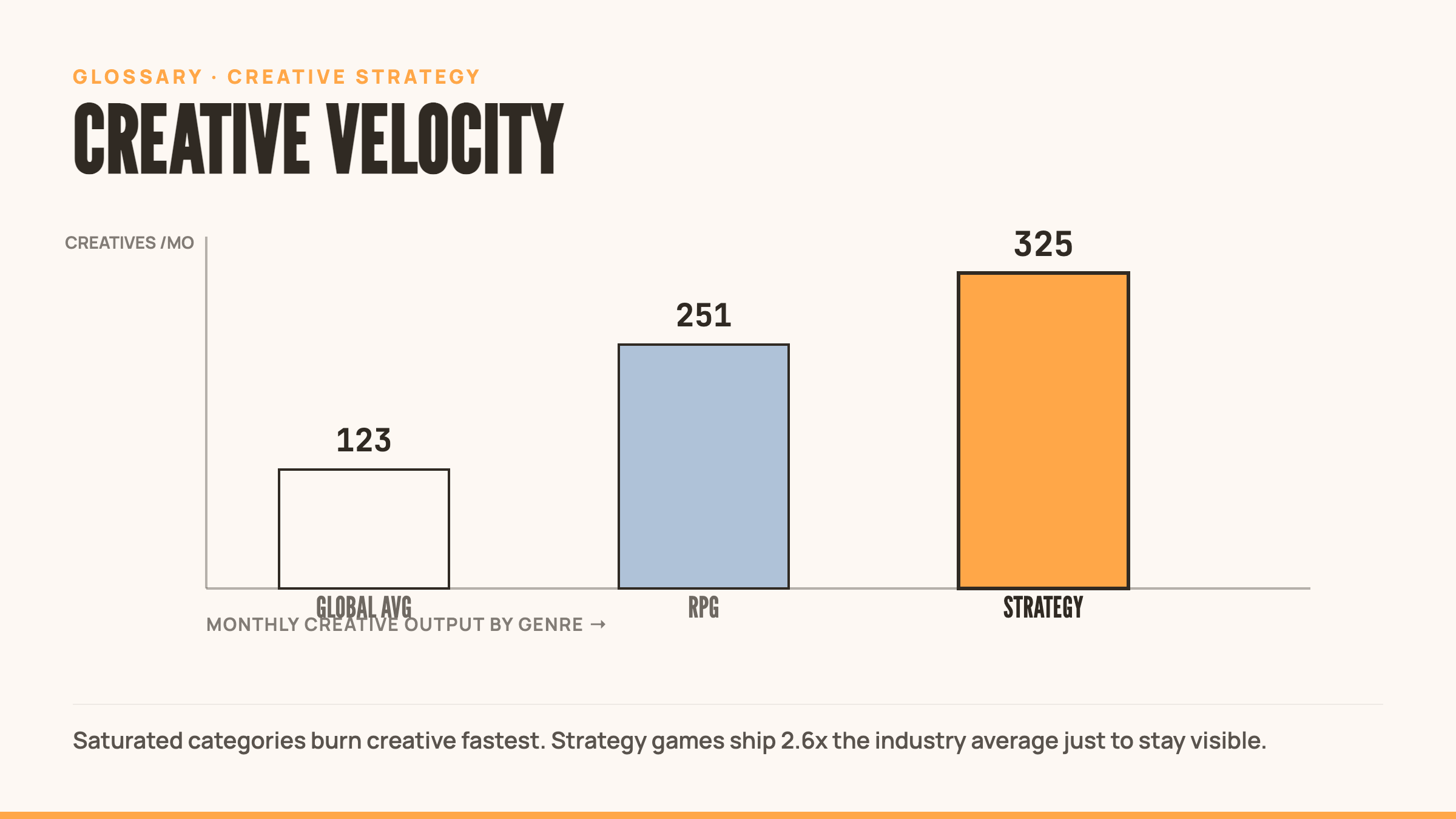
Global average: 123 creatives per month, up 19.4% year-over-year. But averages hide the winners.
Per MobiDictum’s Creative Trends Report, strategy games lead at 325 creatives per month. Per SocialPeta’s H1 2025 report (a separate dataset, different methodology), RPGs average 251 per month. The two numbers aren’t apples-to-apples, but the pattern holds: saturated categories need volume, because creative fatigue happens in days.
The ceiling keeps rising. Some mobile publishers test 50-200+ new creatives monthly just to maintain share of voice. North American mobile game creative volume hit 13.6 million in H1 2025, up 36.4% year-over-year, per SocialPeta.
Budget scales velocity requirements. An advertiser spending $1M monthly needs 10x the creative of a $100K spender to maintain efficiency. More impressions means faster fatigue means higher refresh rates.
Increasing Creative Velocity
Speed requires rethinking what your team builds versus what machines build.
Manual production caps velocity at designer bandwidth. Five designers making two creatives per week gives you 40 per month. That works at $50K monthly spend. At $500K you hit the ceiling.
Agentic creative generation removes the cap. Your creative team defines concepts and strategies. AI systems handle execution, variations, and assembly. One strategist can guide production of 100+ creatives when machines do the making.
Template systems help but only at the margin. You can pump out variations faster, but you still need humans to set up each template, swap assets, render, and QA. Real velocity needs full automation from concept to export.
Testing infrastructure matters as much as production speed. Fast creation is worthless if deployment takes three days. Build systems that let you ship 20 new creatives to live campaigns in under an hour. A/B testing at scale requires this.
Quality thresholds stay non-negotiable. Velocity means nothing if your ads perform poorly. The goal is more high-quality shots at finding winners, not spam.
Common Mistakes
Chasing velocity without infrastructure turns speed into chaos. Launching 100 untested creatives weekly with no attribution or analytics means you can’t learn what works. Build measurement systems before scaling production.
Confusing volume with exploration. Making 50 variations of the same concept gives you velocity on paper but zero learning. True velocity explores diverse concepts, formats, and hooks at speed. Creative exploration drives discovery.
Ignoring ad network requirements. Platforms like AppLovin require diverse playable ad libraries for optimal delivery. Pumping out static images at high velocity misses the format requirements that unlock distribution.
Burning out creative teams by treating them like production machines. Sustainable velocity comes from automation, not overtime. If your designers are working weekends to hit creative quotas, your system is broken.
Forgetting that winners expire. High velocity at launch means nothing if you stop producing after week two. Creative fatigue is permanent. Velocity is a continuous practice, not a campaign tactic.
Related Terms
- Creative Fatigue – The performance decline that makes velocity necessary
- Creative Engine – The system that enables sustainable high-velocity production
- Creative Discovery – The exploration process that velocity accelerates
External Resources
- Creative Trends Report: Ad Volume Surges 20% – MobiDictum’s analysis of global creative production benchmarks and genre-specific volume
- AppLovin Guide: Mobile Playable Ads – AppLovin’s requirements for playable ad diversity and testing cadence
- The Creative Calculator: How Many Ads Should You Be Making? – Framework for calculating required creative volume based on budget and fatigue rates
Frequently Asked Questions
What is creative velocity?
Creative velocity is the rate at which new ad creatives get produced and deployed into live UA campaigns. It shows up two ways: creatives shipped per week or month, and time from concept to launch. Both matter.
How many creatives per month should we be producing?
Depends on budget and category. As a baseline, reserve 10-15% of monthly UA spend for creative production and aim for at least one new video variant per week per platform. Strategy and RPG games need meaningfully higher volume because competition is more intense.
Does creative velocity sacrifice quality?
Only if the system behind it is weak. The goal is holding your quality bar while increasing volume through automation, not spamming variations. Done well, velocity tends to improve average quality because your creative team shifts from execution to strategy.
How do we measure creative velocity effectively?
Track two things: creatives deployed per week or month for volume, and time from concept approval to live campaign for speed. Pair both with performance data (CTR, CPI, ROAS by creative) so velocity translates into learning, not just noise.