

glossary
Creative Engine
Quick Definition: A creative engine is the systematic capability to continuously produce, test, and optimize ad creatives at scale. Advertisers deploy an average of 123 creatives per month globally (up 19.4% year-over-year), with RPG studios averaging 251 creatives monthly. Building this internal capability reduces agency dependency and accelerates discovery. 01. What is a Creative Engine […]
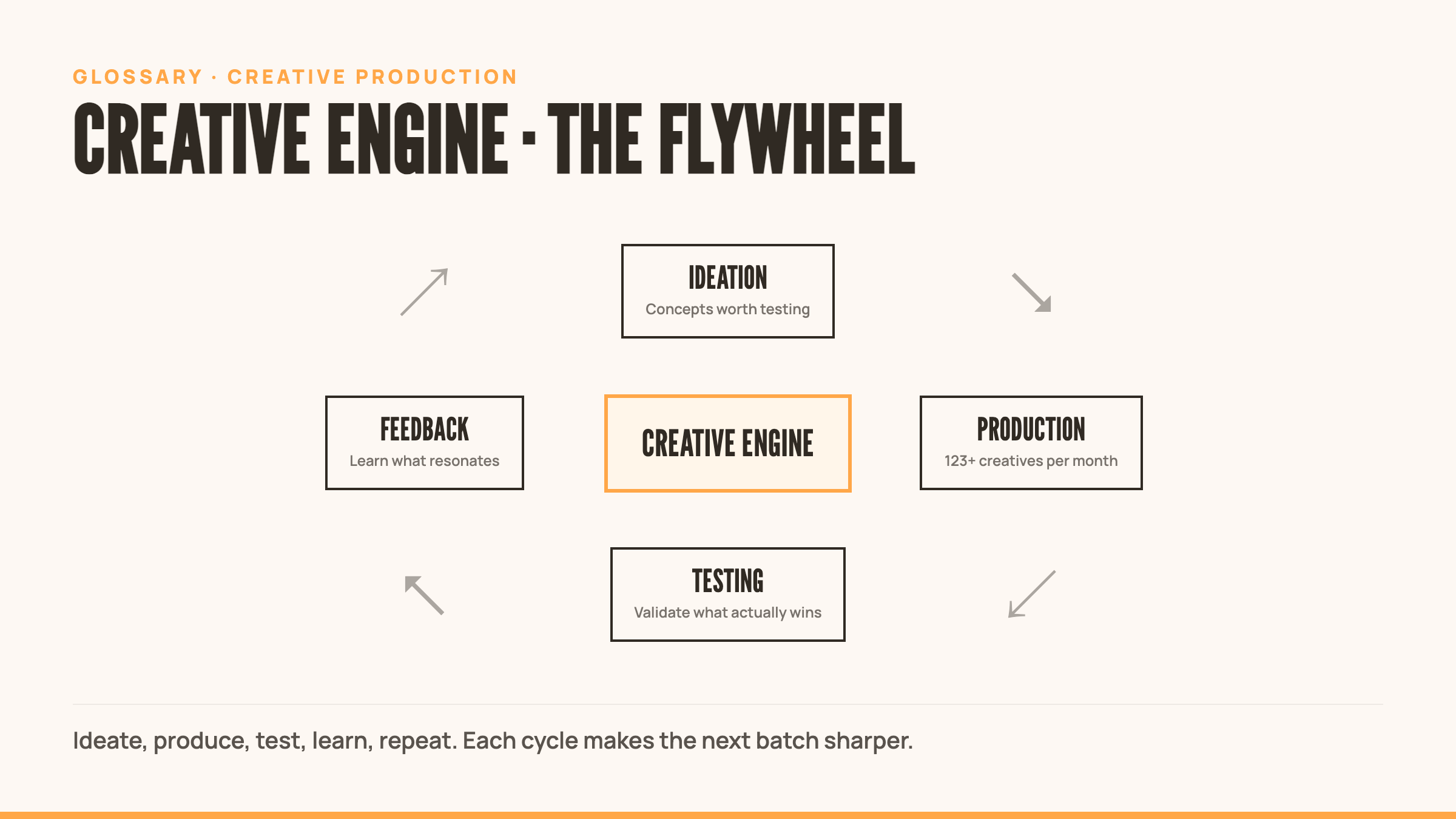
Quick Definition: A creative engine is the systematic capability to continuously produce, test, and optimize ad creatives at scale. Advertisers deploy an average of 123 creatives per month globally (up 19.4% year-over-year), with RPG studios averaging 291 creatives monthly. Building this internal capability reduces agency dependency and accelerates discovery.
What is a Creative Engine
Studios are stuck in slow loops. Production happens through agencies. Testing is narrow. By the time content goes live, you already need more.
A creative engine changes that. Think of it as your internal assembly line for creative discovery. You produce fast. Test smart. Learn what works. Repeat.
The traditional approach relies on external vendors and ad-hoc requests. Production takes weeks. Iterations feel expensive. Bold ideas die slow deaths.
The modern approach treats creative production like any other critical operation. You build capacity internally. You instrument feedback loops. You iterate daily instead of quarterly.
Mobile gaming demands this shift. Creative fatigue sets in fast on performance channels like Meta, TikTok, and AppLovin, though the window varies by channel. TikTok and hyper-casual UA often fatigue within a week. Meta creatives typically hold up longer, into the second or third week before decline sets in. If you wait weeks for new creatives, you lose momentum. If you rely solely on agencies, you cap your velocity.
Studios with creative engines control their destiny. They explore faster. They discover more winners. They maintain performance when competitors stall.
Components of a Creative Engine
Production Capacity
The ability to generate volume. RPG studios average 291 creatives per month. Strategy games hit 325. The global average is 123.
This requires staffing (internal designers, motion artists, copywriters), tools (design software, animation platforms, rendering infrastructure), and systems (templates, asset libraries, reusable components).
Production capacity determines your throughput. Low capacity creates bottlenecks. High capacity enables exploration at scale.
Testing Infrastructure
The ability to validate what works. Each creative gets dedicated testing with isolated variables. You measure CTR, IPM, CPI, and ROAS. You retire weak performers early. You scale winners fast.
NCSolutions’ 2023 study of nearly 450 campaigns shows creative quality drives 49% of sales lift. More than four times the impact of targeting (11%). Over three times the impact of reach (14%).
Testing infrastructure requires channel integration (Meta, TikTok, AppLovin, Unity), measurement frameworks (mobile attribution, incrementality, creative scoring), and decisioning processes (kill thresholds, scale triggers, iteration rules).
Data Feedback Loops
The ability to learn and improve. What messages resonate. Which formats engage. What creative lifespans look like in your genre.
Creative lifespan varies widely by channel and genre. Hyper-casual and TikTok-style UA often see fatigue within a week. Other channels hold longer. Without feedback loops, you repeat mistakes. With them, you compound learnings.
This means analytics pipelines (creative-level performance data), insight generation (pattern recognition across winning creatives), and knowledge management (documented learnings, creative briefs informed by data).
Ideation Systems
The ability to generate concepts worth testing. Exploration beats opinion. Your engine needs mechanisms for idea generation beyond “what feels right.”
This includes competitive analysis (what others test), audience research (player motivations, pain points), format experimentation (video ads, playable ads, UGC styles), and systematic variation (concept matrices, message testing).
Building vs Buying Creative Capacity
Most studios start by buying. Agencies handle production. You pay per asset. This works early when volume is low.
As you scale user acquisition, agency models break. Cost per creative stays fixed while your needs explode. Turnaround times create bottlenecks. Communication overhead slows iteration.
Building internal capacity requires upfront investment. Hire designers. License tools. Build processes. But per-unit costs drop dramatically. Iteration speed increases. Knowledge stays in-house.
The threshold varies by genre and scale. As monthly creative needs climb past a few dozen, internal capacity starts to pay off. At the volumes top studios run (hundreds per month), it becomes close to non-negotiable.
Hybrid models work too. Build core capacity internally. Use agencies for specialized work (high-end 3D, celebrity partnerships, complex production).
The goal: control your creative velocity. Never let production capacity limit your exploration.
Creative Engine Metrics
Creative Velocity
How fast you produce. Measured in creatives per week or month. Global average: 123/month. Top performers: 200+/month.
Velocity determines exploration surface area. Higher velocity means more tests. More tests mean more winners discovered.
Time-to-Market
How fast you go from concept to live. Measured in days or hours. Traditional agencies: 2-4 weeks. Internal engines: 1-3 days.
Speed compounds. Faster iteration means faster learning. Faster learning means better creatives sooner.
Discovery Rate
What percentage of creatives beat your baseline. Industry reality: the vast majority of creatives fail to beat it. Your engine’s job is finding the small share that win.
Discovery rate measures efficiency. Higher rate means better ideation, better production quality, or better targeting of what to test.
Creative Lifespan
How long creatives perform before fatigue. Varies by channel, genre, and creative quality. Faster-cycling channels like TikTok and hyper-casual UA often see fatigue within a week. Meta and other channels typically hold longer.
Shorter lifespans demand higher velocity. The faster your creatives fatigue, the more fresh content your pipeline needs to produce, week over week.
Cost Per Creative
Production cost per asset. Agency models charge a fixed fee per creative that doesn’t improve with volume. Internal engines require upfront investment in people and tools, but per-unit costs drop sharply once those fixed costs are amortized across higher output.
Lower costs enable more exploration. More exploration finds more winners.
Common Mistakes
Optimizing too early. Teams find one winner and milk it. Creative fatigue kills performance. Keep exploring even when you have winners.
Confusing volume with velocity. Producing 200 mediocre creatives helps nothing. Velocity only matters when paired with quality and testing rigor.
Ignoring feedback loops. Building production capacity without instrumentation means making the same mistakes faster. Data turns volume into learning.
Agency dependency at scale. Agencies work early. They break at high volume. Most studios wait too long to build internal capacity.
Testing without isolation. Changing multiple variables per test makes learning impossible. Test one thing at a time. Control everything else.
Forgetting creative fatigue. One winning creative feels like success. But performance decays. Your engine needs constant replenishment.
Related Terms
- Creative Velocity – The speed at which you produce and deploy new creatives
- Creative Discovery – The systematic process of finding winning ad concepts through exploration
- Creative Strategy – The overarching approach guiding what creatives to produce and test
- Creative Fatigue – Performance decay as audiences see the same creative repeatedly
- Creative Testing – Structured experimentation to validate which creatives drive results
External Resources
- Scaling Mobile Game Ad Creatives: How to Grow UA Without Losing Quality – Practical guide on building modular design systems and scaling from 20 to 1000+ creative variations
- Producing and deploying advertising creative at scale – Deep dive on why streamlined creative production is a massive competitive advantage in mobile marketing
- Creative Testing for Mobile Game User Acquisition – Complete framework for testing infrastructure including metrics, isolation techniques, and performance benchmarks
Frequently Asked Questions
How many creatives do I need to produce monthly?
Depends on genre and scale. The global average is 123 creatives per month. RPG studios average 251, strategy games average 216. If your creatives die in 5 days, you need at least 6 fresh assets weekly per major channel.
Should I build internal creative capacity or use agencies?
Both have a role. Early stage, agencies work fine. At scale, a hybrid model works best: internal capacity for volume, agencies for specialized work like high-end 3D or celebrity partnerships. Past 200+ creatives a month, internal capacity becomes non-negotiable for cost and speed.
What defines a strong creative engine?
Three things. Production velocity that outpaces your fatigue rate, so you never run out of fresh creative. Testing infrastructure that validates winners and kills losers fast. Feedback loops that turn performance data into better concepts. Missing any one of the three leaves you with a bottleneck, not an engine.